11th
07 -
2017
|
2 comments »
Director/Screenwriter: James Gray

By Roderick Heath
James Gray has failed to wield commercial success equal to his critical standing, which is significant, particularly in Europe, but also tellingly divisive. Perhaps a greater part of the reason for this lies in the key underpinning of his aesthetic, from his steely debut Little Odessa (1994), through his curiously elegiac crime films The Yards (2001) and We Own The Night (2007), and the mature, mutable drama of Two Lovers (2008) and The Immigrant (2014), is they resist familiar rules of screen drama in refusing to emphasise urgency or agency for its characters, but instead constantly nudge them along with the ineluctable quality of fate. They are, in essence, ghost stories set amongst the living. Gray’s oeuvre consists of tales of outcasts and troubled inheritors as much stricken and burdened with their ambitions as compelled by them, shot in sombre, moody, yet inescapably authoritative panoramas. Gray is often described as an old-fashioned talent almost without peer in the contemporary cinema landscape, but the truth is his kind of filmmaker was never particularly common or popular, crafting rigorous, lushly shot but essentially told tales of the emotionally thwarted and the life-beset.

Gray’s influences seem to include the stately gravitas of Luchino Visconti, the streetwise tragedies of Martin Scorsese, the sombrely artful side of Francis Coppola, the hymns of repression and freedom of David Lean, and the subtler side of John Ford, the one obsessed with social rituals and the problems of maturation. The Lost City of Z, Gray’s latest, is a venture into new territory for the director, as a film recounting the life of a British adventurer in exotic climes, and yet it pushes the ghost story aspect to Gray’s tales to an extreme. Every action of the central characters in The Lost City of Z is tethered to inevitable dates with obsession and doom. The story he takes up here itself immediately evokes such an mood of eerie transience and doomed embarkation, in recounting the life of Percy Fawcett, a controversial and much-mythologised figure who met a mysterious end in his attempts to penetrate the innermost heart of the Amazon jungle in search of a lost city he had become convinced once flourished there. Fawcett’s adventures were the stuff beloved of Boy’s Own magazines and early mass media hoopla, as Fawcett’s willingness to feed those beasts with tales of giant spiders and snakes as well as lost civilisations fed the lurid dreams of generations. Recently history has caught up with Fawcett in seeming to vindicate his wildest flights as evidence of just such a civilisation around where he thought it might be, discoveries that cast a new light on the theories of a man who had been, at different times, dismissed as a charlatan, a eugenicist, and an Ahab-liked madman who lured his son and others to ignominious death in the jungle.
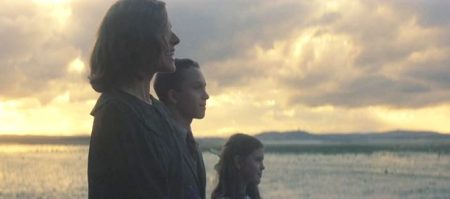
Gray presents him rather as a smouldering social rebel, driven along by the disgrace of his father, who, straining against the tight leash of high Imperial Britain’s social prescriptions, finds a way to give them the slip and strive to touch something grand. In this regard, The Lost City of Z takes up the little-considered but powerful spiritual side of David Lean’s later epics like Lawrence of Arabia (1962), and strips away the more sensational elements to makes this pining desire for a transcendence tinged with pantheistic sublimation the focus of the journey. Fawcett, when first introduced, is seen gaining victory in a deer hunt held by British officers stationed in rural Ireland. Much as D.H. Lawrence identified Hawkeye in The Last of the Mohicans as the embodiment of the western death-dream, Fawcett has the same gift for the chase and touch with death, but he is doomed to hunt something much more rarefied, nominated by chance and temperament as a knight embarking on a grail quest. His swashbuckling prowess is in the meantime undoubted, but he’s still held at arm’s length by superiors who disdain meeting with him at the soiree following the hunt. Fawcett’s attempts to be a model soldier and citizen are contradicted by his broader mind and deeper emotional reflexes than most of the people around him. He’s married to Nina (Sienna Miller), a Victorian New Woman and free-thinker. Fawcett, pushing into his mid-thirties without any significant distinction to his name, finally gains a chance for advancement when his map-making skills, honed in doing surveying work for the army, are requested for use by Sir George Goldie (Ian McDiarmid) and Sir John Scott Keltie (Clive Francis), chieftains of the Royal Geographical Society.

Goldie selects Fawcett to head to South America and plot the precise parameters of the border between Brazil and Bolivia, to head off a brewing war between the two nations in the hunger for the riches produced by rubber. On his passage there, Fawcett meets the man who has volunteered to join his mission, the hirsute Henry Costin (Robert Pattinson), who’s joining him purely for adventure, but who soon proves a stalwart out in the wilds. He picks up a third comrade in Arthur Manley (Edward Ashley), a ranking British soldier sent to meet him in the jungle rubber planters’ town of Fazenda Jacobina, ruled over as a kingdom by petty potentate Baron De Gondoriz (Franco Nero). The Baron gives Fawcett an enslaved native as a guide, Tadjui (Pedro Coello), who tantalises the Englishman with tales of mysterious people who live in the jungle in their large and sophisticated cities.

The Lost City of Z represents a sharp digression for Gray in some ways as the first time he’s ever ventured out of New York, let alone a North American setting, and his intricate grasp on the lost souls of the urban landscape, even as it slots into his oeuvre stylistically speaking with ease, and Gray methodically disassembles several of the potential genres the film belongs to. Gray orientates himself in the jungle by referencing a pair of his favourite films, Werner Herzog’s Aguirre, the Wrath of God (1972) and Apocalypse Now (1979), both tales of self-appointed supermen with egos unchecked in the jungle, as Fawcett and his pick-up expedition venture into the wilderness only to find themselves beset by a nightmarish sensation of being unmoored from all familiar yardsticks of life and society. They become targets for native tribes who pepper their barge with arrows, and beset by maladies, like one that causes a team member to vomit up black blood. The forest proves near-desolate as a source of food, until Fawcett finally manages to shoot a wild pig. A brief attempt at revolt by a subordinate sees Costin shoot the mutineer’s ear off. But Gray also contends with such evocations and similarities and moves quickly past them, particularly as although as obsessive as the antiheroes of those canonical works, Gray’s Fawcett latches on to a dream of the landscape that beckons to the higher part of his mind rather than the black part of the id, and his journey becomes more one of diffusion into the landscape than resistance to it. He makes contact with tribes who have known only the thinnest connections to the outside world but soon learns of their capability in existence and the subtle harmonies of their lifestyles, which range from cannibalising dead tribe members to cultivating food and catching fish with special drugs.

Fawcett begins to glimpse haunting signs of long-ago habitation in the jungle, remains of pottery and other fragments of civilisation, and faces carved into trees and rocks, gazing out like the spiritual eyes of the land, a lost part of the collective memory, an idea that gives rise to his decision to name the city out in the jungle ‘Z’ as the last piece of the human puzzle. Fawcett’s return to civilisation sees him mocked at a Royal Geographical Society meeting when he presents his findings and he angrily defends his theories against a reaction he interprets as contempt for the Amazonian peoples. One of the Society’s senior figures, Sir James Murray (Angus Macfadyen), proposes they venture back into the Amazon together to look deeper, and Fawcett eagerly agrees. But Fawcett soon finds he’s made a poor bargain, as Murray proves not only too old and unfit for the arduous exploration, but bilious and recalcitrant too, proving a terrible drag on the expedition. Murray presents a different order of nuisance to the men from Fawcett’s previous expedition, so rather than continue to suffer his insolence and unable to blow a hole in his ear in deference to his standing, Fawcett gives him their only horse and some provisions to head back to the nearest outpost.

Shortly after, Fawcett catches glimpse of another carved face in the rock, and realises he’s finally made his way back to the realm of Z. But a flash flood nearly kills him, and then he’s called back to Costin to camp, and the sickening discovery that Murray sabotaged their supplies before leaving, a petty revenge that might also be intended to forestall any achievement of glory that sidelines him. The bedraggled party make their way back to civilisation and then to Britain, only to find Murray has beaten them there. After mutual recriminations and accusations between the two men, a charged meeting of the RGS sees Goldie and the other society bigwigs pressuring Fawcett to paper over the cracks in their unity and apologise to Murray, but Fawcett refuses and quits the society. Fawcett seems to have crashed headlong into a barrier of class and credibility even in amidst his elevated mission, but the outbreak of World War One soon erases all other concerns. In the trenches Fawcett, Costin, and Manley, who fight together, soon learn that Murray has pulled the same tricks on another expedition, leaving no debate as to his treachery.

Fawcett’s tale of real-life daring and fixation has all the hallmarks of a type of adventure tale that feels all but by-gone, but Gray’s approach pointedly disassembles the Boy’s Own side of Fawcett’s ventures and instead transmutes them into a cinematic work that calls to mind other portraits but which Gray bends to his own purpose, placing his emphasis not in derring-do so much as personal states of seeing and understanding. The Lost City of Z finishes up as much a portrait of a time and place as of Fawcett himself, an old world teetering on the edge of collapse, with Fawcett far out in front of its spiritual plane, hunting for signs in the wastes that once there were not just dragons here. Although an intrepid soul who seems far removed from the drab victims of life in Gray’s earlier films, Gray nonetheless sees shared traits with them, including We Own The Night’s Bobby Green, Two Lovers’ Leonard Kraditor and The Immigrant’s Ewa Cybulski, because like them he is both well aware of how much his place in society and his identity, imbued by genetics, reputation, nationality, and all the rest of it, define him, and drive his simultaneous need to find a place in the world and desire to escape it altogether. Upon return from his second expedition Fawcett finds his son Jack (Tom Holland), born when he was away on his first expedition, has grown into adolescence with a smouldering resentment for him by the time he comes back from the second. But that resentment soon enough evolves into eager desire to join in his adventures, whilst Percy himself obeys the urge to pursue a habit, one that imbues a feverish high whilst risking extermination all too similar to the one his gambling addict father chased by other means. Both men feel an urge towards honouring identity that nonetheless will destroy them, recalling the brothers in Little Odessa and We Own The Night who similarly find bonds of love and emulation become crushing chains.

What Gray signals is important about people like Fawcett is less the specifics of their own manias but the way they inhabit the shape of our dreams at large, as Percy becomes a popular hero and celebrity for much the same reasons the establishment figures are obliged to constantly close ranks against him, for letting his imagination get away from him, and encouraging others to do the same. The limitations of will against identity are also crucially illustrated when Nina, beset by anxiety and resentment at being left at home when her energies and capacities cry out for better use, suggests that she accompany Percy on an expedition. But the idea horrifies her husband and reveals to the limitations of his radical principles, as he declares allegiance to the idea of gender equality of mind but not body, particularly not hers in the gruelling reaches of the jungle, a place where, in fairness to him, he’s seen hardened trekkers and warriors crumble. This is a vital scene, not just for Hunnam and Miller’s all too volubly human incarnation of an essential modern problem, but also in offering a scene all too left out of this breed of film, encompassing two entirely understandable but diametrically opposed points of view between people who love each-other whose life circumstances and internal battles keep pulling them in different directions. Each time Percy returns to his wife she’s older has more children rooting her securely to a world she’s in even more conflict with than he is.

Percy’s encounters in the jungle with the fringes of his own society and what he finds beyond them come as a series of pierced veils that reveal new truths but also new mysteries and tantalising prospects. The pretences to grafting European culture onto a primal shore first glimpsed when Percy finds opera in the jungle gives way swiftly to the backwoods warlord stances of De Gondoriz and the network of scars on Tadjui’s back, whilst the apparently blank malevolence of the tribes who try to wipe out the intruders soon reveal faces and rich gifts for cultivation and nuances of lifestyle. They yield to Percy’s determination to communicate: at one point he gets his men to sing “Soldiers of the King” and waves a Bible and handkerchief before him as signs of his friendliness, signs and song the keys to human interaction, and doesn’t let an arrow that pierces part-way through the Bible break his gesture, even as the sickening proximity of death sends his mind scurrying back through memories of baptising his son. The act of unveiling and discovery gains a new context when Percy is left temporarily blinded by poison gas and rediscovers his family whilst lying bandaged and sightless in a hospital bed, prompting reconciliation between father and son. Survival and reconciliation are themselves a false ending before the quest calls again, and when news comes to Percy a new expedition might be chasing Z, this time Jack convinces his father to let him come with him to the Amazon, and a reluctant Nina acquiesces, and joins her other two children in farewelling them when they set off, in a sequence of unforced rapture, with daughter Joan (Bethan Coomber) chasing after the van carrying them away.

Gray’s repute for crafting films with great visual beauty and concision on tight budgets reaches an apogee here, as every frame The Lost City of Z, thanks to Darius Khondji’s photography, comes on a muted yet cumulatively delirious beauty. And yet there’s a fragmentary quality to them as well, like pictures trapped in amber, managing to evoke the sensation Gray constantly reaches for as more remembered than witnessed. The sequence when Fawcett first enters Fazenda Jacobina is staged as a rapturous string of discoveries, as the bush parts to suddenly reveal an opera stage in the wilderness with singers mid-performance, and they tread the streets of the outpost, a warren of flickering firelight, an emanation from the physical and mental outskirts of the human world. This scene is rhymed later on when Fawcett returns to it with Jack only to find the place deserted, the jungle swiftly clenching it and drawing back into its heart. The town has become an instant and frightening example of just how fast nature can erase the imprint of human achievement once it ceases to be cared for, and thus providing in miniature a thesis statement for Fawcett’s concept for Z itself. Gray carefully violates the texture of his steadily paced, classical outlay of images with flashbacks, as when Percy, exposed before the arrows of a potentially hostile tribe, recalls baptising his son with Nina in a country church, a moment more dream-like than anything he finds in the jungle, which seems to be a trap for time but is actually a rigorously straightforward place.

The cyclical construction and collapse of civilisations is a historical phenomenon Fawcett becomes privy to as he and his mates are shoved into the eye of the Great War’s furore, the battlefield studded with splayed corpses and a lonely statue of Jesus jutting from the wasteland, just as the remnant artworks and wares of Z dot the jungle. Z is Fawcett’s own world, hammered into mud and splinters, whilst he clings on to his Edenic dream, sketched upon a paper scrap he carries with him; Gray locates the science fiction film lurking within the rough-hewn veracity of Fawcett’s adventure, diagnosing Fawcett as a proto-modern with eyes fixed uneasily on a new state of being that is also unknowably ancient, appropriate for an age when history will undergo a violent and wrenching reboot. Fawcett’s command is visited by a fortune teller who grasps the essence of his ambitions and the attractive power of the world he dreams of, “A vast land bejewelled with peoples,” whilst Gray’s pivoting camera matches the stark and filthy mugs of Percy’s battered soldiers with the visages of the Amazonians amidst the primal green. The devolution is completed as Percy leads his men into battle, envisioned in a war scene reminiscent of the one Stanley Kubrick conjured in Paths of Glory (1957) as the Germans become a mere blank force of extermination randomly picking off men around Fawcett. The hawkeyed hunter of the opening deer chase is reduced to ineffectually firing off his pistol at unseen enemies, the cavalier tradition Percy both exemplifies and nettles at finding its ultimate cul-de-sac. Z, a place he senses is real even as it seems to exist beyond any liminal reality, has become not simply a preferable place to be but the only place.

There’s incidental pleasure to be had in the way Gray utilises and disrupts the movie star wavelength of Hunnam and Pattinson, both of whom had been dismissed as pretty boys in their past roles and whose paths to proving themselves lend subtext to their characters here. This is particularly true of Pattinson with face smothered by great wispy beard, playing the oddball Costin who gains his introduction to Fawcett when the officer assaults him, believing him to be some ruffian dogging his footsteps, only to find he’s a tippling Edwardian bohemian looking for a life less ordinary. Costin eventually finds his own limit for Quixotic adventures after the war, when Fawcett tracks him down to a club where he doesn’t want to abandon his soft leather chair and whiskey. Hunnam’s own quality is one several directors have tried and failed to quite harness – Anthony Minghella came closest casting him as a vicious albino gunfighter in Cold Mountain (2003), an ironically villainous role for an actor sent down from matinee star casting, one that understood the tension between his standard, Nordic good looks and his slightly alien intensity as an actor. But it’s this tension that allows him to inhabit both Fawcett’s ready embodiment of the magazine hero type and the contradictions roiling around under the surface, the suppurating anger and spice of special lunacy that sends him again and again into the valley of death. Indeed, there are witty and intelligent casting choices throughout, particularly as Gray employs the likes of Nero, McDiarmid, and Macfadyen, actors with strong and specific associations in the modern movie canon. Murray Melvin, best known as the effete minister and gatekeeper in Kubrick’s Barry Lyndon (1975), appears briefly in a similar role here as one who warns a grandee that Percy had an unfortunate choice of parentage. And yet the movie fan aspect to incorporating such actors has been carefully smudged into the landscape. Miller’s part critiques the many loyal wife roles Miller has played lately by inflicting that lot on Nina even as she does her best to escape it.

Gray’s patience as a filmmaker often pays off in climactic moments that strike hard as they resolve the themes of the films in ways words cannot, like the contact between the brothers in We Own The Night, and the schismatic last image of The Immigrant that sent its protagonists on their differing ways to paradise and purgatory respectively. Here Gray goes himself one better as he tracks Percy and Jack into the bush on their date with destiny, being caught between two warring tribes and being caught by one, who, deciding to help them on the last leg of their quest, feed them what might by medicine or poison, and carry them through a jungle alight with fire, an image hinted throughout the film and now abloom with atavistic glory for a crossing of the river on the way to oblivion. Nina keeps a faith at home, handing over a totem – Percy’s compass – as a sign they might still be alive in the jungle, living now with the natives as the ultimate mutineers against civilisation. Gray revises the last shot of The Immigrant here as Nina leaves the Royal Society building, filmed in a mirror, vanishing into crepuscular light through greenhouse fronds as the sounds of Amazonia arise on the soundtrack. Gray here signals Nina’s fate to be held arrested by the mystery of her husband and son’s fates, subject to the same vexation in being spiritually if not physically reclaimed by the same cruel and beckoning promise of subsistence within the wilderness, Pandora left nursing hope as the last and most mocking evil, and as ever the most desperately needed, in the box that is the modern world.
9th
07 -
2017
|
no comment »
Director/Screenwriter: Sofia Coppola

By Marilyn Ferdinand
I’ve read a few reviews of Sofia Coppola’s revision of the 1971 The Beguiled, made by Dirty Harry director Don Siegel with Dirty Harry star Clint Eastwood at its center. Some of the reviews have been sincere engagements with the newly released film; others are desperate attempts to wrest this Civil War drama of a Union soldier mixed up with a small group of females in an exclusive Virginia girls school from its feminine focus and return it to its lurid, macho, misogynistic roots. To the latter I say, ‘I’ll give you this movie when you pry it from my cold, dead hands.”

Coppola’s The Beguiled has no clichés to spin about repressed schoolteachers, deviant headmistresses, Lolitas in cotton bloomers, and slaves who stand by their masters. It isn’t particularly interested in the Civil War either. The director’s films are not intended to be history lessons—they are explorations of timeless, therefore contemporary, human nature, fleshed out but not overwhelmed by their period detail. Coppola made that point perfectly clear in her sometimes reviled, but truly brilliant biopic Marie Antoinette (2006) by, among other things, scoring it with contemporary music. It is ironic (and partially proves my point) that the Cannes crowd booed her for her sympathetic, updated look at their executed queen, but gave her the Palme d’Or for a similar treatment of women and girls from slave-holding families.

Coppola’s film reaches beyond the usual narratives of the war and Southern gothic genres to present a psychologically plausible story about real people in real circumstances. The handful of women and girls who are holed up at the Farnsworth Seminary for Young Ladies, run by Miss Martha Farnsworth (Nicole Kidman), are relatively isolated from the war not only because of their location in the middle of a dense forest, but also because leaving would not be safe. Nonetheless, the war gnaws at the fringes of their world, with the occasional boom of cannon fire, small groups of Confederate soldiers and captured “blue bellies” passing by their front gates, and smoke rising above the treetops. Finally, it enters their sanctuary.

Mr. Stranger Danger is the injured Cpl. John McBurney (Colin Farrell), whom tween Amy (Oona Lawrence) finds while she is gathering wild mushrooms in the forest and brings back to the school. Christian charity motivates the ladies to tend to his wounds and shield him from discovery. An object of curiosity not so different from Steve Trevor in the Amazon colony of Themyscira in Wonder Woman (2017), he rouses in each of them a desire to attract his attention. All of the ladies (always addressed as “Miss”) dress beautifully for dinner, with young Marie (Addison Riecke) borrowing pearl earrings for the night, and the oldest student, Alicia (Elle Fanning), stealing away from evening prayers to plant a kiss on the sleeping soldier.

It is important to emphasize that while most of the residents of the school take Cpl. McBurney into their confidence at one point or another, it is at his urging, and he remains largely a stranger and potential enemy. Indeed, Edwina (Kirsten Dunst), an unhappy woman who teaches at the school, greets his professed ardor for her with, “but you don’t even know me.” The tables are turned here, with McBurney as a male Blanche du Bois depending on the kindness of strangers to see him through. At the same time, it makes him a perfect screen to project back to the ladies their fondest wishes—Amy, his greatest friend; Edwina, the woman with whom he will escape to a new life; Miss Martha, a paragon of virtue and strength; and Alicia, a woman men find irresistible. These projections are really the only insight we are allowed into these characters, as Coppola is more interested their self-defining fables and prejudices than their personal histories.

Of course, even flattery has its limits. Miss Martha, the ultimate authority of the house and a Southern aristocrat and astute judge of character, questions McBurney’s honor and, though wavering, maintains her resolve to return him to his outfit once his wounds are healed. A recent immigrant from Ireland who took money to take another man’s place in the Union Army, he deserted after landing in the thick of battle. While he is unconscious, Miss Martha carefully sews his gaping wounds and washes him with mounting sexual excitement, but reprimands him later for his dirty fingernails, evidence of his attempt to hide from battle in a hastily dug ditch. We know what he’s up to as well as she does, but until his essentially selfish and greedy nature asserts itself, we enjoy the game the entire household is playing and don’t blame McBurney for wanting out of a fight that’s really not his own. However, one seeming throwaway line, “There is nothing more frightening than a Southern woman with a gun,” sets us up for the violence to come.

In some ways, The Beguiled is reminiscent of Coppola’s first feature The Virgin Suicides (1999). In that film, boyhood friends recall their teenage years and the mysterious Lisbon sisters who haunt their memories as beautiful, desirable creatures who, one by one, killed themselves. I’ve long been convinced by the clichéd details of some of the deaths—the sister hanging herself while in schoolgirl attire is particularly relevant here—that there was only one death and that the men created the mythology of mass suicide as an expression of their own sexual frustration. In The Beguiled, Coppola and cinematographer Philippe Le Sourd create a look that has heavy psychological overtones. The colors are muted, almost desaturated in many scenes, like a period black-and-white photograph, with candles and sunlight seemingly the only lighting sources. The images of lush forest and overgrown garden offer a primal splendor and interiority to the formerly grand Farnsworth estate, while the women almost always wear light-colored clothing, without even a trace of dirt at the hem despite the manual labor they must perform to keep home and hearth together. We can also surmise that perhaps with the exception of Edwina, who may have been farmed out to spinsterhood by her rich family, all of the ladies are virgins.

Coppola is greatly aided by the performances of her skilled cast, particularly Nicole Kidman. Miss Martha never loses her cool save for the need to splash cold water on her face after she bathes the corporal. The girls follow her lead without question and trust in her judgment implicitly. When she tells Edwina to fetch a saw and the anatomy book so that she can amputate the corporal’s leg after Edwina, in anger, has pushed him down a long flight of stairs, we are inclined to believe that the leg is irreparably torn and broken. Yet, her protestations that she doesn’t know how to set a broken leg, but can saw it off with the aid of an anatomy book, leads our thoughts in another direction. Why the leg must come off is anyone’s guess at this point, but his serial seductions of members of the household certainly pose a threat to her authority.

Reportedly, Don Siegel said the underlying ethos of his The Beguiled was women’s desire to castrate men. Coppola picks up that thought, but twists it. Women have a great capacity for love and kindness, she suggests, but will defend their power and honor when men seek to undercut it. In the protracted war between men and women, circumstances may force us all to become warriors.
3rd
07 -
2017
|
4 comments »
Director/Screenwriter: Terrence Malick

By Roderick Heath
Terrence Malick’s unexpectedly prolific burst of work in the second decade of the twenty-first century, The Tree of Life (2011), To The Wonder (2013), and Knight of Cups (2016), forms a loosely autobiographical, delicately interwoven trilogy exploring the sum and meaning of Malick’s life experience. His latest feature film, Song To Song, quietly reframes that series as well as extending it, resituating the three most recent works as a triptych describing the present day, but can also be seen as coda, revision, or even a return to point of departure. Here we are back in the heat-glare and sultry airs of Texas, the houses on sun-dappled streets charged with quiet yearning that have predicated Malick’s reminiscences since Badlands (1974), and returning to the theme of the eternal triangle that compelled Days of Heaven (1978), if in a radically different style. That film’s painterly poise in contemplating the tension between human unruliness and natural composure has given way to Malick’s recent, vertiginously mobile camerawork and his newly restless, hungry efforts to both experience and contemplate all at the same time, an option open to the filmmaker as it is no artist in any other art form. With his recent output, Malick has steadily abandoned the unique status he once had as American cinema’s most elusive and rarefied creator, a teller of grand tales of national genesis and mythical parable, at least to the extent that now he’s been releasing films regularly and engaging with the state of today rather than the epic pivots of epochs past. And yet Malick’s concerns here are generally exactly the same ones that have always dogged him: love, creation, destruction.

Song To Song is a movie centring, of all times and places, on the contemporary music scene of Austin, Texas, a nexus for messy conception and peculiar faith. The story involves a daisy chain of romances and seductions, some of them sexual, others artistic and fiscal. Malick’s mixture of pride and bemusement that a corner of his home state has become a crossroads for modern pop culture is written into this work’s texture, as he repeatedly and amusedly returns to the juxtaposition of modern Austin’s new high-rise architecture looming cheek-by-jowl with neighbourhoods still composed of fibre cement and wood-frame houses, an outpost of super-modernity grafted onto a parochial patch of earth. Hell, this could well even be Malick’s metaphor for his own imagination. The choice of the music scene as a frame for this tale essentially transposes Malick’s meditation on his early Hollywood days, already explored in Knight of Cups, onto another social landscape, albeit one with a transient vitality that contradicts the ponderous machinery and alienation of the movie industry’s outer precincts. The previous film’s portraits of the hilarious vulgarity of wealth and the corrupting effects of obtaining success at someone else’s whim and in betrayal of one’s muse are here re-engaged more directly, and so are questions about what drives an artist to create or not create depending on the moment, questions Malick, who spent twenty years out of the directing game, has obviously asked himself often. Michael Fassbender incarnates Cook, a music producer and recording magnate around whom the other characters are locked in orbit, as the person who can make or break dreams but who is himself beset by contradictory forces he seems unwilling or unable to identify. Rooney Mara is Faye, a would-be performing star who is, at the outset, Cook’s aide and also his sometime lover. Ryan Gosling is BV, another musical talent who impresses Cook sufficiently to be anointed as his next big thing.

In its initial story proposition, Song To Song calls to mind Kris Kristofferson’s “,” one of the many visceral yet sarcastic post-mortems that musician wrote about what it’s like to be a failure in a culture-industry town – in that case, the Nashville Kristofferson haunted in the 1960s, musing on watching a girl you like being romanced by a successful man. Malick’s narrative runs contrary to this in deed if not spirit as the artist wins over the mogul in chasing the heart of the lady fair, but then finds things are never quite so simple. The boiling masses of tattooed fans who surge around the Austin City Limits Festival stages and other venues might seem like expressions of riotous pagan impulse at odds with Malick’s Augustinian sensibility, but he readily subsumes them into his world-view, rejoicing in the bristling energy and explosions of primal life-force on hand. Cook uses their performances in part as a prop in his own life, an end to his labours and also a means for charming both lovers and artists. The bruising yet rapturous spectacles of communal joy and conjuring are counterpointed with the intimate and protean world of bohemian becoming that is the rest of the movie, and the camera (wielded by Malick’s invaluable recent collaborator Emmanuel Lubezki) locates the lead actors here with a general aura of solitude even when in the midst of vast crowds: to be the artist is to suffer an eternal frustration of severance from the freedom the crowd has to simply experience the artwork, and indeed life itself. Faye inhabits a limbo as a talent who, through connections rather than actual, proper committed work, lives in comfort and prosperity, in a sky-riding apartment in one of the downtown buildings, which Cook probably bought for her.

Faye’s wont to turn the world into a smorgasbord of experiential possibility and Cook’s ability to offer it up that way is visualised with genius economy when, at one of Cook’s parties, Faye finds herself looking over a woman used as human food platter, her naked body bedecked with hors d’oeuvres (and the woman herself looks unnervingly like Faye), whilst Cook tries to interest BV in the bevy of beauties flocking around his swimming pool. But BV quickly zeroes in on Faye because of her self-declaration as someone detached from the scene, as she strides amongst the partiers listening to her iPod: when BV catches her eye, instead of stepping out of her bubble, she invites him into it by handing him one of her ear-buds, and they gently bop to the sounds she’s listening to. Cook’s methods of seduction ironically echo the great business of romance as it blooms between Faye and BV, and other Malick couples. The film’s first quarter is replete with images of the mogul and his two pals having a good time in distinct couplets, getting drunk in the streets of old Mexico or spinning weightlessly in a plunging jet, matching the way the first flush of the thrill in being freed from the rules of gravity through the alchemy of creation and the lubrication of money. But this loose, semi-clandestine menage comes to an end as Cook takes both Faye and BV south of the border, and recognises quickly Faye has fallen properly for the performer, diagrammed in terms of proximity with excruciating clarity amidst the geometrics of the Mexican architecture.

Cook quickly expiates this humiliation by flirting with Rhonda (Natalie Portman), a former teacher who’s now making ends meet working as a waitress. Cook breezes into her life and storms her barricades with all the swagger of his success and his practiced charm, and in short order marries her. Her mother (Holly Hunter) cautions her to be careful, as her finances aren’t in the best shape and she’ll have no power to fight her husband if she needs to break from him: “The law’s no help for those who are ruined,” her mother states. Cook even buys her mother a house. But true to mama’s rueful warnings, Cook uses his grip on Rhonda to draw her into his lifestyle, including at one point getting her into a threesome with Faye, who maintains an occasional sexual relationship with her boss even as she and BV move in together and share a seemingly bucolic existence. A rupture comes in this state of affairs when BV confronts Cook during a fraught drinking session over his copyrighting BV’s songs under his own name. BV spits at Cook’s feet and severs their business ties as well as their friendship. Soon Cook makes an offer of a recording contract to Faye, perhaps as a device to cleave the couple apart. BV advises her to take the chance even though he despises Cook, but soon BV also learns the real nature of Faye’s past with Cook, which soon learns to their breaking up. Both quickly drift into new amours. BV, trying to re-establish himself with declining enthusiasm for the music scene in general, encounters divorced millionaire Amanda (Cate Blanchett) and they have a good time together in spite of the discomfort some take in their age difference. Meanwhile Faye has a bring fling with a French artist, Zoey (Bérénice Marlohe), a steamy little affair that nonetheless quickly cools down as it has no emotional content.

Song To Song is tantalising, infuriating, utterly distinctive but also sometimes wearyingly repetitious, at once richly composed and yet often curiously lackadaisical. It feels more loosely assembled than any of Malick’s other recent films, but also flaunts this quality. Part of this seems dictated by setting and production and other parts by the matter at hand. Most of Malick’s movies have all been love stories to some extent, they’ve also been stories about the difficulties of humans evolving into their proper selves, even if it means leaving behind states of contentment. To The Wonder concluded with its errant exiled heroine giving herself up to a type of pantheistic world-love rather than merely human; Knight of Cups concluded with a vision of its hero finding happiness but leaving it vague as to just how. Song To Song commits itself to speaking of the damage lovers can do to each-other but also patiently traces the paths that can lead them back together. It tells of young emotions with a youthful zest of technique but with a notably aged note of languorous yearning and fumbling to articulate wisdom hard-won. Malick’s trademark use of voiceover is less prevalent here, the musings less abstract and more like attempts to boil specific understandings down to worldly sutras. It’s also the first of his labours to be told mostly from the perspective of an adult woman, Faye. The urgency that has propelled his recent output, the frantic, daring attempts to paint entire life cycles into two hours of cinema evinced in The Tree of Life and Knight of Cups, gives way here to a more modest study of desire in both its momentary and perpetual manifestations. Malick lets us see his performers footloose in the moment, adjusting themselves to his directions or provoking each-other in actor-exercise improvisations. The method suggests Malick’s attempt to reproduce the rough-hewn aesthetics and improvisatory lifestyles of the denizens of the music world, offering the technique he’s steadily mastered on his previous handful of films with the work showing this time.

Of course, one might be justified in regarding this as a sign Malick’s rigour and craft are abandoning him in his old age and following a string of such stylistically similar films where he’s worked them good and proper, especially as some of his obsessive motifs come on with almost self-satirising regularity – flocking birds, waving grass, infinity pools, dance-like choreography of everyday human activity, and sexuality that seems to do everything but the nasty – and Song To Song starts to feel like a by-product. Certainly some of his themes here also threaten to edge into a zone of triteness he’s generally been able to avoid before, particularly in portraying Cook as serpent in the Edenic zone, the sponging corporate type who uses and abuses the folk about him. And yet Malick’s empathy is strong enough even to wrestle this cliché to a draw, hinting constantly at Cook’s sources of torment. He’s glimpsed pouring booze into an urn containing what seems to be a family member’s ashes towards the start, and he seems dogged by the absence of actual creative capacity itself. He can only frame it or augment it, and his habits of reducing the artists he encounters to prostitutes in relationship to him in part mimics his own actual reliance on other people to provide meaning to his actions. “I can’t take this world straight,” he confesses to Rhonda as he eddies in the flop-sweat-sodden, dull-eyed exhaustion after one of his orgiastic good times. “I was once like you – didn’t know what I know now,” he is heard uttering at one point. This voice of frantic, nihilistic need is projected over a fragment of an experimental film replete with images of lonely planets and axe murders, in an aside that curiously resembles Malick both engaging and satirising a generational fellow and temperamental opposite: David Lynch’s similarly stark and evocative tendencies towards surreal yet visceral pessimism.

Whilst it’s not a star turn in the traditional sense, Fassbender gives nonetheless a performance close to career-best as he exposes Cook’s flashes of smarmy brutality and supernal charm, but also the desperation in his glass-under-rain eyes. His habit of reducing his relationships to adjuncts of his appetites is ultimately enormously destructive but also rhymes with Faye’s own seeker status, as she has dedicated herself to obtaining experience at any cost. Sexuality, a matter Malick notably avoided depicting in his early work, is very much a topic Song To Song tackles with curiosity as well as a certain censorial instinct, in a way that constantly evokes erotic fervour but also grazes the edges of moralism. Certainly Malick examines the problems of people reducing each-other to bodies whilst neglecting other forms of connection, a problem that foils Faye’s efforts to grow: “I took sex – a gift – I played with it – I played with the flame of life,” her narration sums it up at one point. Yet Malick doesn’t disdain the vitality seen even in Cook’s carnal escapades, his boyish delight commingling with screaming need for escape in being squeezed between two prostitutes, flesh boiling in protoplasmic forms, manifestation of a desire to slip the bonds of being, that most inarguable and desolately inescapable of states. Romance for Malick is as ever a state close to returning to childhood, driving the poised and cynical beings he portrays into paroxysmic motion, making them run, dance, skip, leap, screw, and cling to each-other in tactile need, always teasing the surfaces of their lovers, even penetrating, but never quite gaining proper union with until a strange state Malick feels is close to divine intervenes.

The solitary, wanderer-in-the-world lot of Malick’s protagonists is bound in with their sexual identities here, their search for completing piece of their being. But it’s also tethered to their own status as familial creatures, the products themselves of people coming together. Cook’s possibly grieving rootlessness is contrasted with BV and Rhonda’s connections to family. The fact that both these characters live in a place at once cosmopolitan and parochial allows Malick to study them in the context of family allegiances and alternative value systems, whereas the protagonists of many of Malick’s earlier films were constantly cut off from native soil and their own pasts either by fate or design. BV is drawn back in by his family as his father has fallen into vegetative senescence, a reminder of imminent mortality and the bonds of identity that lend a subtle drag to his efforts to recover from the damage Cook did him. Faye has a solicitous father (Brady Cameron) who readily operates as her sounding board and confessor, as Rhonda’s mother serves for her. If some of Malick’s ways of masticating his material here feels a bit shop-worn in terms of his signature approach, one more original aspect of Song To Song lies in how it furthers the documentary element to his filmmaking that The Tree of Life mooted and Knight of Cups embraced. Lubezki’s camera floats freely through landscapes noting life in its asides and grand stages, evinced during the many vignettes set during musical performances, where the actors are knitted in with music stars. Crowds of young moshers and rockers are glimpsed at the outset engaged in gymnastic cavorting. Music stars careen by the camera, some fleetingly glimpsed like Florence Welch, Alan “Neon Indian” Palomo, and Tegan and Sara, whilst elder gods like John Leydon, Iggy Pop, and Patti Smith are lassoed in to fulfil a more intriguing function: they offer snatches of personal wisdom, Greek Chorus-like commentaries on the problems besetting Malick’s characters gleaned from their own struggles and triumphs.

Nor is this just glorified star-fucking, for Malick has time for less spectacular confessionals, as he wrings from two of the prostitutes Cook hires, recounting their self-perceptions and experiences in hauntingly exposed terms, one young and fresh, the other older and feeling the stir of life’s colder winds. Malick’s familiar approach to utilising his actors, mining their most ephemeral, essential, and transient gestures and knitting them into the greater pattern of his editing, catches his actors both extremely wary, as Mara’s wide, alien glare absorbs her surrounds in suspicion and stoic remove, and also at their most unguarded, as when she launches into a dance in a bedroom, suddenly alight with the remembered pleasure of romantic moments. Gosling’s comedic gifts are allowed some leeway, as when he tosses away a terrible meal at some social shindig he’s been invited to. Val Kilmer appears in a bizarre cameo, part recreation of and lampoon on his famous role as Jim Morrison, as an aging rock star Faye is drafted into backing, who fires up the crowds with calculated barbarisms like using a chainsaw to cut a speaker in half, and scissoring off his own hair – pure incarnation of rock ‘n’ roll’s Loki-like, trickster god glee in all things antithetical and cathartically ruinous. Lykke Li has a substantial part as BV’s former girlfriend who’s become a jet-setting superstar, who visits him after he’s broken up with Faye and gives the siren call of joining her and drifting off into wild blue yonders. But BV, feeling the nagging tug of identity and responsibility as well as dissatisfaction with his life, instead retreats into his affair with Amanda, one that demands nothing but persistence in the moment. Faye seeks the same easeful time with Zoey, but her demanding, sensual, yearning face with its vulpine brows and teeth anxious for the red meat of love proves too potent for such a casual arrangement and an interloping straight lover, and the relationship quickly sunders. Meanwhile Cook’s indulgence of his many habits drives Rhonda to despair, and finally death, probably by suicide.

The splayed in water identifies her as a sacrificial victim for the cult of art, but the images of her mother wailing in banshee-like despair in a carpark identifies banal consumption of the soul as another trade of modernity. As Rhonda’s body is scooped up by a shocked and terrified Cook, Malick confronts an image of cold, cheerless death he has avoided in its last few films – even the crucial death at the heart of The Tree of Life, of the hero’s brother, was suggested rather than seen. It’s a logical end for an undercurrent of interpersonal violence witnessed continually but never evinced in blows or wounds. BV’s split from Cook is in itself as a fleeting yet gruelling vignette that precisely measures the meaning behind such acts as stealing someone else’s credit and smashing a bottle for cataclysmic underlining, whilst Rhonda’s squirming through the sessions of sexual adventuring her husband draws her into constantly prods with the spectacle of her reduction to concubine. Malick is also merciless in his understanding of a Buddhist philosophical truism, that what appear to be actions are in fact only ever consequences. BV’s understandable rejection of Cook nonetheless creates the circumstances that lead to Rhonda’s death because Cook is left untethered to any amity. BV and Faye’s journey by contrast eventually sees them reconnect and finally settle down, albeit it in quite different terms. BV abandons his music career for a simpler existence as an oil driller, swapping a frustratingly ethereal accomplishment for engagement with the physical world in a manner tied to his reclamation of his family identity, whilst Faye finally regains her musical fire even whilst settling into a more lucid and composed existence as a mother.

Song To Song is a striking and enriching collage on so many levels, and littered with gorgeous fragments that still bespeak of Malick’s capacity to find an arresting image in any setting and scatter intricate rhymes and patterns throughout. Like in a moment, close to the film’s start, when BV caresses Faye with Christmas lights, the accord of their nervous systems given a beautiful visual simile, rhymed to a shot much later of Faye lying sprawled alone on a coiled length of fluorescent lights, drifting in the ether of her own melancholic dreaminess, BV’s touch a memory. Or the sequence of BV and Cook’s first Mexico venture, a rollicking interlude of boozed-up good cheer that sees the two men following the old Beat trail, in the Indian summer of their mutual reliance and excitement at finding a second musketeer, giving way to the sorry sight of Cook trailing after BV and Faye as they spin off into their ecstatic union. And yet the film as a whole fails ultimately to cohere on several levels in a manner none of his other works quite fail, except perhaps his hippy-dippy war movie The Thin Red Line (1998). The reason why seems bound up with the absence of that aesthetic and expressive urgency that drove along Malick’s other recent works, the need to get at some vital fact of existence that had to be articulated no matter what damage was done or discomforting memory was parsed. Part of this failure is linked to the careless approach Malick takes to his characters’ actual business as artists. That facet could be neglected in Knight of Cups because its screenwriter was patently detached from his hack line of work, whereas here the business of making music is supposed preoccupy and define everyone. Malick’s polyphonic cinema on the other hand can’t sit still long enough to engage with creation and performance in any kind of meditative feeling.

Another problem is that none of these characters quite dominate the screen, and so they remain relatively remote as identification figures. The urges of Malick’s dramatis personae towards their destinations in the other films of this unique quartet gain momentum through and because of the pressure-cooker intensity of the filmmaking, mimicking their own impossible urges to move in every direction at once, to feel and know and be and conquer themselves and become unbound. Olga Kurylenko’s Marina and her desperate urge to chase ultimate liberty in To The Wonder had this persuasive, tidal intensity; in Knight of Cups, although the dramatic landscape was even busier than the one here, Christian Bale’s Rick remained key to all we saw, and understood his perpetually Sisyphean existence, so his flight into the wilds at the end also retained cathartic impact. Rhonda’s plight has the stuff of high tragedy but she’s only a minor character in the film when all is said and done, whilst BV and Faye remain comparatively muted figures, avatars for what Malick is trying to say but not quite gaining the stature of archetypes Malick pushes them to attain. But it also must be said that Song To Song also wears its imperfection on its sleeve, its (relatively) ragged, offhand feel as a war banner. Malick’s late oeuvre has stood as a general rebuke to the small-mindedness and watery technique of too much serious contemporary cinema, particularly that coming out of an independent film scene taken as natural heir to the American New Wave, an era Malick stands as one of the last standing warriors from. Song To Song is less rebuke than an act of leadership, signalled through the synergy Malick is chasing between his medium of film and the subculture he studies; just as the elders of the music scene like Smith offer their own counsel to the young artists on hand, this is Malick’s. Song To Song is about its own making and its message is that making, as Malick presents to independent filmmakers a template for creativity that makes virtues out of seeming limitations.
17th
06 -
2017
|
no comment »
Director: Danny Boyle

By Roderick Heath
Trainspotting was one of the signal cultural moments of the 1990s. After his helter-skelter debut, Shallow Grave (1994), Danny Boyle placed his name on the lips of the international caste of cineastes with his second work. Although set nearly a decade earlier, Trainspotting was the closest thing the decade’s cinema offered to a big screen avatar for the zeitgeist of the already waning grunge scene in music: grimy, blackly comic, pungent in its evocation of society’s margins and the up-yours attitude of its citizens. Adapting Irvine Welsh’s cult novel, Boyle and screenwriter John Hodge depicted a landscape of scruffs and dropouts making do, without a countercultural era to lend them glamour, on heroin and dubious friendship, finally torn apart by money in an ultimate act of self-liberation that was also, in aptly sarcastic manner, an act of obeisance at last to an entirely commercialised world. Trainspotting’s antic sense of humour and its equally vital if sometimes exceedingly grim depiction of the junkie were visualised by Boyle in ebullient cinematic terms. I remember describing it to a friend a few years later as A Hard Day’s Night’s (1964) evil twin, a comparison the film readily courted in quoting the Abbey Road cover. This sort of touch also confirms Trainspotting’s complicity in the Cool Britannia moment of the mid-‘90s, when new pride in the nation’s post-war cultural accomplishments surged in time with the oncoming Tony Blair era. As for me, like many, the film was a galvanising moment in my teen years, when the indie film scene was roaring at full blast and interesting moviemaking could come from anywhere and still find an eager audience. Now, at a time when everything old is new again in the movie theatre, revisiting beloved movies from beyond the usual roster of multiplex fodder gains a certain attractiveness, particularly when pitched as an investigation into nostalgic as a contemporary state of mind.

T2 Trainspotting is officially spun out of Welsh’s follow-up novel, Porno, but is as much about the original film, its place in the lives of anyone who saw it and loved it, as well as its unmistakeable lexicon of images and, perhaps even more crucially, sounds. This self-reflexive urge is both the most interesting aspect of T2 (the title itself is an act of cheek, appropriating the carefully groomed marketing contraction of another ‘90s hit, Terminator 2: Judgment Day, 1991) and its most irritating. Or to put it another way, it’s like having a friend rave on in your ear about how great the good old days were whilst occasionally stepping back and making fun of himself for his nostalgia: the cake is had and eaten too. Reacting to this sequel also means reckoning with passing time and shifting attitudes. Boyle, who seemed to me the coolest cat on the street back when I was a teen, has long since revealed himself as a creature of facetious cinematic energy whose work I soon started to dread more than anticipate. Boyle and favoured star Ewan McGregor followed their breakthrough hit with the now blessedly forgotten A Life Less Ordinary (1998), a raucous mess that fulfilled the threat of ‘90s alternative culture to turn into a caricature of itself in throwing out all narrative sense and instead linking a series of pop cultural pastiches, and then actor and director purportedly fell out acrimoniously over McGregor being displaced by Leonardo DiCaprio on Boyle’s next film, The Beach (2000). T2’s status as a reunion project adds a charge of subtext to the scenes of angry and recriminatory but ultimately forgiving confrontation between old friends. Steve Jobs, Boyle’s surprisingly measured if flagrantly theatrical 2015 release, suggested Boyle was capable of restraining himself still, and I hoped returning to this ground might provoke something latent in the director.

Boyle and Hodge here try to entwine the characters’ pining for a social past that was largely mythical with their own longing for their youth. The formerly dynamic duo of Mark Renton (McGregor) and Sick Boy, now going by his more mundane real name of Simon (Johnny Lee Miller), are now easily caught up in free-flowing rhapsodies about various national past touchstones in a way that feels less appropriate to these once-cynical drop-outs than to Boyle’s self-appointed status dating back to the London Olympics as the framer of the national psyche, proxies for an imagined audience of barroom mates for whom the original Trainspotting is a fixture along with George Best and James Bond instalments. The storyline here mimics the act of revisiting the past as Renton is driven back to Edinburgh after twenty years living in Amsterdam. The collapse of his childless marriage and impending joblessness, on top of a suddenly nascent heart problem, events he attempts at first to cover up, have compelled him to return home. Soon he’s walking along streets where wistful recall is forever accompanied by a low-key pang of anxiety, considering that he left Britain after ripping his mates off and absconding with the proceeds of a drug deal. Simon greets him by wrapping a pool cue around his ear, which is cute compared to what their vicious mate Francis ‘Franco’ Begbie (Robert Carlyle) will do when he meets up with Renton.

Begbie is currently incarcerated, serving a twenty-year stretch for his many crimes, but after he’s rejected yet again for parole, he contrives to have a fellow inmate stab him to get transferred to hospital, and then to escape. Meanwhile Simon has taken over his aunt’s old pub, but that building is a solitary monolith now amidst a bulldozed neighbourhood, leaving Simon trapped between a disappeared community and an oncoming wave of gentrification. To make extra cash, Simon sets up opportunities for blackmail, making clandestine recordings of his pseudo-girlfriend, Bulgarian prostitute Veronika (Anjela Nedyalkova), in her romps with respectable clients. Once the visceral business of dealing with old betrayal is done, Renton and Simon quickly fall back into matey ways, to the point where Veronika sarcastically tells them, under the cover of a language they don’t understand, that they actually love each-other. Veronika and Renton quickly become lovers regardless, whilst Renton eagerly joins Simon in an enterprise to transform the pub into a brothel, an enterprise that demands capital, so they set about fleecing suckers whilst also applying for a business loan from a government panel. Meanwhile Begbie returns to his terrified wife June (Pauline Turner) and now-grown son Frank Jnr (Scot Greenan), only to experience impotence in bed and frustration with his wannabe hotelier son, whom he drags along with him on robberies. When Begbie visits Simon, he fobs him off with suggestions Renton is still in Amsterdam, but the two foes are doomed to encounter each-other in a rave palace toilet.

Part of the original Trainspotting’s cunning lay in the way it mused with carbolic acidity on the then still-recent sting of insult so many felt from the ‘80s conservative reaction, but refracted through the cracked lens of a bunch of fuck-ups whose personal deficiencies only gained relevance through that context. The characters’ mordant pronouncements on modern life had their true side, but there was an irony involved, as their own lives were revealed to be littered with jagged shards of tragedy and violence and brushes with death, their rebellion a method of slow suicide. By comparison, T2 cannot commit to any new cultural thesis. There’s a gag early in the film when Renton is met by a flotilla of female greeters at the airport, all dressed up like stars in the first reel of a porn film, who turn out to be immigrants. As this joke evinces, T2 buys not so subtly into the logic of Brexit, that the present is a deracinated joke and Britain is now full of foreigners living out the dreams that were those of locals however many years ago; this idea is literally the underpinning of the plot, as Veronika reproduces Renton’s arc from the original. The film’s most political interlude is also one that takes aim not at contemporary malfeasance but at the habits of backward-looking pockets of the British Isles, particularly a social schism that’s long been niggling the Scottish community, as Renton and Simon infiltrate a club for right-wing Protestants who still celebrate ancient victories over Catholics. As Renton quips, “They have something we don’t – an identity,” for they retain a folksy brand of communality that just happens to be based in sleazy sectarian prejudices. Renton and Simon bluff their way out when they’re almost unmasked by improvising a song about killing Catholics, and then fleece many of their bank accounts simply by punching in the date of the Battle of the Boyne.

Renton himself can’t even bear to listen to Iggy Pop’s “Lust for Life,” the original film’s thunderous theme, on his old turntable, as the emotions it stirs are too intense. Meanwhile Danny ‘Spud’ Murphy (Ewen Bremner), the fourth pillar of the surviving gang, has relapsed into addiction after trying to settle down with old girlfriend Gail (Shirley Henderson) and their young son. Spud’s attempt at suicide is narrowly averted by Renton’s arrival, and as well as coaching the two eager entrepreneurs, Veronika pushes along Spud’s attempt to supplant his mania for heroin with a mania for writing down his experiences. Following the lead of Porno, T2 substantiates Spud as Welsh’s stand-in in this, the most wretched of the group whose scrappy creative gifts will nonetheless finish up the most viable for any real survival and prosperity. By contrast Renton and Simon’s labours add up to nothing when they’re leaned on by a gangster who nixes their project and dumps them in the woods, whilst Begbie romps around the city, alienated from his family and with no object in mind more profound than to visit cruel revenge upon Renton. The other three make an excursion into the hills to pay tribute to the missing member of their old gang, Tommy, whose death, Simon reminds Renton, was partly his fault in introducing him to the junkie lifestyle. Whereupon Renton reminds Simon in turn about how his neglect when high also killed his infant child. When the business loan is approved unexpectedly, Renton and Simon find themselves each trying to work up the nerve, and self-justification, to rip off the other man and flee to A Better Life 2.0.

The major pleasure of T2 is seeing these actors snap so confidently back into their old roles, many relishing the new dimensions of the original’s rather Hogarthian sprawl of gangly, hyped-up caricatures. Miller’s performance here is a splendid roadmap of egotistical traits that have lost the sexy edge they had when he was a twenty-something and settled into mere scuzzy pathos: far from tongue-swapping Es with girlfriends, now he’s only gotten it up far enough to bang Veronika once, and prefers to get high and watch music videos on his big screen telly. Bremner, who has gained the charmed career natural character actors know, plays Spud with a blend of keen empathy for his flailing as he tackles the chance to regain control over his life, whilst retaining an edge of unhinged, almost alien attitude to his physical comedy, prancing like a denuded spider through some scenes, quivering like jelly in others, and sometimes finally locating the lode of character and creative zest under all his timorous, life-shy unease. Carlyle’s act as Begbie is just as uncanny as ever in describing the terrifying side of the Scots character, that inchoate berserker will, but it’s stretched here in some discomforting ways, as Begbie finally reveals a self-aware streak as he finally makes peace with his son. Welsh turns up playing the same part he did in the original, former small-time drug dealer-turned-fence Mikey Forrester.

McGregor is by comparison not so well served as the straight man to these freakazoids: Renton’s successful but only temporary integration into the world at large has left him bereft of the outsider cheek and verve that once served him well, and it’s not until half-way through the film that he’s allowed a glimmer of the bard-like state of cynical ferocity that so famously marked him in the original. This comes as he explains the meaning of his and his mates’ old, sarcastic “Choose Life” motto and updates it to take a poke at the bullshit of the present day. One problem here, however, is that the original Trainspotting was rooted securely in its portrayal of an era, an era that was already slightly antique when the film was made: by this logic, T2 should be set in the late Blair era. But the reference points here are much hazier and generally present-tense, and when Renton delivers an updated “Choose Life” rant, it’s a sprawl of whinges directly transcribed from a million Twitter accounts: “Choose rape jokes. Choose slut-shaming, revenge porn…Choose 9/11 never happened.” The angry thrill of rejecting officially sanctioned bromides has now become a SJW’s list of bugbears, as a vast slice of society at large has stolen Renton’s thunder but without the irony. In its best moments T2 coherently visualises the feeling of being plunged back into the past in the frame of the present, when that past was so much more vibrant if also often terribly ugly, as in a moment when Spud finds himself on a familiar street and remembers events that pierce him to the core – and the viewer, as those events are the iconic opening moments of the original.

T2 locks itself into this pattern and can’t get out of it, reproducing the fault of its characters. These middle-aged goons are left looking back perpetually to a time when, however squalid they were, they were at least confident in their disasters. Building an entire film around this reflex is a dodgy move at best: long after the point where this film should have moved on to new business, the filmmakers are still busy rehashing the old. Almost everything that takes place in this entry is beholden in some way to the original, rather than presenting a new piece of art that properly creates an interesting present-tense. T2 reminded me of some other attempts to synthesise second acts for reasonably serious hits. One unfavourable comparison is Martin Scorsese’s The Color of Money (1986), which expertly crafted a mature continuation of a not-so-dissimilar character portrait whilst avoiding miring itself in retracing old steps. Trainspotting’s concentration on characters barely holding on to a place in society and thus moving from scam to scam might easily have loaned itself to such fresh contexts, but instead T2 takes the least adventurous course, never quite making truly effective drama and only occasionally wringing fresh and outrageous comedy out of the thin plot. Porno was more concerned with Spud’s reinvention as an artist and the other characters’ gleeful repetitions of the past. Boyle and Hodge make gestures towards rendering T2 as a kind of work-in-progress, post-modern depiction of its own creation as Veronika urges Spud to give us an ending to his tale. But to call these gestures hamfisted feels excessively kind. Teasing snatches of familiar music keep bobbing up on the soundtrack, calling back to the original’s anthemic use of “Lust for Life” and Underworld’s “Born Slippy,” but the new soundtrack is very forgettable, or littered with tracks straight out of Boyle’s iPod shuffle.

The female characters retained from the original are left holding the bag in a way that confirms how suffocating the portrait of male ageing angst has become. Henderson, who loaned mischievous humour to the original, is reduced to a barely-glimpsed walk-on, a forlorn martyr to Spud’s fecklessness. Sadly, Kelly Macdonald returns only very briefly as Diane, Renton’s one-time randy, underage party girl pick-up. Now she’s a besuited, coolly confident lawyer installed in bright and shiny offices, whom Renton and Veronika hire to spring Simon from prison after his blackmailing racket rebounds. The spark in Macdonald’s eye as she teases Renton about his latest too-young girlfriend gives the film a momentary spark of knowing, randy energy that Veronika can’t match in spite of Nedyalkova’s admirable poise even wearing cavorting in a strap-on dildo: the foreign hooker girlfriend looking for her chance is a little too cliché a figure. Indeed, too much of the film’s would-be biting commentary has shop-worn aspect, like the opening that finds Renton not running through the streets but on a treadmill, an arch way to tell us he’s devolved into just another yuppie, and the gangster’s punishment of Renton and Simon’s disrespect by leaving them naked and forcing them to venture their back home, a sequence that feels like it stumbled in out of another movie. A scene in which Begbie reconciles with his son feels entirely phony, a sop to the imperative in so many modern films to offer some kind of maudlin connection even as everything we know about Begbie shouts at us that he’s an insensate psychopath without such capacity for introspection. Now Begbie has traumatic memories of a drunken father and a streak of class rage. But in the very next scene he’s carrying around a bag fool of tools intending violation and dismemberment of Renton. So who cares what his issues are?

The original Trainspotting was a daft ode to its own bratty energy but it was in that way true to its characters and their smart-arse viewpoint on pop cultural mores. Boyle’s stylistic showiness was attuned to the frenetic highs of junkie life and to its wilful blindness and weak grasp on reality – moments of gouging tragedy passed by noted and then lost amongst oblivious recourse into more drugs, vignettes of fantasy and kitschy self-mockery coming at you with such fervour they coalesced into a kind of sense. Here, the mood demands something totally different, and if Boyle had been less concerned with re-establishing his hip bona fides he might have tethered this tale to an artistic palette rooted in the bleak feeling of being washed up after a shipwreck. Instead, Boyle’s style settles into weak self-imitation, replete with canted camera angles and freeze-frames of no function, and random film references – Spud imagining himself as the hero of Raging Bull (1980), and a finale that spoofs Blade Runner’s (1982) climax. Boyle pulls off one great shot when Renton first approaches Simon’s pub, a monolith in the midst of an apocalyptic landscape, remnant outpost of an age and a culture that has literally upped sticks and moved on. Indeed, Anthony Dod Mantle’s photography is perhaps the best thing about the film, even when Boyle makes him do nonsensical things. The film does still offer its occasional comedic coups, like the sequence with the Protestant clique, and the cleverly deadpan sequence in which Renton and Begbie finally encounter each-other, sharing cross words through a toilet stall without initially recognising the other’s voice, only then for the penny to slowly drop for both. And there are images that sharply capture the evanescent emotions Boyle is chasing, as when Renton watches Diane in her office from the street, the outsider looking in and pining for all lost time.
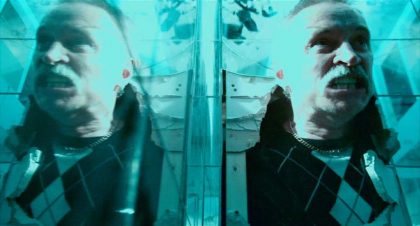
After moving in circles for what seems like an eternity, T2 finally starts barrelling towards a climax as Begbie finally encounters Renton, and he leaves his quarry with a gashed arm as Renton flees him. Soon Begbie tracks down Spud and is momentarily stalled in his quest when he starts making Spud read his written anecdotes to him, taking great pleasure in hearing his old sadisms mythologised, only then to find the same way that Renton cut Spud in on the money he stole. At Veronika’s behest, Spud aids her in filching the money the lads got off the government, before trying to warn them about Begbie’s murderous intentions. But he arrives too late, as Begbie has already entered Simon’s pub, forcing his former friends to try and battle him. The trouble is that once the actual story pace of T2 picks up (as opposed to its shot pace, which remains stroboscopic), it stops making sense, and resolutions to the various plot lines carry unusually little weight. That’s in part because unlike his younger self, Boyle, like many a recovering cynic, has become an indulgent and syrupy filmmaker, loathe to drag any of his characters too deep off into the woods. Unsurprisingly for the guy who made me sit through Slumdog Millionaire (2008), far from revisiting this material to shock current cinema out of its lethargic state, Boyle instead has, in spite of the occasional bit of male nudity and his empty showiness as director, removed the fangs from his creation. T2 isn’t a bad film by any stretch, and yet I found it a profoundly disappointing, even dispiriting one on many levels. Not because of its melancholic streak, but because it doesn’t know how to frame that melancholia. Something I’ve long suspected is now hatching out in movie land: after decades whining about Boomer nostalgia, the Generation X equivalent threatens to be utterly insufferable. Where are the worst toilets in Scotland of yesteryear?
15th
06 -
2017
|
2 comments »
Director: Emil Ben-Shimon

By Marilyn Ferdinand
It is with a light and generous heart that I suggest anyone within reach of a movie theater showing The Women’s Balcony pack up your necessities and head there at your earliest convenience. What will unfold over your 96 minutes in the dark is a comedy so droll, so full of love and celebration, and so wise in its mild cautions that you may see the world much differently when you emerge into the light.

The Women’s Balcony, a major hit in Israel, offers a look at an orthodox Jewish community—and community is what makes this film so endearing and healing. As the film opens, men and women move rapidly with a buoyant excitement through the narrow streets and alleys of ancient Jerusalem bearing casseroles and chasing after escaped liters of pop on their way to their tiny synagogue. A bar mitzvah is to take place, though the white-garbed, formally attired women give the impression that they are attending a mass wedding. They watch with pride from the women’s section, a balcony above the sanctuary, as the grandson of Zion (Igal Naor) and Ettie (Evelin Hagoel) stands to read his torah portion just as the candy the women customarily throw on the bar mitzvah boy (Yair Parash) arrives after being left behind in all the excitement.

At that moment, the middle section of the balcony collapses. The torah is destroyed by the falling concrete, and several people are injured, including the rabbi’s wife, who is hospitalized in a coma for the duration of the film. The rabbi (Abraham Celektar), inconsolable about his wife’s condition, can no longer lead the congregation. The glue that held this community together starts to come unstuck.
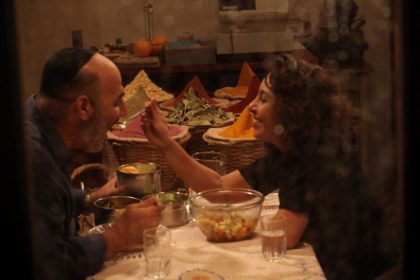
The milieu, though possibly not the plot, of The Women’s Balcony is based on screenwriter Shlomit Nehama’s upbringing. Her knowledge of and affection for the ways of her Orthodox Jerusalem community make it easy for viewers to become immersed in and identify with a culture they may never have seen before. What is particular to this community—kissing affixed to door jambs, using a non-Jew to perform tasks that Jews are prohibited from doing on the sabbath, trying to form a minyan (10 men) needed to hold a religious service—is educational for non-Jewish viewers and stirs familiarity and affection in Jewish audiences. What is universal—the easy love between Zion and Ettie, the exasperation of Ettie’s unmarried niece Yaffa (Yafit Asulin) at the constant nudges to find a husband, the bar mitzvah boy who thinks the collapse was his fault for not learning his torah portion and hoping something would prevent his embarrassment in front of the whole community—brings us all into communion with their humanness.

Despite the liberal doses of humor that keep the film moving briskly, Nehama set out “to tell the story of the moderate people who are forced to deal with growing religious extremism.” The snake in the garden is young, charismatic Rabbi David (Avraham Aviv Alush), who comes to the congregation’s rescue by rounding up a group of his acolytes to help them form a minyan at their temporary sanctuary in a storefront. He offers to preside over their services during their rabbi’s indisposition and even smooths the permitting process so they can rebuild their synagogue. Through these favors he claims a subtle, but powerful debt of obedience from the congregants and attempts to turn them toward a more extreme form of worship that would have the women banished from the main synagogue and pushed into more modest attire and behavior.

First-time feature director Ben-Shimon shows a sure hand in handling the script’s tonal shifts and providing a rounded picture of all of the players. He makes Zion and Ettie the core of the film and the exemplar of the health of the community, reveling in their playful and happy marriage. As Rabbi David’s influence starts to push the men into uncomfortable actions—giving their outraged wives headscarfs, allowing the women to be put in a cramped annex outside the sanctuary after the synagogue is made usable, allowing themselves to be discouraged from consulting with their rabbi on these and other changes—arguments escalate among the congregants. Ora (Sharon Elimelech) breaks with Ettie and starts wearing modest clothing full time, an ultra-Orthodox little boy is prevented from visiting Zion in his store, and most of the women leave their homes or force their husbands to sleep on the couch. We feel the pain of this group of once-happy people reduced to misery and strife by a wolf in black frock coat and hat spouting pieties designed to divide and control.

It is wonderful to see women so honored and central to the life of this community and their impassioned resistance to demotion, a shocking betrayal of what the community stood for—the love for their rabbi and his wife, and at base, for their faith, strong anchors in rocky seas. In the end, love has the final word. The old rabbi receives much-need medication through a deception that is a scene of comic genius and, sanity returned, he visits his comatose wife and returns to his flock. We have no doubt that the reawakening of the community she served will help speed her recovery.
The Women’s Room opens June 16 at the Gene Siskel Film Center, 164 N. State St., and at the AMC Renaissance Place in Highland Park. It is expected to go into wider release following limited runs in Chicago and other cities.
28th
05 -
2017
|
4 comments »
Directors: Guy Hamilton, Lewis Gilbert, John Glen

By Roderick Heath
Roger Moore’s death at the age of 89 last week was a sad moment in spite of what was obviously a well-lived life reaching a natural end. There was a sting I didn’t expect in losing Moore and his image, his unshakeable veneer of savoir faire and eternal boyish good-humour, and the fact that Moore had often never quite gotten his due. Certainly not a thespian of enormous range, Moore nonetheless shared a fate common to many actors in that he made difficult things look sublimely easy and remained perpetually patronised as a result. Moore is for the most part associated with his lighter roles, his dashing playboy heroes in the James Bond films and the TV series like Maverick, The Saint, and The Persuaders. His greatest talent was as a comedian placed in apparently dramatic circumstances, where his poker-faced whimsy and way with a perfectly sculpted wry look could bring the house down. But he could get gritty and command the screen with force when he wanted to, as he did in several films made between stints as more familiar characters, including Basil Dearden’s doppelganger chiller The Man Who Haunted Himself (1970), two films he made with former Bond director Peter Hunt, the mining thriller Gold (1974) and the seriocomic war epic Shout at the Devil (1976), and two he made with Andrew V. McLaglen, ffolkes (1980) and the rowdy mercenary drama The Wild Geese (1978), where he’s introduced executing the drug dealer responsible for killing an ex-girlfriend’s daughter in a manner bluntly contrasting Moore’s usual image. But Moore’s greatest claim to fame is, inevitably, as 007. And also his greatest claim to infamy, for Moore was doomed to be described as perpetual second-fiddle and tailor’s-dummy fill-in for Sean Connery in the role. Yet Moore’s stint as Bond was so far the longest and busiest of any actor to date, racking up seven films in twelve years.

Looking back on Moore’s stretch as 007 with the gracing interval of a few decades and three other actors in the part, his is now identifiable as just another phase in the character’s surprisingly unshakeable tenancy in pop culture, a phase that defined the character at one of several possible extremes, and mapped out its share of high and low points. The reason Bond has been trending back to a tougher, gamier edition ever since is bound up with that very modish popularity of Moore’s take. Watching the series through again a couple of years ago, it struck me that when Timothy Dalton took over the part with 1987’s The Living Daylights, he used more facial expressions in various scenes than Moore did in his entire occupancy, and yet Dalton simply never seemed eased into the part so well. Ian Fleming’s Bond, under his veneer of classy traits and official duty, was an emotionally dysfunctional creature chasing after jolts of livewire excitement to his general existential numbness. This was an aspect of the character Connery captured well even as the film adaptations began to obey certain cues in Fleming’s stories and drifted towards becoming modern-day editions of classic pulp heroic tales of Fu Manchu and Bulldog Drummond, and Louis Feuillade and Fritz Lang’s serial thrillers. Moore’s Bond adapted to the louche, jaunty mood of the 1970s, a seductive charmer, the driest of vodka martinis, quite often confounded by the strange sights his job thrusts before him but never entirely out of his depth. He could be offhandedly violent but usually only when snatching his chance before bigger bullies and insolent toerags. He was, in short, the perfect Boy’s Own hero for a series that embraced its status as disco-age entertainment, combinations of action movie, slapstick comedy, soft-core gaze-fest, and travelogue fantasia.

Live and Let Die was helmed by Guy Hamilton, who had left an indelible imprint on the series with his first try at it, Goldfinger (1964). Hamilton had found a way to push the series towards a gaudier, flashier, more knowing brand whilst not entirely losing contact with Terence Young’s lean and cool first entries. Hamilton had been brought back for Connery’s one-off return to Bond Diamonds Are Forever (1971), produced as antithesis to George Lazenby’s solitary run in the part, Hunt’s On Her Majesty’s Secret Service (1969). Lazenby’s film is perhaps still the greatest Bond film, but its relative seriousness and tragic finale, as well Lazenby’s indifferently received performance, saw it written off by many as a miscalculation. Diamonds Are Forever, on the other hand, gave audiences exactly what they seemed to want, glib and glitzy thrills without a solitary thought. On Her Majesty’s Secret Service had laboured to introduce Lazenby in a manner that at once gave him instant iconic lustre whilst also authenticating him as the direct continuation of Connery. Live and Let Die takes the exact opposite approach of simply discovering Moore in the role, lounging in bed with a gorgeous Italian spy (Madeleine Smith). Bond was now an interchangeable part of his own franchise. Up until Live and Let Die, the Bond films had been a cultural force unto themselves, defining a central fantasy of the age. With this entry you can sense one aspect sneaking in that would both help keep Moore’s films spectacularly popular but also a tad facile: aping of trends. Live and Let Die mixes together the vogue for urban cop thrillers and Blaxploitation flicks with Hammer horror and some nods towards real-life fixtures on the news landscape of the day, including the early days of the war on drugs, and a villain modelled after ‘Papa Doc’ Duvalier, then dictator of Haiti.

Fleming’s source novel had shown off both some of his finer gifts, like his pungent way with atmosphere and cunning for harsh violence, illustrated in vignettes when Bond’s CIA pal Felix Leiter is lunched on by a shark, and also his least charming traits, like the gross racism constantly apparent in a story pitting Bond against Mr Big, an American gangster and agent of the Russian spy group SMERSH. The film’s answer to this problem was simply to offer up one of the series’ usual conspiratorial cabals in fly drag. As a result, Live and Let Die became perhaps the purest pop-art moment the Bond film has had to date and also the instalment that seems most in thrall to the series’ deep roots in Feuillade and Lang-style thrillers. Here we see Bond contending with portals that suddenly open up between normality and the underworld, with a villain who rules over two worlds with disguises and who uses the paraphernalia of superstition to terrify and exterminate enemies, complete with scary craft-art voodoo idols that disguise hidden cameras and poison darts. A stylistic cue was presented by Paul McCartney and Wings’ theme song, a helter-skelter venture into raucous rock, setting the scene for the film’s fever-dream plunge into such madcap climes. Maurice Binder’s traditional opening credits took up the cue in presenting fiendishly beautiful, trippy images of blazing skulls and satanic fires and juju-eyeball lovelies.

Some liberation came from the fact Live and Let Die was the first Bond film since Goldfinger not to use SPECTRE as the antagonist, and the filmmaking team, headed by impresario producer Albert ‘Cubby’ Broccoli, were eager to take a risk in sporting black villains. One way the film mediated the idea is with humour, as it takes its bad guys fairly seriously, and instead presents an archetypal redneck sheriff, J.W. Pepper (Clifton James), as figure of clumsy comic relief and bogus authority, haplessly trying to keep up with Bond and his enemies as they carve a path through his parish: what had been a strict cultural power a decade before is now a figure of utter ridicule. There was even hope of making the Bond girl Solitaire black too, but fear of getting the film banned in certain overseas markets like South Africa nixed that idea. Instead Bond has a brief tryst with klutzy double agent Rosie (Gloria Hendry), and indeed that was cut out in some markets. Yaphet Kotto, who had made his name the year before in Superfly, was also eager to take on the part of designated villain, Dr Katanga, who also poses as Mr Big, head of a shadowy criminal enterprise that spans the US using the Fillet of Soul bar chain as a cover for his operations. Katanga is himself the president of a small Caribbean nation, San Monique, pictured gassing on about post-colonial politics whilst enriching himself by growing vast fields of opium poppies and planning to muscle his way into the North American drug trade by dumping two tonnes worth of free samples on the market. He has a pet fortune teller, Solitaire (Jane Seymour), whose virginity he guards jealously to preserve her sortilege genius, and a coterie of impressive henchmen, including mechanical-handed Tee Hee (Julius Harris) and the gangly Baron Samedi (Geoffrey Holder), who plays Emcee to Katanga’s reign of terror based in voodoo worship.

An obvious issue with Live and Let Die’s assimilation of Blaxploitation tropes is that genre depended on black protagonists to mediate their morbid fixation with the bleak side of urban life. Bond is the whitest guy around, although he had also helped foster new heroic figures like John Shaft. By this point in his career, Bond finds himself contending for the first time with a cultural landscape rapidly turning unfriendly to his status as a rich, smug, quick-draw, highly libidinous Caucasian male – a motif that would extend through the Moore years as he would be confronted with aspects of feminism and détente-era niceties. Bond’s adventure into Harlem in the film’s first third sees him isolated and curiously helpless in a way he’s never been before, as one character quips, “like following a cue ball,” and he has to be saved by a black CIA agent, Strutter (Lon Satton). The film gets a kick out of this, but also interestingly points out the path that would see Bond safe for another forty years. Whilst his films would readily reflect changing mores, the filmmakers had accidentally struck upon a truism: the more retro Bond’s style became, ironically the more appeal it retained. The supernatural aspect of Live and Let Die is also one that makes it rather unique in the Bond canon. The film takes the idea that Solitaire can really see the future seriously, and exploits this aspect to lend the film some tangy atmosphere, even to provide perhaps the most stylish moment in any Bond film: Solitaire’s anticipation of Bond’s arrival is visualised with her laying out tarot cards on a table, upon which is projected the image of Bond’s plane on the wing, with the promise that he “brings violence and death.” The paraphernalia of Katanga’s operation reveals the voodoo terror to be so much smoke and mirrors, there’s a suggestion right at the end that Baron Samedi really is the spirit of death lurking eagerly around the corner, Bond’s eternal friend and foe. Bond seduces Solitaire by taking advantage of her susceptibility after she keeps turning up ‘The Lovers’ in her tarot deck, by convincing her to go to bed with him with a stacked deck. Bond experiences momentary guilt at his ploy, only for Solitaire to eagerly embrace adult sexuality with a sly smile.

This last touch helped show off a defining trait of Moore’s Bond, his commanding ease as a seductive presence and way with a double entendre perfectly attuned to the oncoming disco era’s predilection for erogenous exaltation. The early Bond films had done a large part to midwife an age in which sexuality was no longer a hanging matter and where it was generally acknowledged that everyone was hunting pleasure in the sack, but had mediated this by couching them in rigorously macho terms. Moore simply took the edge off the machismo. Meanwhile the film throws up a raft of mischievous touches, like the recurring joke of a New Orleans street funeral being held for one of the luckless do-gooders watching it, to Bond constantly dropping through secret hatches in Fillet of Souls into the midst of Katanga’s operations, and roasting a snake snuck into his hotel room by improvising a flame thrower with a spray can. Only the slightly languid pace of Live and Let Die counts against it, as it seems to keep building to show-stopping action scenes and then throttling off, trying to whet the appetite for the epic boat chase in the last third that sees Bond trying to outrun Katanga’s assassins through the bayous in stolen speed boats, a brilliant parade of stunt work (one boat jump was the longest ever staged at the time). The finale sees Bond venturing onto San Monique to rescue Solitaire from one of Katanga’s cod-voodoo sacrificial rituals along with ally Quarrel Jnr (Roy Stewart), son of his former assistant from Dr. No (1962), in a sequence that splits the difference between The Devil Rides Out (1967) and dance number. Holder, a magnificent presence rarely utilised by film, is particularly memorable with his demonic laugh and physical grace, and Kotto comes into his own in the inevitable confrontation with Bond, alternating between gentlemanly bonhomie and feral grit as tries to knife our hero, before Bond force-feeds him a gas pellet that sees him blow up like a balloon and explode.

Hamilton also directed Moore’s second film, The Man With The Golden Gun (1974), which sported Christopher Lee as a born Bond villain but only afforded him a sluggish, ramshackle entry. Resolving to provide a true showstopper with the next episode, Broccoli brought back another legacy director, Lewis Gilbert, who had helmed 1967’s You Only Live Twice, one of the most spectacular movies in the series. The Spy Who Loved Me could well be considered the design classic of Moore’s films. The film’s most famous flourish, punctuating the usual pre-credit sequence, apexes with Bond skiing off the edge of a great cliff, only to open a parachute festooned with a Union Jack, a perfect ideogram for and encapsulation of the series’ wry tributes to parochial values and commitment to ridiculous yet breathtaking spectacle. The rest of the film comes at you as a perfect parade of essentialist Bond tropes that still loom large – a monstrous plutocratic bad guy with a plan to end the world, his environs of aseptic, asexual futuristic technocracy, a hulking henchman assassin, fast-paced globe-trotting, and plentiful opportunities to get laid. The plot sees Bond pitted against his Russian rival and opposite Agent XXX, aka Major Anya Amasova (Barbara Bach), in competition and then collusion for evidence that will explain why nuclear submarines belonging to both East and West keep vanishing at sea. The two spies follow the chain to shipping magnate and genocidal maniac Karl Stromberg (Curd Jurgens) and his plot to restart human life under the sea after starting World War III.

The Spy Who Loved Me secured Moore’s superstar status as Bond and started the series back on track for record-breaking profits, for unsurprising reasons. It’s an act of grandiose showmanship, utterly confident in itself, avoiding all discomforting matters and even playing the Cold War for laughs as mutual spy bosses M (Bernard Lee) and KGB chief General Gogol (Walter Gotell) readily team up to take on a common enemy. But it also sports many of the problems with the Moore years. In particular, it idles along for nearly two-thirds of its running time, proffering an assemblage of regulation tropes and diversions lacking real wit, as Bond contends with Stromberg’s heavies and Amasova’s frenemy attentions. The series devolution into self-mockery and referential gags had become corny by this point, like playing the Lawrence of Arabia (1962) theme over one scene, and pushing the beloved gadgetry to the point of silliness as Bond is kitted out with a Lotus sports car that turns into a submarine. Amasova was evidently intended as a feminist-era answer to Bond after the series had dodged the problem for a while with dim-bulb comic-relief heroines, like Diamonds Are Forever’s Tiffany Case and The Man With The Golden Gun’s Mary Goodnight. But the film doesn’t quite commit to the notion, and Amasova emerges as rather less convincingly tough and kick-ass than some others amongst Bond’s previous roster of heroines. Amasova does beat Bond at his own game when she seduces him and then knocks him out to get a valuable microfilm reel off him, but is reduced to regulation damsel-in-distress status by the end when Stromberg kidnaps her with evident intent of using her to repopulate his corner of the Earth. Not helping is the fact that Bach is painfully wooden in the role. Caroline Munro makes far more impression in a much briefer part as one of Stromberg’s crew, a bikini-clad flirt who gleefully tries to riddle Bond’s Lotus with machine gun holes whilst giving him a saucy wink.

Stromberg himself is a solid series villain with Jurgens offering silken sadism in his abode, festooned with baroque accoutrements but actually contained within a colossal submersible city, a private sanctuary where he can dine, plot world domination, and feed underlings to sharks in peace. Richard Kiel’s hulking henchman, dubbed Jaws because of his penchant for breaking necks with his deadly steel teeth, rightly became an instant hit and permanent reference point in the Bond lexicon. Eventually The Spy Who Loved Me springs into a last act that, although essentially just a replay of You Only Live Twice, nonetheless pulls out so many stops that you don’t care much. Bond, Amasova, and the crew of a US submarine are captured by Stromberg’s sub-swallowing super-tanker, the Liparus. Bond stages an escape, breaking out the captive crews of Yanks, Brits, and Russkies to seize control of the ship in a brilliantly-staged battle on a colossal set (built inside the specially-constructed 007 Stage at Pinewood Studios, then the largest movie stage in the world). The no-expense-spared solidity of the settings and special effects here give the film a special kind of stature. Another of this entry’s singular flourishes was Carly Simon’s earworm theme song “Nobody Does It Better,” fittingly an ode to the thrill of a lover who’s not terribly good for you but so utterly accomplished as bringer of the big O you can’t quit them. Composer Marvin Hamlisch repeats the song at the very end as a Broadway chorus tune, a genuinely funny acknowledgement that the series had reached a pinnacle as pure crowd-pleasing ham.

The next instalment, Moonraker (1979), pushed many aspects of The Spy Who Loved Me even further, annexing the sci-fi craze sparked by Star Wars (1977) for the series’ box office highpoint. But many also came away feeling this was a bridge too far for the franchise in pushing towards total cartoonishness. When the time came to make For Your Eyes Only, John Glen, who had served as editor and unit director on several previous entries, was promoted to director, a role he would hold for the next five films. Glen’s credentials as series helmsman were obvious – he knew how to cut and shoot action and corral such elephantine production values. But unlike Hunt, the last director promoted from the crew ranks, his brand of flash was also rather anonymous, and when the series needed shots of fresh style to back up the changeover to Dalton, it instead trundled on until reaching a crisis point in the late ‘80s. All that was a long way in the future, however, when For Your Eyes Only was released to instant, colossal success, sufficient to save United Artists from oblivion after Heaven’s Gate (1980). Originally projected as an opener for a new actor in the role whilst Moore was having one of his legendary rows over pay with Broccoli, For Your Eyes Only stands as evidence the series had tried the art of the gritty reboot 25 years before Daniel Craig’s Casino Royale (2006), paring away fantastical elements and trying to get the series back in touch with its roots as still-cavalier but more human-scaled adventuring.

The pre-title sequence also offered a call-back to another era in the series, as Bond, after visiting his dead wife Tracy’s grave, is almost killed when his helicopter is taken over by remote control by a bald man in a wheelchair and a white cat on his lap – evidently supposed to be old nemesis Ernst Stavro Blofeld (John Hollis) attempting a last act of revenge. Except that Bond manages to regain control of the chopper, scoop him up on a landing prop, and dump him into a factory chimney. This makes for a coldly amusing line scratched through a bit of unfinished business in the series, after rights disputes prevented a more thorough conclusion. The plot stakes when the story proper gets going still invoke worldwide menace but in a more convincing fashion. A British spy ship, the St. Georges, disguised as a trawler, is accidentally sunk by an unexploded mine caught in its nets, the secure, highly secret coding system that allows control of NATO nuclear systems left intact aboard. A marine archaeologist, Havelock (Jack Hedley) is hired by the Secret Service to locate the wreck, but he and his Greek wife (Toby Robins) are assassinated before the eyes of their daughter Melina (Carole Bouquet) by a Cuban contract killer, Ferrara (John Moreno). Bond is sent to follow in Havelock’s footsteps, and he tracks down Ferrara hoping to learn who hired him.

Bond soon finds Melina has the same idea: she plants an arrow from her crossbow in Ferrara’s back, and his hirer, Belgian hoodlum Locque (Michael Gothard), absconds whilst Bond and Melina dodge the wrath of bodyguards together. Bouquet’s Melina was probably the best Bond girl since Diana Rigg’s Tracy twelve years earlier, Bouquet’s powerful jawline and mystic-green eyes perfect for a heroine who explicitly compares herself to avenging Greek heroines like Electra (although even Bouquet still couldn’t escape the Bond girl curse of being listlessly post-dubbed). Her program of revenge stirs both Bond’s sympathy and caution. Bond finds his job complicated not just by Melina’s itchy trigger finger, but also by the enmity of two smuggling organisations with roots in the Greek resistance of World War II, one run by Kristatos (Julian Glover, who had been one of Moore’s rivals for the part of Bond years before), an anglophile and seeming samaritan, and that of Milos ‘The Dove’ Columbo (Topol). Kristatos paints Columbo, his former partisan partner, as the villain trying to obtain the coding device for Gogol. But Bond learns the hard way that Kristatos is the real villain, and must contend with his coterie of thugs, including fake defector and Olympian Erich Kriegler (John Wyman), and Locque, who runs down and kills one of Bond’s casual lovers, a fake Countess (Cassandra Harris, married to Pierce Brosnan at the time) who works for Columbo. Bond gets salty vengeance by pushing the trapped Locque off a cliff inside his wrecked car, before teaming with Melina to study her father’s log and track down the St. Georges.

The desire to stretch the now well-worn Bond formula in some new directions manifested here in some tweaks both slight and significant, including offering a glimpse of singer Sheena Easton as her sultry theme song for this entry plays in the credits, and signing off with a gag as Bond ignores a phone call from Margaret Thatcher (Janet Brown), the only time a Bond film ever nodded to a contemporary politician. This return to a down-to-earth take on Bond doesn’t always pay off as potently as it might have, in part because the pacing problems that would dog Glen’s entries are apparent, and the film still strides languidly through some regulation franchise business, like visits to swank casinos and doomed side romances. Kristatos and Columbo make for interesting villain and ally, but don’t quite seem able to carve a space large enough for themselves, and Glover gives a distracted performance. An annoying subplot sees Bond contending with teenage maneater Bibi (Lynn Holly-Johnson), an ice skating protégée of Kristatos, which seems present to sneak in some youth appeal given Moore was over 50 by the time, and to demonstrate there are some thresholds Bond just won’t breach. For Your Eyes Only also had to deal with the death of Bernard Lee, whose brief but inimitable turns as the crusty M had always been a series highlight. After offering a string of brilliant action sequences, the film builds to a climax that plays out with a weird lack of good action.

These problems are however more than matched by the plusses, which include location work in the Italian Alps and the Greek isles filmed with fervent colour by Alan Hume, and a trio of excellent action set-pieces. The first is a combination ski and motorcycle chase that sees Kriegler trying to run down Bond, careening down snowy slopes and traversing a bobsled course. The second is an underwater battle when Bond and Melina find the St. Georges and obtain the coding machine, but then have to fight one of Kristatos’ henchmen in a pressure suit, and another in a submersible. The third comes when Bond, backed up by Melina and Columbo, climbs a cliff to Kristatos’ hideout in a former monastery at Meteora, only for the stays for his roping to be knocked out one by one by a goon. There’s also a terrific sequence in which Kristatos keelhauls Bond and Melina behind his yacht, their bodies grazing coral crops and both desperately snatching for air, until Bond manages to tie their tow rope around a rock and snap it. Here For Your Eyes Only manages beautifully to tie together the more often divided spirit of the Bond series, the serial-like situation of peril mediated by an eminently credible and gruellingly physical sense of danger. Although he would remain for the most part a fairly stolid director, Glen manages some good directing touches here, based in his feel for editing, as when he repeatedly cuts away from Bond and Melina in the ship to the viewpoint of the approaching hardsuited goon, raspy breathing and menacing perspective ratcheting up surprisingly creepy anticipation. Later, the lights of the enemy submersible are glimpsed like the eyes of some great underwater beast far off in the murk. Glen warns the audience each time something is about to happen, but then holds off the reveal for a few beats longer than expected, so he can land the punch as a shock.

Moore himself took the turn towards a tougher brand of Bond in his stride, perhaps reflecting the recent ventures he had taken out of this zone in other movies. The actor doesn’t quite bring the same ease to the part he did to The Spy Who Loved Me, betraying the fact he knew he was getting a bit old for this sort of thing, and seeming a little strained by proceedings. But that also helps lend some depth to his performance, as Moore does the necessary trick of spinning on a penny from flip to gravitas when confronted by reminders of how brutal and irrational human beings can be, and then indulging the streak in himself, as when he kills Locque. His desire to present Bond as essentially a gentleman is apparent observed as he coaches Melina through a spasm of hate and determination to press ahead with killing her enemies, and when he fends off Bibi’s advances with careful deflection and spry quips. The punch-line, in which Bond cheats Gogol of his prize by throwing the coding machine over the cliff and declaring this act the essence of détente, has a laconic kick that does seem worthy of Fleming’s creation. Another of Moore’s charming if not so purposeful qualities was his declining skill in the rough-and-tumble aspects of the role – the odd karate kick was generally the limit of his action man cred by this point. But this opened the door for the incredible stunt work that recurs throughout all entries, particular in For Your Eyes Only, which testify these days to a lost world of gutsy glories, in such contrast to our CGI-riddled days, when even the most lightweight movies really were made and not processed. These three films certainly confirm that Moore’s Bond days were uneven, but just as readily speak of how, at their best, they offered sublime entertainment.
21st
05 -
2017
|
7 comments »
Director: Ridley Scott
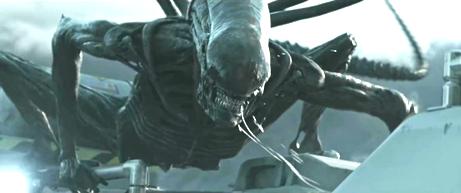
By Roderick Heath
Here there be spoilers…
Ridley Scott’s chimera of horror and science fiction, Alien (1979) launched its director on a Hollywood career and established a franchise that has become a fixture of the modern cinema landscape. Expanded by James Cameron, David Fincher, and Jean-Pierre Jeunet, the Alien series, whilst declining steeply in quality as it went on and spawning an army of imitators, still managed to remain distinctive. That distinctiveness stemmed from the films’ unique blend of down-and-dirty generic imperatives, telling blood-and-thunder stories of rampaging monsters, obscene pregnancies and infestations, and raw survivalism, fused with high-class production values, conceptual intelligence, and technocratic grandeur, lending a veneer of respectability to a portrait of a future far less cheery and far more id-like than the norm for such spacefaring tales. This is a future defined by eerie fusions of biology and technology, painted in chiaroscuro contrasts of assailed light against overwhelming blackness, a place where nightmares dwell and heroes survive only by pure nerve. The series reached a nadir when the menace of the xenomorphs was pitched into combat with the hulking Predators of Twentieth Century Fox’s other beloved sci-fi action property for two readily ignored movies, but then Scott elected to return to the series that had made his name with Prometheus (2011). Suddenly the series, and its director, were exciting for many again. Prometheus proved a peculiarly indecisive concoction, however, and a divisive one.

Undoubtedly, Prometheus was an ambitious and hefty piece of work. But many, including me, were hoping that Scott would extend his work not just in theme and scope but in style. The specific aura of his original, defined by a mood of miasmic dread and mystery, and tension slowly ratcheted then exploited with relentless effect, was attuned to environment as a tool and source of drama, in the twinned environs of space’s unknowable expanse and the labyrinthine twists of the Nostromo. Such carefully worked filmmaking offered lessons too many contemporary directors forget, including, it seemed, Scott himself. Still, Scott poured a great deal of his matured technical and storytelling expertise into the film and many examples of his great eye, so that when viewed as a standalone thrill-ride, Prometheus was a fine effort, sporting one truly classic sequence depicting an excruciating surgical birth. But as a revisit to beloved universe by its progenitor, it was surely more conventional and clumsy.

The curious squeamishness Scott revealed on Prometheus about drawing too many clear lines to his original gives way with Alien: Covenant, his latest foray into this zone, to a bolder reappropriation of his stylistic cues, opening the door for an instalment that moves a long way towards closing the linkage between the two entries. The titles recreate the assembling motif of the original’s opening credits, and Jed Kurzel’s music score quotes Jerry Goldsmith’s plaintive, eerie, barely-there scoring for the original. Scott also quotes ideas from subsequent entries, like a projected image of lovely forest offered as a bogus panacea for grief and the stern rifle-wielding quoted from Aliens (1986). There’s a deftly clever reason to this sort of conscientious trope-harvesting, beyond mere homage and service to a conceptual universe, that becomes clearer as the film goes on. Prometheus dealt with an expedition financed by dying tycoon Peter Weyland (Guy Pearce) and his efforts to track down the possible source of life on Earth, discovering facilities used for genetic engineering and the remains of a colossal alien race dubbed Engineers, who laid the seeds for the genesis of the human race but also intended its destruction and supplanting by more fearsome creations. The finale saw sole human survivor Elizabeth Shaw (Noomi Rapace) appropriating an Engineer spaceship to track down their home world in the mangled company of Weyland’s magnum opus in cybernetic engineering, David (Michael Fassbender).

Alien: Covenant opens with a sequence depicting David’s first conscious moments as a creation and tool of Weyland, back when the creator was still relatively healthy and David was immediately faced with a quandary of being the perfect and undying progeny of a very frail beast indeed. Most of Alien: Covenant however takes place ten years after the events of Prometheus. Following Prometheus’ lead, Covenant is also the name of a spaceship, a craft carrying a load of 2000 colonists in cryogenic stasis to a distant planet chosen as a new home. Their well-being is overseen by the on-board synthetic human Walter (Fassbender again), an upgraded, less independent version of David’s make. In between leaps through wormholes with a solar sail deployed to recharge the ship’s power supplies, the Covenant is struck by a surge of energy from an exploding star, frying its electrical systems and causing the ship’s core crew to wake up. The captain, Branson (James Franco), is burned to a cinder when his stasis pod catches fire, leaving his partner Daniels (Katherine Waterston) distraught and his second officer Oram (Billy Crudup) in anxious command. Whilst repairing the solar sail, another crew member, Tennessee (Danny McBride), picks up an extremely faint and mysterious broadcast from a relatively nearby planet. Watching the broadcast, the crew realise it’s a faint image of a woman singing John Denver’s “Take Me Home, Country Roads.” When they look at the planet it’s sourced from, a mere seven weeks’ flight away, the crew decide it’s worth travelling there to search for the mysterious woman, because the planet appears to be a closer and superior place to set up their colony.

Arriving at the planet, the Covenant crew, who are mostly married or in relationships to better foster the colonial mission, leave a skeleton force to man the space vessel whilst most of the crew departs to the surface to investigate. Tennessee’s wife Faris (Amy Seimetz) is one joins the landing team, which also includes Oram, Daniels, and stalwart Lope (Demián Bichir, under-utilised), whilst her husband stays aboard ship with another couple, Upworth (Callie Hernandez) and Ricks (Jussie Smollett). Daniels has protested vociferously to Oram about his decision to come to this planet which she describes as too good to be true, a protest Oram registers as another slight against him, feeling a victimised status he blames on his oft-proclaimed religious faith. Touching down, the landing party soon find the planet apparently free of all animal life but weirdly rich in familiar, overgrown versions of Earth vegetation. They soon find a crashed Engineer spaceship and find Shaw’s dog tags on board. Two members of the party, Ledward (Benjamin Rigby) and Hallett (Nathaniel Dean) also inadvertently find something else, spore pods that release microbes that latch themselves on their bodies and soon start a gruesome and grimly familiar biological process. Both infected men soon fall ill, bleed copiously, and finally have small but deadly alien organisms erupt out of their bodies. These things grow and go on the hunt, leaving several crew dead and their shuttle craft destroyed. What’s left of the party is saved by a mysterious cloaked figure who releases a bright flare to scare the monsters off. This is soon revealed to be David himself, surviving a solitary existence on this planet with naught to do but pick up where the Engineers left off.

The early scenes of Alien: Covenant confirm Scott’s intention to reverse-engineer the series back to original specs, whilst also quietly stretching out sinew in readiness for hard exertions when they come, as he makes a film where its very status as a variation on a theme is an explicit part of the show. The workaday tedium that afflicted the denizens of the Nostromo is not quite rhymed with the more upbeat and expectant Covenant crew here, whose outlook is fixed on new horizons rather than hacky bonus cheques. This positive aspect to the crew makes them more harmonious and likeable for the most part, but also means most lack the hardened edge of survival instinct that finally sustained Ripley through to safe harbour. The crew’s increasingly panicky, frail responses to hard-charging survival situations comes both in response to sudden swerves of fate but also repeatedly create them. Daniels’ tragic loss of her partner which is also the loss of the expedition leader and pillar of stability has immediately punched a deep and ever-widening hole in the integrity of this unit. Oram cringes and privately fumes at presumed dissension to his authority, especially when the other members of the crew take pause during their repairs to give Branson a funeral. Tennessee becomes increasingly stressed and places the Covenant in danger from the violent storms that sweep over the planet’s upper atmosphere as he becomes increasingly worried about his wife. The way stressful and lethally intense situations sort out personalities, a minor but consequential theme of the original, is here revisited and becomes an overriding part of how Alien: Covenant investigates humanity and alienness as conditions.

This aspect is illustrated with particularly ruthless zeal when the long, investigative first act gives way to rapidly spiralling crises and hysterical goads to action. The creature in Ledward rips its way out of his back whilst he and Oram’s botanist wife Karine (Carmen Ejogo) are in the shuttle craft’s med bay. Faris locks Karine in with the monster and makes a frenetic but ineffectual attempt to get a weapon and kill the creature. Although new-born the creature still gnaws Karine to death and tracks Faris through the ship, finally driving her to accidentally blow up the craft with her wild gunshots. Scott repeats this process several times, as situations fall suddenly and ruthlessly on his characters, a callous quality given fresh bite by the fact most of these characters are in relationships, their functions as team members cut across by personal loyalties and instincts driving them in contradictory directions. Daniels’ enveloping grief is employed both as a personal trait and an aesthetic keynote in a mad dream where everything spirals in towards to twinned moments of birth and death. Her hopes for building a log cabin on an alien shore with her husband are recited as pathetic confession, and she shares an embrace with Tennessee when they’ve both lost loved-ones. Scott contrasts the increasingly frenzied, messy, and desperate actions of the humans against the ever-poised David, who, in spite of his solitary Ben Gunn-like existence on the planet and long, ragged castaway’s hair, has kept his composure and found peculiar purpose. He takes the survivors in hand and leads them to a deserted city where the petrified remains of the Engineer race still lie scattered across agora cobbles, like some grotesquely apocalyptic, genocidal edition of Pompeii’s dead. David explains to the survivors that the Engineer ship he and Elizabeth brought to the planet accidentally released a sample of the Engineers’ own biological agents, killing them and all other animal life, whilst Elizabeth was mortally injured when the ship crashed.

Although it has undoubtedly been composed of uneven individual works and has received little recognition, Scott’s late career has been rapidly taking shape as one of the most vital and interesting runs in recent cinema from a major filmmaker. This is apparent on both on the level of sheer cinematic swagger, replete with genre-swapping skin-changes worthy of his xenomorphs, but also in the way the key fascinations of his films have become increasingly compulsive. This phase began after the flop of Body of Lies (2008), probably Scott’s weakest film, and kicked off with Robin Hood (2010), both an attempt to recapture and to farewell a phase in his career defined by the success of Gladiator (2000), the movie which restored his standing as a major hit-maker but also reduced him to a spinner of simplistic fairy-tales for grownups. Robin Hood, although violently uneven and poorly focused, was nonetheless a complex conjuration, meshing closely observed historical context with mythology in a manner that highlighted several of Scott’s career-long concerns, particularly class conflict and the fate of the out-of-place individual, and the question as to how our contemporary humanity has evolved, in terms of one of Britain’s most famous folkloric figurations. The films Scott has made since then – Prometheus, The Counselor (2013), Exodus: Gods and Kings (2014), The Martian (2015), and this one – have all agitatedly sorted and re-sorted an essential catalogue of ideas and images, taking on parables in various settings and each with a different tone for framework. The Old Testament punishments for hubris in Prometheus, The Counselor, and Exodus saw moral dramas played out in landscapes of jagged stone and bleak portent, whilst the communal efforts to achieve sanctuary in Exodus and The Martian evinced a positive but exacting sense of vulnerability in the face of eternal powers. Like Luis Bunuel, a very different filmmaker in obvious ways, Scott has explored his own contradictory nature as a person without overt religion but easily fired up by a religious sensibility, urgently examining the forces that make and break us, trying to live up to a humane creed but constantly offering sly sympathy to his Satanic figures.
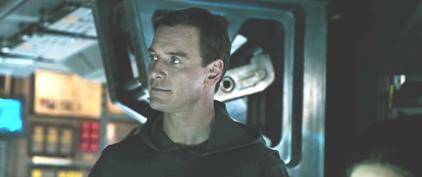
Alien: Covenant certainly extends this last aspect through the figure of David, who has slipped his bonds and become determined not merely to be excellent product but a most excellent and laborious producer. He’s that figure Scott admires most and has most qualms about, the exceptional being straining against a world of lessers, an antihero driven to be rebel archangel in his outrage at the way things are. Oram is a man of religious faith but little faith in himself and, more importantly, little gift for leadership, and he falls prey to David’s designs with tragicomic ease. The deliberate echoes and suggestions of direct connection provided here with Blade Runner (1981) flesh out something long implicit in the diptych offered by Scott’s most evergreen films, as David here marches on fearlessly into zones of self-definition Roy Batty could not quite bear to contemplate: he still wanted his father to tell him things would be all right. One forceful idea of Prometheus was the notion that discovering God might be a colossally disappointing act, underlined here with the revelation David casually exterminated the Engineers with their own works. One mask of creation simply gives way to another, leaving more mystery and more frustration. This becomes a spur ironically not to despair but to further, ever-more restless engagement with the act of creation itself. But the creation is only ever a mirror to the faults and strengths of what produces it, and David’s root programming error is suggested with a daisy chain of literary references that connects Lord Byron, Percy Shelley, and the latter’s wife Mary, as the Frankensteinian progeny plans an elaborate and cosmically terrifying revenge on having been made so well and yet so impotent. His recitation of Percy’s epistle to the titanic urge, “Ozymandias,” reveals his own trunkless legs by misattributing it to Byron – a mistake Walter, seemingly David’s perfect replica, but carefully castrated by a more cautious and circumspect society, notices, the one clue that this would-be god is cracked.

The relationship between David and Walter is one of Alien: Covenant’s most sublime ideas, giving Fassbender a chance to give two supremely confident, carefully varied performances, and the ultimate actor’s challenge and fantasy, to enact both seducing himself and killing himself. David introduces Walter to the pleasures of personal artistic creation when he teaches him to play a flute, the perfect Narcissus eventually even kissing his double in his effort to find a worthy companion in his solitude, and what could be more worthy than himself. But Walter resists and eventually becomes the only real force standing between David and victory over the pathetic flesh-bags. David has become as central and eclipsing to Scott’s re-conception of this franchise as Peter Cushing’s similarly cool, incisive, utterly unrelenting Frankenstein was to Hammer’s series about the character, towering far over the monstrous by-products of his tinkering. The eventual battle between the two synthetics is the ultimate and perfect version of the essentialist struggle that Scott has meditated upon as far back as the inevitably titled The Duellists – at last the mirrored antagonists are actually, truly identical, distinguished only by the mysterious code called personality. Alien: Covenant eventually unveils another inspired notion as it reveals that the missing link between the Engineers’ parasitic monstrosities and the familiar xenomorphs of the series is David himself, toying with these in his attempts to build a species perfectly adapted not just to survival but to actively exploiting and destroying humans.

This provides an impishly clever explanation for why the xenomorphs seems at once so strange and so familiar, compositing animal types found on Earth and giving the Engineers’ brilliant but mutable creations a new spin. At one point David acidly refers to one of his human male victims as the intended mother of one of his children. David has become in word and deeds his own god, a version of god blazing hatefully out of gnostic texts and bitter agnostic fantasy, a mad designer perched over neo-medieval texts splicing together misbegotten demons. The film’s blackest joke involves two renditions of a passage of Wagner’s Das Rheingold depicting gods entering Valhalla, and is also a cunning call-back to a motif again mooted in the original, where Ash celebrated the purity of the alien beast with ardent fascist admiration. The Hitlerian dream is unbound and now written into the music of the spheres. Appropriately, Alien: Covenant is a mad scientist’s concoction itself, all mediated by Scott’s utilisation of David’s urge to creativity as a metaphor for his own, speeding through drafts, each one tossed off with ever-more feverish drive than the last no matter how good or how lousy the results; only the urge to keep moving counts. Thus Alien: Covenant is a highly perverse hymn to creativity as a natural law and urge, manifesting in whatever form it will. Scott’s professional drive to keep working, so often the source of critical suspicion of his output, is constituted by him as the essence of his being.

Scott does more than make a horror film here; he makes a film about the horror genre, its history, its place in the psyche, analysing the way the death-dream constantly underlies all fantasies of ego and eros. Scott reaches out for a hundred and one reference points, some of the already plain in the Alien series lexicon. The deserted Engineer city recalls the Cyclopean confines of the lost cities in Lovecraft tales like At the Mountains of Madness, the Elder Gods all left gorgonized by David’s perfidy. At one point Scott recreates Arnold Böcklin’s painting “Isle of the Dead,” an image that obsessed H. R. Giger, the crucial designer behind so much of the Alien mythos, as much as it did Val Lewton, whose cavernously eerie psychological parables redefined horror cinema in the 1940s; Scott no doubt has both in mind. David’s “love” for Elizabeth, which has taken the form of relentlessly exploiting her body to lend genetic material to his creations, is both reminiscent of a particularly tactile serial killer worthy of Thomas Harris and of the obsessive, invasive eroticisation of the loved one’s cadaver found in Poe, whilst the whole meditates as intensely and morbidly on its landscape of Poe’s poetry. The design of the failed prototype xenomorphs and David’s rooms hung with sketches reminiscent of medieval alchemic ephemera both pay tribute to Guillermo Del Toro’s films and also poke Del Toro’s oeuvre back for its own debt to Scott and Giger. A head floating in water comes out of Neil Jordan’s self-conscious unpacking of fairy tales, The Company of Wolves (1984). The touch of Captain Branson’s death struck me as a possible tip of the hat to Dark Star (1974), in which the captain had died in similar circumstances, and which was of course made by Alien co-writer Dan O’Bannon. Late in the film Scott stages a shower sequence that sees Upworth and Ricks having a hot and steamy moment under the spigot only to be surprised by a xenomorph. At first glance this sequence revels in a trashier brand of horror associated with 1970s and ‘80s slasher films, but Scott also adds self-reference – the xenomorph’s tail curling in demonic-penile fashion around their legs calls back to the similarly queasy shot in Alien when Lambert was attacked by the monster, whilst also nodding back to Hitchcock and Psycho (1960). It’s staged meanwhile with all the pointillist precision of Scott’s most fetishistic visual rhapsodies – spraying water like diamonds playing over soft flesh, fogged glass, grey knobbly alien skin, and the inevitable rupture of red, red blood.

Which points to another quality of Alien: Covenant – its deeply nasty, enthusiastic commitment to being a horror film, an anarchic theatre of cruelty and bloodlust barely evinced in any other film of such a large budget, especially in this age of gelded adolescent fantasies. If it’s still not the deep, dank leap into a barely liminal space like the original, it is perfectly confident in itself and bleakly poetic in unexpected ways. I don’t know if a film has ever been so casually beautiful even when deploying visions of hellishness, apparent in moments like the shower attack. Or in the following scene when a blown-out airlock results in air turning to million-fold vapour pellets and then ice, exploding in dazzling shards. Or in the surveys of the desolate sculpture garden that is the Engineer city. Daniels’ resemblance to Ripley, in her short dark hair and singlets and pluck in the face of monstrous adversity is both another purposeful echo and a miscue, a by-product of Alien: Covenant’s status as a logarithmic variant. Her embrace with Tennessee is one of the most unaffectedly humane moments in Scott’s oeuvre, and a summation of the film’s repeated statement that to be alive is to need others. Only that’s a rule that cuts both ways in a predatory competition for lebensraum, and leads to such fragments of ecstatic insight as David’s distraught look when one of his children fails.

Scott stages another brilliantly executed, madcap suspense sequence as Daniels and Tennessee attempt to flee the planet surface with a xenomorph scuttling around the hull of their craft, Daniels trying to blast the beast on a wildly pitching deck as the monster tries to head-butt its way through Perspex to get at Tennessee. There’s a skittish, occasionally madcap quality to Pietro Scalia’s editing throughout the film that communicates the off-kilter will at the heart of this project. Only in its very last act does some of Alien: Covenant’s assurance slip, as Scott doesn’t quite match the patience with which he deployed his sneak-attack coda in the original. But there’s still a final twist in store, at once galling and perfectly apt, deployed with obviousness but sustained in ambiguity with such malign showmanship that it becomes increasingly vexing and entirely riveting, before the axe finally falls. Scott builds with cold mirth to a punch-line for the tale that both echoes one he initially mooted for Alien, and which also recalls the sting in the tail of one of the signal influences on that film, Mario Bava’s (1966). Scott exploits his own well-worn material here to push right to the brink of the abyss in a way reminiscent to what he did before in The Counselor, complete with a note of predetermined evil fate, only in a context where he can bait people to swallow it. But he also leaves a tantalising question open that might still be answered in creative and thrilling ways. This is the worthy achievement of this entry – it rejuvenates a well-worn property and restores all its dark and unexpected power. But more than that, it’s a testament of pure delight in his medium from a filmmaker who really has nothing left to prove, but likes to prove it anyway.
19th
05 -
2017
|
no comment »
Director: Lilly Rivlin

By Marilyn Ferdinand
“They said, ‘Elizabeth, if you really want to push for this consumer agency, you’ve got to get organized.’ And I said, ‘Great! How?’ They said, ‘I’ve got two words for you: Heather Booth.’” –Sen. Elizabeth Warren on the subject of the Consumer Financial Protection Bureau.
Ever since the results of the 2016 U.S. presidential election became known, people throughout the country and the world have been mobilizing in a resistance to the current regime the likes of which haven’t been seen since the 1960s. The current outrages to human decency that are emanating from Washington, D.C., however, are neither as unprecedented nor as unusual as many newly woke people seem to think. Again we have had to learn that democracy is not a spectator sport. Now is the perfect time to reflect on the power of community organizing, and virtually no one has been a more important community organizer than Heather Booth.

People who know what community organizing is usually think immediately of the late Saul Alinsky, a Chicago-based educator and activist who wrote Rules for Radicals and is often called the father of community organizing. Or they may picture young community organizer Barack Obama, who we see in a still photograph at the very beginning of Heather Booth: Changing the World knocking on someone’s door. However, although few outside the groups that call on her for help know about Heather Booth, her influence is enormous. One interviewee says: “It’s like Zelig.” Anywhere a progressive cause needs a helping hand, you’re likely to find Heather Booth.

The sheer volume of Booth’s activities could be a challenge to any documentarian, but director Rivlin takes us through Booth’s life and career economically through the use of Booth’s audio diary, begun in September 2015, and interviews in which Booth recounts her personal history. What emerges is an inspiring portrait of a highly effective activist who has accomplished a great deal in her 70+ years on this planet.

The film starts with a look at the nuts and bolts of organizing, as Heather records in her audio diary the steps she is taking to organize a September 2015 rally on the Mall in Washington, D.C., for a group called Moral Action for Climate Justice. Booth lays out the basics of a successful action: “Clarity of purpose, clarity of the specific tasks, accountability on the tasks, and interconnection on the tasks.” Rivlin films her laying the groundwork for the event and then the successful rally itself. It then segues into a rough chronology of Booth’s life and activities.

Booth was raised in Brooklyn by progressive Jewish parents. When they moved to Long Island, she realized that did not feel comfortable in a suburban social setting. She spent as much time as she could in the free-wheeling atmosphere of Greenwich Village, taking up the guitar and hanging out with “the beatniks.” It was there that she took her first steps as an activist, handing out flyers for a group opposed to the death penalty, a task that intimidated her. Her own experience informs her approach to activism: “We need to give people confidence to take even simple steps like that.”

She lived on a kibbutz in Israel, but galvanized by news of the 1963 March on Washington, she returned to the United States to be part of the civil rights movement. Among her activities at the time involved going to Mississippi to set up freedom schools and to register voters. Her visit to Shaw, Mississippi, during Freedom Summer put her in touch with the Hawkins family, who eventually sued the city for equal access to services the white side of town enjoyed, such as sewers, traffic lights, and fire hydrants. Booth says that some consider the U.S. Supreme Court decision in favor of Hawkins to be as important as Brown v. Board of Education, which codified equal access to education for white and nonwhite citizens.

She met her husband Paul, then the national secretary of Students for a Democratic Society, in 1966 while both were involved in a sit-in on the University of Chicago campus to protest the war in Vietnam. He proposed on the third day of their acquaintance, and their life together, says Heather, “gets better and better. We work on our marriage the same way as our organizing.” It was inevitable that once the Booths had children, in 1968 and 1969, Heather’s work would turn to the plight of families. She helped organize the Action Committee for Decent Childcare in 1972 that eventually squeezed $1 million from the City of Chicago for childcare services. Her account of how the group accomplished this amazing feat shows her humor, ingenuity, and tenaciousness.

It’s not often commented upon, but the progressive movement was and often still is dominated by men. Booth decided that to help women avoid being marginalized in the movement, she would help found an institute to train more women in community organizing. The , which she chairs to this day, was the result. Other work on behalf of women included JANE, a service that provided illegal abortions before Roe v. Wade made the procedure legal and widely available.

Rivlin’s film, which includes title cards, archival footage and still photos, and talking-head interviews, moves briskly, even breezily, with encouraging news about the wins Heather Booth helped effect, all scored by the infectious Bob Marley-like social justice song by Kyle Casey Chu, “Woman Strong,” that repeats “ain’t nobody gonna stop her now.” Her accomplishments are too numerous to recount here—a very good reason to see this movie and hear people like Rep. Jan Schakowsky, Sen. Warren, Rep. Luis Gutierrez, and other community activists sing her praises.
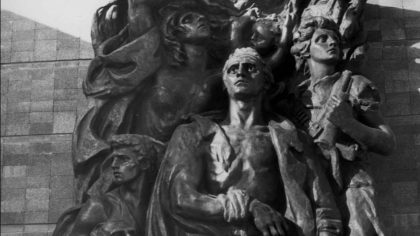
The forces that shaped Booth’s destiny helped her empower others. Booth said that visiting Yad Vashem, the Holocaust museum in Israel with its monument to the resistance fighters of the Warsaw Ghetto, had a profound effect on her. She says, “This was a place where people stood and and fought back—this feeling of better to go down standing up than living on your knees.” Just because you’re paranoid doesn’t mean they’re not out to get you, whoever and wherever they are. A sign on Booth’s desk confirms this idea, but prescribes an attitude that refuses to admit despair: “Pessimism of the mind, optimism of the will.” It’s a good thought to keep in mind for the fight ahead.
Heather Booth: Changing the World screens Friday, May 19 at 7:45 p.m. and Saturday, May 21 at 7:30 p.m. at the Gene Siskel Film Center, 164 N. State St. Heather Booth and director Lilly Rivlin will be present for audience discussion after both screenings.
14th
05 -
2017
|
no comment »
Director/Screenwriter: James Bidgood
By Roderick Heath
Pink Narcissus is a relic of cinema that has journeyed from virtual oblivion to belated appreciation in a corner of the cinematic world that long hungered for elders to respect. The story of how it came to be unearthed and its worth today is bound up in who made it and why. Born in Madison, Wisconsin, James Bidgood arrived in New York in the early 1950s aged 17. Like many young gay men then and now, self-described farm boy Bidgood was surely on the search for a tenable existence and a community, and he carved out his place in the city’s queer underground as a drag queen and night club dancer. He found commercial success as a dress designer prized for his opulent debutante apparel, as a window dresser, and as a photographer. This last passion became increasingly compelling to Bidgood, and through the 1960s his homoerotic studies were popular in the “physique” magazines that allowed a little soft-core gazing to gay readers; at a time when most of their pictures were flat and trite, Bidgood gained attention by bringing his decorative and compositional gifts to bear. Bidgood sarcastically referred to his Hell’s Kitchen apartment as Les Folies Des Hommes, in tribute to the Folies Bergeres, as that tiny abode doubled as his studio and theatre of creation, and he soon started using it as a pseudonym when publishing his photos. Soon Bidgood began trying to make a movie, shooting entirely within his apartment confines. Bidgood’s partner of the time, Bobby Kendall, a former hustler, became the epicentre of his attempts to inscribe in pure cinematic terms an obsessive fascination with his lover’s body and, beyond that, to create a total work dedicated to celebrating his aesthetic fetishes, in a film encapsulating a series of fantasy sequences built around what Bidgood himself described happily as “gay whack-off fantasies.”

Bidgood worked on the film off and on for about seven years, eventually spending about $27,000 on the project. He utilised friends and acquaintances as actors, including Charles Ludlam, who had founded the landmark avant-garde “Theatre of the Ridiculous” movement, which was to have a powerful effect on later expressions of camp aesthetics like The Rocky Horror Picture Show (1975). The time it took Bidgood to finish his dialogue-free, highly experimental movie testified to his fastidious dedication and creative verve, but also foiled what ambitions he harboured for the result. By the early 1970s, following the Stonewall riots and the explosion of the new liberationist era, gay culture was just starting to claw its way to the surface of modern life whilst also developing a taste for more direct and hard-edged self-portraiture. If Bidgood’s film had come out a couple of years earlier, it might have seemed radically frank and a pivotal artwork. Instead, it was dismissed as a kitschy, already dated hunk of amateur showmanship. Bidgood’s obsessive points of reference, encompassing a brand of lush, artificial expressiveness beloved of vintage camp enthusiasts including old Hollywood fantasy films featuring the likes of Maria Montez, belonged to a mode then falling out of favour. Not helping matters was the decision by Bidgood’s distributors, who, having invested money in his never-ending project, eventually decided to finish the editing and release it without his permission. In retaliation and fond hope, Bidgood took his name off the film, on the off chance this might lend it an inscrutable aura on the underground movie circuit. He was right, as the film did begin to slowly accrue a cult following, and many fans theorised its director might be Andy Warhol. Over the next few decades Pink Narcissus had occasional revivals, but it wasn’t until the writer, and fan of the film, Bruce Benderson set out to finally solve the riddle of its creator that the link was made between the movie and Bidgood.
The sheer level of craft and ingenuity often on display in Pink Narcissus for a work made in such conditions is worthy of admiration purely in itself, but the real quality of delirious artistry Bidgood achieved is quickly evinced even in his opening shot, with his camera tracking through dense, obviously fake jungle. The full moon shines through the leaves, orchids bloom at night, and a butterfly emerges from chrysalis. All is touched with a quality of hand-made magic thanks to Bidgood’s reverence for a certain brand of artificial yet pellucid beauty and mystique, and his utilisation of basic yet difficult cinematic effects like stop-motion animation. Pink Narcissus wears some of its inspiration in its title, a twist on Michael Powell and Emeric Pressburger’s Black Narcissus (1946), as Powell’s films were a potent influence on Bidgood’s ardour for intense colour and drenched optical effects, and their method of bending established melodramatic narratives and exotic trappings to their own purposes. Pink Narcissus’ title is also a statement of plain subject, as Kendall’s central character is presented as both a love object and a narcissist, captured in all his self-love, which is also the love of the camera-filmmaker. The story, such as it is, finds Kendall’s young and insouciant male prostitute, referred to as Pan by most reviewers because he’s first glimpsed dressed up like that god of nature, lounging around an apartment presumably paid for by his sugar daddy, who occasionally phones up to make sure he’s there. Pan seems to leave the apartment for a quick adventure, or perhaps only remembers doing so. He finds it in a tryst with a leather-clad biker in a toilet block. Back in the apartment, Pan idly masturbates whilst ranging through a series of fantasies in his head, including being served up as a dessert at a Roman emperor’s orgy, being the favourite in a Sheikh’s male harem, and escaping into green fields and jungle night.

Pan’s encounter with the biker is a great example of Bidgood’s fearsome cinematic energy and his will to express erotic furore with unique concision, as Pan dips in and out of fantasy transformations of the event in contrast to the gritty immediacy of actually getting a blow job from some random dude in a toilet. He sees himself as a matador, waving his red cape for the biker riding his motorcycle who transmogrifies into a very horny bull. Bidgood puts across the idea of fellatio without quite showing it as the biker, mouth welded to Pan’s crotch, is submerged in a bath of foaming water, filmed in orgasmic slow-motion, sexual thrill rendered as amniotic immersion and painted over with jets of ejaculate-mimicking soap foam. Pan’s nasty streak emerges as the encounter turns violent: he knocks the other man to the ground and enjoys the sight of him squirming in both pain and auto-erotic pleasure. Pink Narcissus reveals itself at such moments to be about the very urge that drives Bidgood’s filmmaking, the tension between a sordid reality and a transformative vision that can constantly remake that reality in an ever-shifting series of guises. Artifice isn’t just a method but the essence of the work, as Bidgood painstakingly creates a series of little worlds, totally invented zones of being and imagining where caprices cordoned off from the main flow of life can bloom in private domain.

Not that the fantasies are esoteric. Indeed, most have easy analogues with common straight fantasies, particularly that of the harem. But that passage appropriates the oh-so-common dancing girl scene of historical epics and disposes of the barrier of enjoyment so many gay fans found in such movies. Indeed, the commonality of the fantasies here seems very much part of the point Bidgood was trying to make, to synthesise a clear and recognisable shared ground, trying to map out the coasts of a hitherto largely uncharted continent. Pan exists as male houri kept around purely for convenient moments of sexual pleasure. His is a little uterine world of pinks and reds, gilt frames and mirrors where his own image lurks like some wistful spirit fascinated in his person looking in from a more real world as he lounges through the day. Pan is a satire-cum-inverted celebration of the great cliché of Orientalist art, the lounging odalisque – a figure embodying all voluptuous sensual potential happy enough to exist purely for that end and frustrated only when they cannot indulge it. This lineage is also clear in the harem sequence, where Pan and his master and fellow slaves watch a male belly dancer, whose shimmying fills the screen in images layered one upon the other, his penis shaking like a fire hose under diaphanous silk. Bidgood’s frank enjoyment of eroticising the male body – or to put that another way, his delight in great butts – is in constant evidence throughout, as Pan’s mental peregrinations drag him through various settings replete with fantasies of sexual wealth. But he’s also subject to another pull, away from other people, to imagined scenes of lounging in fields and forests, jerking off on the grass and inseminating the earth.

Pink Narcissus betrays evident influences, or at least precursors, from the history of experimental and underground film added to the stew of images harvested from popular cinema. There’s a similarity to Joseph Cornell’s fetishistic appropriation of Hollywood image-making and two-bit exotica, Rose Hobart (1936). Kenneth Anger’s imprint is powerful throughout, in the use of double exposures for dense and oneiric incantation: the shots of the mystic moon strongly recall those in Anger’s Rabbit’s Moon (1950) and the belly-dance, with its hallucinatory historical kitsch and double-exposed images, is reminiscent of Inauguration of the Pleasure Dome (1954). Equally Anger-like is the employment of music, ranging from surges of high-romantic classical music to harvested movie scores to electronica-tinged avant garde racket. When Bidgood makes occasional forays into the world outside Pan’s apartment, he does so only with extremely stylised models and sets that hark back to silent Expressionist cinema. The imprint of Powell and Pressburger lurches to the fore again as Bidgood’s use of highly stylised, purposefully theatrical approximations of reality often resemble those found in the grand ballet sequence of The Red Shoes (1948), all painted imps and cardboard sets. When his camera drifts out the window to survey the city night, Bidgood fills the soundtrack with audio harvested from radio and television, sarcastically portraying that world outside Pan’s onanistic bubble as one of droning advertisements and flim-flam – in short, another bubble contained by infinitely less personal yet equally masturbatory aesthetics than those exhibited in Pan’s existence. Bidgood relishes not just the garishly colourful reaches of Pan’s room but also the grimy fecundity of such sights as graffiti decorating the men’s room wall, and the litter collected in a urinal rises on the swirl of flowing water and urine filmed the way other directors might survey some deep space nebula.

Pan, true to his name, repeatedly leaves behind his invented lovers and overlords for wandering in forests and lounging on hillsides, escaping into nature, although even that can be feverishly eroticised, as when he gets caught up in reeds that he finds he has to please in a phallic manner, whilst drenching rain falls on him. At other points, Pan lies on a grassy patch of ground, playing with the butterfly seen hatching at the start, an emblem of furtive sexuality itself, in a state of constantly becoming. Pan’s connection with nature suggests a part of Bidgood’s mind pining for the lazy sensuality and beauty of a boyhood on the farm, caressing himself all over with a blade of grass in shots where Bidgood renders Kendall’s nipples or navel as universes in themselves, which indeed they can be on such a sensual, nerve-sense level. In actuality, Pan tries to match the imagined/remembered sensation by pouring champagne on himself. Bidgood’s camera strives to record sensuality in such moments on an intimately physical level, communing with his audience through sense-memory stirred by vision: it’s hard to think of more intensely sensual moments in cinema. Bidgood’s hunt for such electric visual similes for sensatory experience also sees a bundle of pearl necklaces caressed in phallic manner during the belly dance scene. This image leads to a climax, in both sense of the word, for the sequence when Pan’s sadistically stoked excitement demands the belly dancer be executed by the Sheikh’s bodyguards. The dancer is hacked down with scimitars, whereupon Bidgood fills the screen with a colossal penis jutting at the camera, squirting spunk both real and gleefully animated in pearl-like globules shooting through the air.

Bidgood’s confrontational streak is gleefully unleashed here, depicting ejaculation as the natural end of all these pictured labours, a fillip of hardcore footage offered not as mere punctuation for the sex act as in pornography but as a totemic event. The way Pink Narcissus proceeds from primly hiding away shots of genitalia to scenes in which extras stand around with their dicks out and increasingly direct sexual expression like this offers a telling incidental depiction of Bidgood responding to the loosening sense of what he could get away with during the laborious process of making the film. When Pan comes, he comes all over the presumed viewers, implicating all in the spectacular pleasure but also examining its strangeness, a wild, flowing vision of galactic panspermia. The death of the belly dancer, as in a slasher horror film, suggests the act of climax can only be matched and correlated in the remoteness of cinema with the spectacle of violent death, one form of violation of the body offered in lieu of another; it also a cyclical moment, the touch of Thanatos lending its perpetual spice to the cause of Eros. Although Pink Narcissus becomes increasingly brave in what it shows, it stands aloof from pornography in the sense that it’s a film trying to purvey an aestheticized essence of experience rather than reflect the viewer’s wont back at them. The only scene that actually describes Pan having sex with someone else, the blow job the biker gives Pan, is both cleverly illustrative but discreet in that regard, and this grandiose celebration of coming is as wildly amusing as anything else. No wonder the film failed to go over with the Times Square beat-off crowd.

Ejaculation might briefly exhaust Pan’s frustrated libido but it also signals a shift in the film into a different realm. An epic, dazzlingly bizarre sequence sees Pan phoned up by his keeper (Ludlam), who is exploring a downtown scene where the flotsam of the city night reel by and rough trade comes out of the woodwork. This sequence is a triumph of Bidgood’s artisanal world-crafting, as he recreates the reaches of downtown Manhattan from its heyday, as glimpsed in movies like Midnight Cowboy (1969), as a place littered with human refuse, reconfigured as a guerrilla theatre playpen. Amidst all the wandering hustlers and cruisers, Pan’s first meeting with his lover is described, an act that Pan is all too aware saved him from selling his body out there. Johns lurk like dapper neo-Bluebeards in their frock coats and bowler hats, satiric visions of classy conformity out seeking their own personal big-dick id-beast for kicks. The prettiness that dominates the rest of the film here is transmuted into a no less aestheticized but far harsher evocativeness. The languorous mood imbued by the orchestral strains on the soundtrack earlier in Pink Narcissus here gives way to spasmodic and grating scoring, approximating the cityscape’s collective nervous system as a schizoid beast. The turn of seasons is noted with cardboard ice, the pavements are haunted by twisted wretches selling flowers and newspapers, and shaggy, filthy wastrels. Rival hustlers try to catch eyes with ploys like pouring mustard on their pricks.

Pink Narcissus is quite often described simply as a perfect gay fantasia, a luxurious decorative object not unlike its hero. And yet Bidgood’s statement about the lot of queer sexuality in his time deepens and becomes more critical here, setting up a new tension that resolves in a series of brilliantly effective images at the very end of the film. Mutual exploitation is in play here, and Pan’s narcissism is much a rebellion against the exigencies of the situation where he plays love object at the convenience of another man as it is against boredom and solitude. And yet this theme is also eternally subject to Bidgood’s engagement in alternations of exterior admiration and interior imagining, invading the object of gazing with an urgent, ferocious desire to possess the very quality of indifference. Pink Narcissus could be the deepest, most fiendishly obsessive and morbid dive into the essential problem of trying to know the lover in American art since Poe wrote about Morella and Ligeia, and yet its urges run in the opposite direction, away from the grave and towards the explosively sensuous. Bidgood opens up vast yet intelligible schisms between the lives we lead and the ones we imagine, and sees the way the two are rarely easily teased apart, as the acts of imagining, contrasting, masking, and discerning, are deeply enmeshed with all experience. The last phase of Pink Narcissus sees Pan, purified of sexual urge by ejaculation but plunged with new intensity into the wandering through his dream life, traversing formless landscapes, entering the jungle where the vegetation slaps against his body and torrential rain falls upon him, as if the very earth itself is intent on ravishing him, and Pan wants to dissolve into world-spirit, assailed by fluttering petals beating at his body, wandering in floods of hallucinatory colour.

The knock at the door must come inevitably and drew the stud out of his fantasia. Except that when his lover comes into the apartment, Pan sees him with his own face, simply incorporating him into his fantasy life, contained as another doppelganger. But the infinite mirror is cracked in the end, the screen itself breaking under the strain of such much looking and the young man’s projections can only stretch so far before he too will be an old man buying love. The crack becomes a spider’s web, glistening in the jungle night again, the place where all dreams well and wane. One prominent modern filmmaker who might well have absorbed something of Bidgood’s vision, or at least displays some telling intersection with it, is Nicolas Winding Refn, whose work often feels like it’s taking place in a similarly subliminal realm, particularly his (2013) and The Neon Demon (2016), similarly exploring environs of clashing, supernaturally rich colour, replete with dangling beads and boles of mysterious and engulfing, eroticised settings, offering up the sign-play of sexuality as a series of masks. As is so often the case, the out-of-time quality that prevented Pink Narcissus from gaining much favour in its day now seems like its greatest quality, the conjuration of the world the mind can contain. Certainly many will still be turned off by Bidgood’s unabashed depictions of gay sexuality, but they’ll only be missing out on a genuinely unique and mesmeric cinematic experience.
can be viewed for free on YouTube…
….
9th
05 -
2017
|
no comment »
Director: Michael Schultz

By Marilyn Ferdinand
The American New Wave of the 1970s saw a great flowering of independent films. The ’70s were an especially fruitful time for African-American filmmakers, freed in part by pioneering director Melvin Van Peebles’ Sweet Sweetback’s Baadasssss Song (1971) to tell stories about their lives and their communities their own way. Filmmakers of the , including Charles Burnett, Julie Dash, and Larry Clark, have won well-deserved recognition not only for the films they made, but also for the generations of African-American filmmakers they mentored. But black filmmakers who had other points of entry into the industry have made their indelible mark as well. Michael Schultz is one of them.

Schultz, a Milwaukee native and multidegreed graduate of the University of Wisconsin-Madison, Marquette, and Princeton, has directed for the stage, screen, and television, with nearly 100 TV and film credits to his name, including a 1972 TV adaptation of his lauded stage version of Lorraine Hansberry’s To Be Young, Gifted and Black. An overview of his work shows care in his choice of projects and a consciousness of his responsibility to the African-American community both on and offscreen. At a 2011 Directors Guild of America event honoring him, he said of working in New York on The Last Dragon (1985):
I was shocked to see that there was only one black crew person out of a crew of about 120. About two weeks into the shoot, the one black crew guy got fired. My hands were so full that I couldn’t fight that fight then. And the refrain kept coming back, ‘We can’t find any qualified people.’ So I said, ‘I’m coming back to New York, and I’m going to make a movie with an all-black crew just to prove that’s bull.’ I came back with Krush Groove and wound up with an 80 percent black crew. That became the bed that Spike Lee used to launch productions, and he carried it far beyond me with workshops, internship programs, and really developed a crew base in New York.”

Schultz’s first major calling card as a film director was Cooley High (1975), improbably produced by Roger Corman’s American International Pictures and penned by screenwriter , whose high school memories of growing up in Chicago’s Cabrini-Green housing project would also form the nexus of the hit TV series Good Times (1974-79). Schultz elicited energy and authenticity from his largely nonprofessional cast and, in the process, made Cooley High a coming-of-age classic.

Based on the unexpected financial success of Cooley High, Schultz found a place inside Hollywood’s major studios, which were struggling to survive and change with the times. His first assignment, for Universal Pictures, was Car Wash, written by future big-time director Joel Schumacher and featuring megawatt entertainer Richard Pryor at the height of his fame in its ensemble cast. Car Wash is a day in the life of the owner and workers of the Dee-Luxe hand car wash in Los Angeles, and as such, depends heavily upon the strength of the characters to keep the film engaging. Schumacher packed his script with types, some of which are an awkward fit to the material. It’s a tribute to Schultz’s directorial skills that he was able to take what could have been little more than a potentially offensive sitcom and bring to life a small, specific world instead.

A lot of films open with a car moving toward and stopping at the destination where the action will take place. This film, wise to its Los Angeles location, opens with a car stuck in traffic (something we saw again perhaps as one of the many film homages in the 2016 Oscar-nominated La La Land). George Carlin plays a blabbering cabbie whose professions of racial tolerance are an unending stream of insults for Marleen (Lauren Jones, the director’s wife), the black hooker in the back seat who looks too exhausted to care. Looking at $19 and change on the meter and then at the contents of her coin purse, Marleen slinks stealthily out of the cab and locks herself in the ladies room at the car wash for a makeover. Thus, we arrive at the film’s mise-en-scène.

From the introduction of the motley cast of characters in the ordinary act of reporting for work, the film feels real, even exciting, despite its focus on a deeply mundane business. The “wet” crew, who work hosing, hand-soaping, and cleaning the car interiors, gradually filter into the employee locker room, joking and signifying as they change into their orange jumpsuits. T.C. (Franklyn Ajaye) fusses with his enormous Afro to look his best when he spots the object of his persistent affection—the lovely, long-haired, pink-miniskirted Mona (Tracy Reed)—walking to her waitress job across the street. Would-be transsexual Lindy (Antonio Fargas) is equally fastidious about her appearance as she winds her carefully coiffed hair in a protective fishnet. Floyd and Lloyd (Darrow Igus and Otis Day) slide into the locker room performing the new opening for their duet singing act; cigar-chomping Lonnie (Ivan Dixon) drolly remarks in his basso profundo voice that “it’s getting better” as he exits the room. Duane, newly minted as Nation of Islam adherent Abdullah (Bill Duke), shows up late, a repeat infraction silently noted by car wash owner Leon (Sully Boyar) as he views the crew at their stations from the front office.

Eventually, the film’s award-winning (Cannes, Grammy) score by Norman Whitfield kicks off as the soon-to-be best seller for Rose Royce, “Car Wash,” blares from the speakers that pipe music from a disco-flavored radio station. Like Francis Ford Coppola’s American Graffiti (1973), Car Wash prefers a diagetic soundtrack, emphasizing the importance of the music to its characters when Leon tries unsuccessfully to change the station and T.C. runs repeatedly to a nearby pay phone to try to win concert tickets from the station so that he can ask Mona out.

Schultz knows how to balance straight-up comic bits with personal moments that lend weight to these often-unremarked-up lives. Leon’s cashier and cosmetics-obsessed squeeze on the side, Marsha (Melanie Mayron), is frightened by wet crew member Chuco (Pepe Serna) as she does her nails while sitting on the toilet, but through her considerable acting chops, she transcends Marsha’s humdrum, dateless existence in a fabulously awkward, but successful flirtation with an aging lothario (Al Stellone) paying for his wash. When she shouts her last line, “I’ve got a date!” we share in her astonished triumph. The script skewers Leon’s son, Irwin (Richard Brestoff), as a middle-class version of a radical chic warrior, eschewing a day in the front office to labor alongside the “workers” and read aloud passages from Mao’s little red book. But Brestoff’s engaging sincerity wins our affection, as well as that of the wet crew. By contrast, Abdullah is far too angry for the car washers or us to relate to, and his pain and confusion are revealed almost too late in the film to soften our regard for him. It’s a credit to the great work of Ivan Dixon and Bill Duke, both of whom would go on to successful directing careers, that a potentially violent confrontation between their characters becomes a heartfelt window into the shared pain and camaraderie of black manhood. Most intriguing to me was Marleen, a largely silent character whose own self-regard oozes from her even as she declares her undying love for Joe, whereabouts unknown, in lipstick on the men’s bathroom mirror.

The white folks in this film are the least interesting and most often humiliated with toilet humor. A rich Beverly Hills snob (Lorraine Gary) drives her spotless Mercedes into the car wash, hysterical that the vomit her son (Ricky Fellen) dutifully expelled out the passenger window will erode the car’s finish if it isn’t removed immediately; inevitable, after the crew in orange tends to her needs, her son barfs all over her as they start to drive away. In another fairly unfunny scene, Prof. Irwin Corey plays a man mistaken for a mad bomber the radio announcer says has been setting fires all over Los Angeles with Molotov cocktails. The wet crew springs into action to get rid of a paper-bag-wrapped pop bottle found in his car and ends up breaking what turns out to be a urine sample on the pavement.

Finally, I suppose I need to talk about Richard Pryor, who almost stops the film dead in its tracks. He plays Daddy Rich, a celebrity preacher who touts the ministry of greed to his faithful followers at the car wash who tend to his stretch limo like it is a holy relic. He is, I suppose, a better aspirational figure than a bejeweled gang leader, but Abdullah calls him out for the pimp he is. This is not a funny scene, and it interrupts the pace of the film for Pryor’s star turn. Fortunately, the Pointer Sisters, who play his female entourage, sing “You Gotta Believe” with all the razzle-dazzle that puts people like Daddy Rich in the plush life. I breathed a sigh of relief when they all drove away.
I’ve barely touched on the many vignettes and characters teeming in this mostly joyful, sometimes soulful film. Michael Schultz seems to love them all and the rich multiethnic gumbo they comprise. Car Wash stands like a beacon between the 1965 Watts riots and the 1992 L.A. riots with a vision of what things might look like if we could “all get along.”
4th
05 -
2017
|
no comment »
Director: Jonathan Demme

By Roderick Heath
Jonathan Demme’s death last week at the age of 73 sent a shock through the film world. Demme was one of the many talents to graduate from Roger Corman’s school for no-budget auteurs in the early 1970s, chalking up his first feature credit with 1973’s Caged Heat, a women’s prison flick that collected a studious cult following in the next few years for its oddball take on a seamy genre. 1977’s Citizens Band was a movie made according to a Corman precept, exploiting the CB radio craze, but started its director on his rise up the Hollywood ranks thanks to Demme’s gift for creating witty, humane movies sporting woolly characters, facilitated by Demme’s love for actors. 1981’s Melvin and Howard confirmed his talents in that regard as he shepherded Mary Steenburgen’s performance to an Oscar. As the ’80s progressed, Demme increasingly satisfied his love for music and exploring the culture at large with a sideline in documentaries, whilst making a string of movies that are the core of his cineaste following: pop comedies often sporting a dash of the violent and tragic, including Swing Shift (1984), Something Wild (1986), and Married to the Mob (1988). After he gained an Oscar himself and was set as one of Hollywood’s reigning filmmakers, he started plying a more conscientious brand of prestige cinema with the sententious but brilliantly made Philadelphia (1993), but hit a reef with the luckless Toni Morrison adaptation Beloved (1998). Amidst a sprawl of further documentaries and music films, Demme recovered his mojo with two little-appreciated but entirely winning remakes, The Truth About Charlie (2002) and The Manchurian Candidate (2004), and vibrant revisits to his everyday comedy-dramas with Rachel Getting Married (2008) and Ricki and the Flash (2015).

A quality most everyone loved about Demme’s films was his big-hearted awareness of the world immediately about him, his sense of life and people as a cornucopia even when abutting grimmer facts of existence, and his unforced, celebratory delight in America’s diverse makeup. Considering such qualities, it’s both a glaring irony and a fitting twist that the one movie he made that everyone knows was his discursion into a dark and morbid annex of the modern imagination via a virulently intense and violent horror film. That film somehow became an instantaneous fixture in the pop culture firmament and was the first of its genre to win the Best Picture Oscar, on top of awards for Demme himself and his stars. This was chiefly the result of Demme’s canniness as a hardy and tested director who knew how to shift and vary his style according to the rhythms of his material and the energy of his actors. The Silence of the Lambs was based on a novel by Thomas Harris, a former journalist who had broken through as a novelist with the terrorist thriller Black Sunday, filmed smartly by John Frankenheimer in 1976. But Harris had found his real metier with his 1981 novel Red Dragon, a tale depicting an obsessive FBI agent’s attempts to track down a serial killer, which he accomplishes in part by seeking the advice of another killer he caught, the entirely mad, insinuatingly wicked, yet often bizarrely composed and helpful, cannibalistic former psychiatrist Dr. Hannibal Lecter. Red Dragon was filmed superlatively by Michael Mann in 1986 under the title Manhunter, but that film proved a surprise bomb. Meanwhile, Harris composed a follow-up that recycled several elements of his first book, but with the inspired idea of substituting for Harris’ first hero Will Graham a young FBI trainee named Clarice Starling, launched in verbal combat with the still-caged but relentlessly scheming Lecter.

Most studios had passed on the rights to Harris’ book, in part because of Manhunter’s flop, but also because it seemed floridly unpleasant and left field, at a time when horror cinema was in a deep rut. The quality of Tally’s script attracted Demme, who was on a hot streak, as well as a battery of stars who normally bypassed such a grim project. They soon had the services of recent Oscar winner Jodie Foster and Anthony Hopkins. Hopkins was long a British actor of great repute on both screen and stage. Since the early 1970s, he seemed in constant danger of becoming a major star, but just never quite got there, from his sub-James Bond action hero part in (1971) to his kindly doctor in The Elephant Man (1980). One peculiar freedom allowed Demme on The Silence of the Lambs was the fact that although there was a recent film sporting some of the same characters and essentially the same plot, he didn’t have to worry about trying to meet any expectations. Nonetheless, his approach couldn’t have been more opposed to Mann’s if he had set out precisely to counter it. Mann had presented Harris through the prism of his terse and stripped-down modernist stylistics, his Lecter played by Brian Cox as a nerveless pervert whose sense of humour is colder than the surface of Neptune. Tally, Demme, and Hopkins instead presented him as a larger-than-life figure armed with Hopkins’ sibilant, slightly alien-sounding vocal mannerisms and an array of blackly comic quips that make him as much the film’s comic relief as its representative from darkest Hades.

Demme’s canniness in handling the material is quickly evinced in the film’s opening moments, depicting Clarice called off the obstacle course at the FBI training school to perform a peculiar errand for senior serial killer tracker Jack Crawford (Scott Glenn). He captures Clarice hauling herself up a slope by ropes, literally coming up the hard way, before his camera tracks her with hungry precision through the woods, establishing the way the camera moves throughout the rest of the film, constantly tugged along, usually by Clarice’s stride in all her alternations of confidence, intrigue, and timorousness. She’s presented as a tiny figure getting into an elevator with a bunch of other, hulking trainees. Many films, both before and after this one, would waste reams of dialogue on a point Demme makes with swift, telling cinematic blows. By the time she’s seated in front of the wiry, paternal yet enigmatic Crawford, we know who Clarice is and what she’s up against. Her mission, given her by Crawford but with unspoken, ulterior motives, is to interview Lecter to learn more about his psychopathology. She does so, followed by the warnings of both the FBI honcho and Lecter’s smarmy psychiatric keeper Dr. Chilton (Anthony Heald) that Lecter is a dangerous being in the extreme. Chilton even entertains Clarice by showing her a photograph of the awful damage he did to a nurse’s face when she failed to keep him restrained.

Clarice’s trip to see Lecter is shot as a journey into subterranean wells, gaining a briefing for a descent into hell from Chilton and the sturdy attendant Barney (Frankie Faison) on the way before she’s ushered into a murderer’s row, in a sequence reminiscent of Val Lewton’s Bedlam (1946). Except that’s it not just clasping hands of the repressed reaching out from the bars but handfuls of sperm, tossed by the resident whacko sex fiend “Multiple” Miggs (Stuart Rudin), representative of the masculine character reduced to its most bestial, counterpoint to Lecter’s equal and opposite monstrosity of the same spirit lurking under the façade of the perfect civilised man. Here the walls are all suggestively medieval brickwork, matching the swirling autumnal hues of the opening for situating the film squarely in a neogothic state of fragrant, fecund dissolution. Lecter himself hovers behind a modern barrier of thick glass, standing straight and unnatural as some kind of lawn ornament when Clarice, and the camera, first glimpses him. Lecter, an irresistible mixture of great mental aptitude mated to unconscionable will, quickly discerns something Clarice has (deliberately?) not thought too hard about. Crawford has another motive for tapping his brain, the possibility that Lecter might be able to provide an insight into another serial killer currently perplexing Crawford and the rest of national law enforcement. That killer has been dubbed “Buffalo Bill” in a pitch-black piece of cop humour because “this one likes to skin his humps,” leaving his female victims in rivers missing patches of skin.

Demme’s often subjective camerawork and use of close-ups represent film technique at its most easily parsed and recognisable, and accomplishes the important task not merely of animating the film’s intense, headlong experiential quality, but also in inhabiting the driving notion behind the psychosis of its villains and the method of its heroes. As Lecter prods Clarice to realise, Buffalo Bill covets what he sees, most immediately, the skins of women and more existentially, their identities, like some corporeal incubus sucking in their beings to give himself solidity. Lecter himself covets freedom and achieves it through a careful and relentless process of keeping an eye out, most specifically demonstrated when he sets eyes upon Chilton’s pen. Clarice and Crawford meanwhile are obligated to look at things almost impossible to look at for the sake of their jobs and their motivations, allowing the evil of others, in essence, to colonise their own minds and emotional reflexes. Thus Crawford has pictures of Bill’s victims decorating his walls, and Clarice discovers the clue of the moth chrysalis by peering at a snapshot of a bloated and stinking corpse. Like Hitchcock, Demme tethers his deepest cinematic reflexes to this interplay of looks, although lacking an obvious analogue in the story for visual obsession, unlike what Hitchcock provided in Rear Window (1954) and in Harris’s own Red Dragon, where the killer was a photographic processor who gazed at the home movies of others and wanted to write himself into their hermetic perfection. Seeing is a source of power in The Silence of the Lambs, particularly for Clarice, whose ability to look at life’s worst facts in raw, corporeal form, is her key to success. Her viewpoint creates her reality, but also creates its own distortions. The pathetic and tragic photos of Bill’s dead victims spur her sense of offended sympathy, but she needs Lecter to point out the fact that Bill “kills women” is purely incidental to her quarry. Chilton’s punishment of her for failing to respond to his chat-up line is to be shown that totemic photo and also informed as to part of the reason she’s being sent in, as a pretty face to turn the monster on.

Looking is also an act bound up with erotic wont and prelude, although here the erotic is always being channelled into other pursuits, or mangled via deeply weird psychological dynamics. Clarice, with eyes straight ahead, is engaged in her ambition to quiet her own sense of wrenching detainment by her past, wilfully oblivious to concerns others would love to impose. Demme notes the way Clarice and her pal and Academy roommate Ardelia Mapp (Kasi Lemmons) attract massed glances from other recruits, and fascinates the men in her life, even Crawford, a paternal figure who rivals Lecter for post of father-mentor and also with hues of potential lover, a point with which Lecter enjoys teasing Clarice. Demme makes a visual rhyme out of two moments of the most gentle physical communion (in a tale where that’s a very wide gamut indeed), those when Lecter contrives to touch his finger to Clarice’s and when Crawford shakes her hand in congratulations. Both moments have layers of import, especially from Lecter, who deduces things about Clarice purely by her smell where others only see, laying claim to Clarice in just about every way except physically until that moment. Lecter’s own olfactory brilliance is again linked to Miggs’ cruder immediacy: “I can smell your cunt!” are the words with which he greets Clarice’s entrance to the ward, and Lecter offers Clarice a compensating clue setting her on the path to Bill in part as compensation for Miggs’ offensive behaviour, just before Lecter somehow contrives Miggs’ death, killing off, at least temporarily, his bestial other.

Clarice follows Lecter’s clues and learns to decode his riddles through an affinity of intellectual seriousness in a generally much less attentive world. This affinity allows Clarice to understand immediately his advice to look “deep inside yourself” not as a pop-psychological bromide but a direction to an actual place, a storage facility where the weird paraphernalia of Lecter’s life resides, including, bobbing in a jar of preservative, a severed head. This sequence is grand, from Clarice’s exchanges with the elderly mogul (Leib Lensky) who owns the facility to the exploration of this zone and her uneasy laugh before venturing into the dark place, a territory that works like Lecter’s mind as a compartment of stored information, complete with hearse and mannequin without a head, and echoes back to the septic American gothic of Psycho (1960) and also to the baroque hideaways in Mario Bava’s films, staged during a heavy downpour for extra flavour. The head, Lecter protests, is not from one of his victims but from a patient who died shortly after reporting his male lover was starting to show signs of hatching lunacy and intense fetishism for the skin of others. Clarice realises that Lecter suspects he knows the killer, but is soon distracted when she’s roped in by Crawford to help him when another of Bill’s victims turns up in a river. Clarice notices a vital clue, a rare insect cocoon jammed into the victim’s throat during the post mortem, and learns from a pair of pleasantly nerdy experts (Dan Butler and Paul Lazar) that the cocoon houses a Death’s Head Moth, a suggestive clue that has to bide time for unpacking when Bill (Ted Levine) snatches another woman. But this one, Catherine Martin (Brooke Smith), brings troublesome portents for the killer, who imprisons her in a pit in his basement. The terrified Catherine nonetheless has enough nascent spunk to try to find ways to escape, and she also happens to be the daughter of a senator, Ruth Martin (Diane Baker), stoking law enforcement into paroxysms of impotent action and giving Lecter a very good reason to help.

The Silence of the Lambs casts a very long shadow over today’s pop culture, as the seeds it planted soon sprouted hundredfold in film and television. Its success immediately disgorged nasty wannabes like Copycat and Se7en (both 1995), and now TV, in particular, is still filled with police procedurals where grisly, often misogynist fantasies are indulged via the actions of fictional serial killers only to be safely caged by swashbuckling law enforcers. That’s one reason The Silence of the Lambs has also often suffered from blurred genre definitions, existing at once on the level of horror (intense, phobic images, a dark, near-surreal visual palette, sustained fight-and-flight sequences, monstrous figurations, and episodes of primal violence) and thriller (puzzle narrative with a proactive hero figure engaged in pursuit and detection). The film’s success in this regard was not simply because of its ineffaceable pictures and catchphrases, but because, although hardly the first horror-thriller with the chase for a murderous fiend at its core, it took the serial killer to be the authentic embodiment of contemporary anxiety, a source of danger all too real but readily translating into the image of a beast from the id.

One of the ways the film achieved this was in bifurcating the image. Buffalo Bill, whose actual name is Jame Gumb, is closer to the squalid reality of the serial killer, a misfit preying on the vulnerable whilst subsisting through a series of borrowed guises in a depressed and drearily fallow corner of the American landscape. Hannibal Lecter is a fantasy version of the same, deliberately removed from the normal realm of psychopathology (“They don’t have a name for what he is.”) and incarnating the idea of the casual thrill killer at an ultimate extreme, at once Renaissance man and man-shaped tyrannosaur, capable of doing extreme damage only with words, smart enough to fool and defeat law enforcement, finally becoming something like the bogeyman as he escapes into the world at large. Clarice’s narrative involves the defeat of the former monster, but the latter is soon unbound. Like a vampire held in check by physical and cultural demarcations, Lecter’s worst ravages can be held off in part through social graces – courtesy, attentiveness, intellectual engagement. Clarice Starling, for her part, was the kind of heroine 1991 needed very badly. Hollywood already had Ellen Ripley and a handful of other tough cookies, but most of those were in fantastic fare. Whereas Clarice was notable for her immediacy and solidity, whip-smart but not omnicompetent, focused but not a hard-ass, connecting to the case not just through professional commitment but from deeply personal motives rooted in the death of her policeman father. In short, an actual character and not a symbol or a contrivance.

Lecter’s easy job disassembling her poised veneer to diagnose her life history and motives shakes her up enough to make her think of her father, pictured by Demme in flashback along amidst memories of an idyllic small town where neighbours wave to each other and young Clarice’s father is the literal and figurative embodiment of paternal protection. The absence of love interest is in part a function of her focus – one of the film’s best jokes is that after just about everyone strikes out with Clarice, the one guy who gets a charmed smile from her is one of the museum entomological nerds, except that he himself is instantly distracted by an exciting development relating to his own field of obsession – and also because the real romance is between Clarice and Lecter. It’s a clue that Starling grips Demme as a heroine, not simply as a small woman in a big man’s world but because she’s a fallen citizen of the kind of world he preferred, the one where human connections, no matter how evanescent, are enormously powerful. Clarice struggles to regain her right to live in such peace but is drawn into a labyrinthine netherworld filled with monstrosities worthy of any Greek hero like Theseus or Oedipus, with Lecter suggesting both imprisoned Minotaur and riddling Sphinx, and Buffalo Bill as lurking Procrustes (cross-reference: the visual kinship between Mario Bava’s Hades in Hercules in the Center of the Earth, 1961, and Demme’s depiction of Gumb’s basement, with its earthy walls and invading roots). Clarice’s journey is marked in a series of met tests, from being easily rattled in her first interview with Lecter to her confident rebuffs of his later attempts to wrong-foot her, building her poise on her path to an ordeal.

Lecter’s insidious delight in penetrating the minds of people and sadistic spectacle, counterbalanced by a psychiatrist’s remnant ethos that sees a curious cleansing in the process of baring all, soon demands its own price from Clarice. The pair engage in a quid pro quo arrangement, Clarice offering up fragments of her traumatic experience after her father’s death, including a time when she was sent to live with some farming relatives where she made a hapless attempt to save a spring lamb from slaughter, a symbolic rescue that had the powerful effect of leaving her even more rootless and rejected. There’s a facetious facet to all this, derived from Harris, in the underlying faith that a great hunter of psychopaths must be a little mad themselves, but it’s the powerful engine of the drama nonetheless. In these sequences, which undoubtedly won The Silence of the Lambs its acting awards, Clarice and Lecter are filmed in delirious close-up investigating every nuance of feature. Where the film becomes less certain is where Harris’s material leaves aside its best side, the theatre of psychological warfare, for more familiar bestseller business of wailing cop cars and low-grade political tussles. The venal Chilton, fully aware of what’s going on between Clarice and Lecter thanks to his eavesdropping, outflanks her and Crawford by convincing the senator to give Lecter an authentic deal for better treatment. Lecter endangers his own good luck for the sake of his own sadistic gratification when he taunts the senator, but eventually, he gives up all the accurate details about Gumb except for his real name. Meanwhile, Clarice and Crawford catch stentorian protests from on high, rebuking Crawford for his methods (although Demme wittily cast Corman as the voice of such authority). When one examines the narrative, it’s actually built not on Lecter’s brilliantly intuitive understanding of another bird of the same feather but on coincidence, the fact that he encountered Gumb’s handiwork in his practising days. Only that crucial act of coveting is explicitly revealed as Lecter’s insight, in part because it is the motif of his own Tantalus-like existence.

Demme’s filmmaking, in spite of such narrative hesitations, retains a remarkable mixture of control and propulsion, and in particular his attentiveness to mood and atmosphere. Like the way he creates a cordoned hush around Clarice as, left alone in a small-town funeral parlour for a moment, she hears soft organ music, and slides into a sad reminiscence of her father’s funeral, seeming to drift out into the service with a fixated purpose before reverting to her child self to kiss her father’s cheek. This moment is again rhymed towards the end when Lecter’s phone call to Clarice at her FBI graduation party again seems to cleave her out of the same reality as other people, reduced to spying back on a bash that was her seeming elevation. There’s enormous craft in the intricate dance of actions and reactions in the post-mortem scene, Demme’s camera leaning close to catch each face, in isolate character and their reactions to atrocity, as a universe in itself. Even the most off-hand gestures have meaning, like the smile Tracy Walter’s character, one of the local coroner’s aides who also doubles as organ player, gives to Clarice when he sees her peering in on the funeral – a moment that supplies a charge of friendliness to proceedings even as both these people go in to inspect a bloated, partly-skinned corpse. Demme’s use of such controlled and sometimes deceptive perspective leads to more spectacular effects later, like the cunning cross-cutting between Crawford leading a SWAT team to what he thinks is Gumb’s house and Clarice ringing the doorbell of his actual home.

The most ostentatious sequence comes when Lecter finally springs his long-anticipated escape plan, segueing from the soft lilt of Bach piano music to face-eating and brain-smashing and then back again. Demme holds his nerve even as he grazes the outer edges of authentically Sadean imagery – a policeman’s face sliced off and used as a mask, another hung from Lecter’s cage, eviscerated and used as a prop in an act of psychological terrorism that renders Lecter’s all-too-human adversaries too blinded by their own feelings to see what’s in front of them. Several major American auteurs would follow Demme’s example in trying their hand at horror in the following decade, but most, from Scorsese to Coppola to Zemeckis, would never reveal the kind of sure hand Demme seems to wield so effortlessly here. Demme himself had hoped to make a work equal to The Texas Chain Saw Massacre (1974) and smartly followed its lead in avoiding gore except for when absolutely necessary, on top of the already fitting connection between the two films, both being based in part on the legend of the “Wisconsin Ghoul” Ed Gein. Part of Demme’s legerdemain lies in how his camera notes all the important aspects of Lecter’s design and yet carefully elides vital aspects and the total concept until Lecter arises from his hospital gurney, strips off his gory disguise, and grins hungrily at the hapless medic sharing his ambulance. It’s a little like that famous The Twilight Zone episode about the man who accidentally unleashes the Devil and an age of calamity begins.

The Silence of the Lambs was controversial as well insanely popular in its time for some understandable reasons, for its violent implications and also for its portrait of Gumb, a would-be transsexual, at a time when cornball queer villains were appearing quite often in Hollywood thrillers as a big red button marked “malevolent other.” Less than reassuring portrayals of human behaviour are part of the territory with a horror film of course, and Demme and Tally still took care, perhaps spuriously, to use Lecter as mouthpiece to dispel the notion Gumb is actually queer, but rather a creature totally lacking in identity who tends to annex anything close at hand that gives shape to his unique drives. Nonetheless, Levine’s Gumb is one of the film’s less appreciated qualities, as is Smith’s terrifically convincing performance as the object of his bleak intentions. Gumb, first seen as a fusion of human and technology as he spies on Catherine, has to convince as the more immediate and genuine threat in the tale in contrast to such a florid scene hog as Lecter. Hopkins’ Lecter, with all his knowing, flashing-eyed deliveries and relish of a good laugh-line, comes on with calculated theatricality. Demme, whose usual playfulness as a filmmaker didn’t belie his more radical side but rather facilitated it, intuited the rebellious aspect to Harris’ dark fantasies, an aspect that gives The Silence of the Lambs connection to its only rival as a mainstream horror hit, The Exorcist (1973), which similarly offered an audience thrilling jolts of revelling in extreme transgressive behaviour viewed through rigid moral veils. Chilton represents authority at its most petty and sleazy, and Lecter whispers with serpentine appeal to that part of everyone who wouldn’t mind dealing out a little biting payback to such egotistical overlords.

Levine’s Gumb, by contrast, is a quieter, more authentically unnerving creation. Introduced play-acting as an injured, gormless man moving a sofa to lure in Catherine, Gumb seems eminently and terribly possible, the kind of bland, unremarkable man who can dissolve amidst the background details even whilst he commits unspeakable crimes, longing for ascension to Olympian stature. Gumb confirms the howling void of human being under his surface as he mimics and mocks Catherine’s screams and literally objectifies her (“It puts the lotion on its skin or else it gets the hose again.”). There’s perverse humour, subtler than Lecter’s quips, and a charge of anxious eroticism running under the sequence when he makes himself up in a feminine form as prelude to furthering his aim of completing a woman suit composed entirely of harvested skin. So deeply ingrained is Demme’s humanism and his love of actors that he offers a certain pathos to Gumb here, seeing his frustrated and fervent creativity, his need to believe, like the insects he cares for, that he’s constantly becoming something. There’s a close kinship with Barbara Steele’s mean but frustrated prison warden in Caged Heat indulging her covert fantasies of being a chanteuse. The appeal of his twisted life becomes apparent in the rainy, depressed town he lives in, a secret bole of radical detachment from the everyday, a secret bohemian lair gone horribly wrong.

The crucial moment comes as climax not just to Demme’s careful deployment of setting and mood but also his attentiveness to his actors: when the penny drops and Clarice realises she’s standing in Buffalo Bill’s house, the man himself is before her, sniggering like a conspiratorial school boy, as Clarice tries to keep her cool, and her fate, foretold throughout the film, is to one who descends to the labyrinth, alone and unaided. This finale is particularly superb not simply in managing suspense effects well but in drawing the film’s consistent obsessions to a wicked point. Clarice is reduced a blind and groping interloper in a Stygian zone whilst Gumb, armed with infrared glasses, stalks her. But Gumb fatally forestalls his own chance to dispose of his enemy and elude capture because he must indulge his coveting, letting his hand hover over Clarice’s face, rejoicing in his power over her, until he makes the fatal mistake of cocking his weapon, giving her a split-second chance to retaliate. Even here there’s a strong visual gag, in the way Gumb curls up, shot full of holes by Clarice and still wearing his night goggles, making him look like a man-sized insect who’s just met his fated can of fly spray, his black abode suddenly filled with cleansing, diminishing sunlight. Clarice’s defeat of one dragon is undercut by the reminder that the other, more eternal one is still out there, planning a moment of revenge on the haplessly fleeing Chilton with impudent cool. Demme manages something rare with his blackly mocking coda, transmuting his blood-and-thunder show into a modern myth, finding strange and saucy delight in Lecter not simply as a sharp-tongued rogue but as the embodiment of something eternally insurgent beneath the human spirit, dissolving into the crowd to become the daemon of the world.
31st
03 -
2017
|
4 comments »
Director/Coscreenwriter: Federico Fellini

By Roderick Heath
Thanks to the enormous impact of La Dolce Vita (1960) and 8½ (1963), Federico Fellini’s name had been vaulted into the tiny canon of filmmakers whose names were household words. The phrase “Felliniesque” came to spell out a brand of gaudy, sensual, yearning artistry in the same way Hitchcockian meant suspense and DeMille meant the epic. Fellini’s panoramic grappling with the chaotic impulses of society at large and his own internal universe glimpsed in those two films had also seen the tension between the neorealist Italian cinematic model Fellini had inherited and the fantasticality, riven with expressionistic vividness, priapic excitement, and raw showmanship, that he was increasingly drawn to, seemingly resolved in favour of the latter. The rest of his career was to be given over mostly to riotous conjurations of spectacle, to the point where filmgoers would be split into camps, those who would by and large reject Fellini’s later works as monuments to self-indulgence, and those who would continue to greet them as carnivals celebrating artistic personality at last given its proper imperial status in the cinematic realm, in a way previously denied to all but the most rarefied talents. When his adaptation of the ancient Roman novel Satyricon was to be released in 1969, another version of the same book was also being filmed. So, Fellini’s name was added to the title, turning auteur into brand, a promise, an advertising gimmick, and soon his works like Fellini Roma (1972) and Fellini’s Casanova (1976) wore their authorial mark like haute couture designer labels.

Fellini had first moved beyond 8½’s fetid self-analysis approach when he made Juliet of the Spirits (1965), a showcase for his wife and consistent collaborator Giulietta Massina that also extended the navel-gazing favour to her, attempting to evoke a woman’s inner life in similar terms to his own autobiographical tale, in flourishes of visual rapture alternated with discomforting personal confessions and obfuscations. For his next feature (with Toby Dammit, his contribution to Histoires extraordinaires, 1967, in between), Fellini took up the fragmentary novel most often credited to Petronius Arbiter, a contemporary of the Emperor Nero, who was famed in his time as a fashion guru and style expert, who nonetheless eventually committed suicide during an epic banquet, an act intended as both escape from Nero’s wrath and a colossal goad to it. The weirdness, extravagance, and decadence of imperial Rome held obvious attractions to Fellini, as a place both to continue the theme of looking at civilisation’s discontents by turning an eye to the past, and a new stage to turn his new delight in pure optical rapture upon. The artistic atmosphere of the late 1960s had evolved at blinding speed, and in some ways Fellini had done his part to help it along. The monologue about doing away with the dead and dated parts of the modern soul in 8½ had been taken up as a generational creed along with aspects of the film’s technique and visual lexicon, and by 1969 Fellini’s once-scandalous approach to sexuality and other corporeal perversities was, if not exactly quaint, certainly restrained. Fellini’s artistic persona was fortunate in many ways, particularly as the things he was wrestling with inside himself were also the things he delighted in provoking others with.

Satyricon was a particularly challenging project to take on in this regard as the book revolves around a daisy chain of sexual couplings, many of which are homosexual. In Petronius’ book, this subject is tackled with blunt and lackadaisical acceptance in the classical way, if laced with Romanesque attitudes still sadly familiar to us today, in which gay activity was often a low and dirty business fit either for comedy or insults with political connotations. Fellini’s ongoing exercise in self-purgation might well have also driven him to take up such a subject. The director’s fascination with physicality as a realm too often ignored by filmmakers usually happy to offer up fantastic perfection, was rich with both fixated fascination and morbid unease. He filled his movies with galleries of oddball types, an allure that with Satyricon branched out into a more complete regard of the body as censorship limits fell away. Fellini’s love of the great, fleshy maternal body, reminiscent of a pagan faith stretching back to the Venus of Willendorf, celebrated in 8½ was his natural theatre of sexual delight, but he pushed past this to try and encompass all forms of carnality. Bodies fill every cinematic orifice of Satyricon, young and muscular, old and pendulous, withered and gross, bulbous and bountiful. A rebellious artist trying to throw off Catholic moralism was also trying to connect urgently with this dance of repulsion and delight. Fellini had offered up some broad queer caricatures in La Dolce Vita, and Satyricon finds him caught in a posture, at once fascinating and perturbing, of trying to encompass pansexual lust as just another wing of the museum.

Fellini also declared that Satyricon was less an attempt to delve into the past as it might have been but rather as a self-conscious modern attempt to dream it – or, as he put it, trying to give it the same atmosphere as an exploration of a Martian city. Right from its early frames, exploring the labyrinthine world where protagonist Encolpio (Martin Potter) subsists in Rome’s lowest, subterranean precincts along with the rest of demimonde populace, Satyricon inhabits a space replete with dreamlike extrapolations of ancient paraphernalia, whilst the characters walk, squirm, wrestle, play, fuck, and fight in spaces alternately narrow and cavernous. Fellini’s imaginative palate here might well have been stretching back to the spectacles of silent cinema. He had already hinted at his lingering fascination for the oversized zest of Italian cinema in those days when he referenced Giuseppe Pastrone’s foundational work Cabiria with his beloved 1957 tragicomedy Nights of Cabiria, a film that wryly correlated the exiled and enslaved eponymous heroine of Pastrone’s work with a would-be modern equivalent. Pivotal images and motifs from Pastrone’s film float to the surface here, like the face of the colossal temple of Moloch, here remembered in a glimpse of a huge sculptural face pushed down an alley, and a violent earthquake shaking the world of pathetically small people with contemptuous energy. Likewise the monumental sets (overseen by Danilo Donati) harken back to the likes of the grand silent projects of Fritz Lang and D.W. Griffith, whilst also taking licence from the oneiric worlds conjured by the German Expressionists. Satyricon takes place in a barely liminal place, a fact clear even before Fellini strays into a countryside where the sky glows hallucinogenic hues, like a ‘50s scifi movie’s approximation of an alien world, and ocean-going galleys that look like crashed spaceships, painted in hues alternately trippy and earthy thanks to the superlative cinematography of Giueseppe Rotunno.

Whilst signalling a never-never approach to the Roman text, Fellini’s method actually allows him to get at the essence of another age in ways many more familiar approaches never manage. He creates an infinitely strange scene, full of painted faces and tinny jewellery and totemic objects, ringing dust and febrile sweat and stinky-looking clothes, all so immediate they threaten to peel themselves out of the screen and haunt your nostrils. The early scenes depict Encolpio living in fetid poverty, a student who seems to have abandoned his studies in favour of cohabitation with his beautiful young slave and lover, Giton (Max Born). But his fellow and former lover Ascilto (Hiram Keller) crows on the fact he’s played a vengeful prank on Encolpio by selling Giton behind his back to the actor Vernacchio (Fanfulla) as a pretty face for his stage. Encolpio, after fighting with Ascilto and forcing him to tell where Giton is, confronts the actor, who surrenders the boy when a rich man in the audience reminds him he’s already on thin ice for his habits of satirising the Emperor, making the actor afraid of any further legal troubles. Encolpio is gratefully restored to his bed with Giton, only for Ascilto to come in, and the boy promptly votes to go with him instead, leaving Encolpio alone and desolate again. The earthquake causes the underground complex where Encolpio lives to collapse, and he barely survives. Later, visiting an art gallery, he encounters a friend, the poet Eumolpus (Salvo Randone). He invites Encolpio along to a banquet being held by the immensely rich Trimalchio (Mario Romagnoli), who fancies himself a poet as well, but is really a might vulgarian who oversees orgies of self-congratulation and indulgence.

Trimalchio’s orgy is the kind of sequence Fellini always went to town with, an extravagant show of what wealth pulls into the plutocrat’s orbit, but lacking the bohemian bravura that often gripped similar scenes in his earlier films. Trimalchio’s festivities are instead crass spectacles where Homer is recited but the real entertainment highlight is the master ordering Eumolpus to be thrown into the kitchen oven as a punishment for his drunken outburst, after he’s pelted with food for reciting his poems. Trimalchio’s servants do drag the poet down to the kitchen and pour scalding matter on his face, but stop short of actually throwing him into the oven. Trimalchio boasts of his desire to own lands right down to Sicily so he travel the length of Italy without leaving his own property, and confesses to a youth spent as sex slave to both master and mistress as part of his long apprenticeship before becoming a crony of the Emperor, with the inference that anyone else who wants to get somewhere needs to get on with such an apprenticeship. Roast animals filled with smaller treats are sliced open, disgorging their goodies like steaming viscera. Trimalchio is carried up through the hills to visit his future tomb, play-acting the mourning rites and genuflecting obligated by his death for his pleasure whilst he’s alive, only for one of his friends to narrate a comic narrative about “the Matron of Ephesus,” a bride mourning her rich husband who falls in love with a soldier detailed to watch a hanged man’s body in the same cemetery. After the soldier’s charge is stolen, the widow quickly volunteered her dead mate’s body as a replacement to save her new lover from punishment: the moment you’re dead, even the greatest man isn’t worth shit.

The alternately tedious and violently compelling proximity of Eros and Thanatos is an obsessive refrain in Satyricon, depicting a world mostly lacking the kinds of safety cordons between activities and moral precepts we’re used to today precisely because the cycles of life and death move much faster, push harder, demand reflexive action. Antihero Encolpius is finally stricken with impotence – “I’ve lost my sword!” – in the film’s concluding scenes, stripping him of his purest device for expressing his life-lust after his many adventures driven by his own erotic urges and those of others. The only quality that elevates him over most of these others is that he is sometimes touched with an effervescent poeticism that comes at the end of such ventures. When Encolpius and Eumolpus stumble drunkenly away from Trimalchio’s company, they fall down on a ploughed field as the poet recites rapturously and offers his spiritual gift of poetry to the younger man: the path through absurd plenty and grotesque wealth has granted the two men a moment sheer, unbridled beauty and essence-grasping. But Encolpius’ finds his life about to take a strange turn, as he’s picked up from the beach where he fell asleep by slavers and dumped in the cargo hold of a ship, where he finds himself accompanied by Giton and Ascilto.

Friends of the emperor are collecting attractive young men for his sport whilst voyaging to his private island, and this wayward trio have been imprisoned on the ship of rich merchant Lichas (Alain Cuny). During the course of the voyage, Encolpius spies on the master of the ship and his wife Tryphaena (Capucine) in their floating pleasure dome. Caught in the act, Encolpius is forced to battle Lichas, who dresses as a gladiator and fights well. Instead of killing the younger man, Lichas prostrates and ravages him. This twist leads into pansexual romps that finally result in Lichas, smitten with Encolpius, engaging in a marriage rite with him, under his wife’s seemingly approving gaze. But when the ships reach the Emperor’s island, the passengers are just in time to see the Emperor (Tanya Lopert) surrounded by assassins sent by a usurper. The Emperor commits suicide before they can kill him, so they board Lichas’ ship and when he protests their actions, he’s swiftly and brutally beheaded. The prisoners are all dragged off to serve new masters, but Encolpius and Ascilto manage to give their captors the slip and traverse the rocky, unfamiliar shore they’ve been stranded on.

Petronius’ Satyricon was a bawdy, talkative, cosmopolitan affair, both a lampoon of a civilisation at its height and a product of it, sarcastically annexing the wanderers of Greek and Roman mythology and forcing them to play out a humorously debased version of those myths, in a manner other artists would take up from Alexander Pope with his The Dunciad to James Joyce with Ulysses. Fellini, although building his film around characters and incidents from the source, nonetheless offered a very different artistic and conceptual beast, transmuting his basis into something that often looks and feels like the kind of crazy dream you’re supposed to have after eating cheese and olives before bedtime. The book as passed down to us is actually a series of portions and extracts, with perhaps hundreds of other pages still missing. Fellini tried to incorporate the disjointed impression this gives the reader in his own film, which segues with dreamy dissolves and interludes between phases of a narrative that stutters forth as a series of tableaux, resulting in an initially bewildering, even maddening sense of flux pervading proceedings. He also bolstered the impression by utilising deliberately mismatched dubbing for the cast, which, as was common in Italian films of the time, was polyglot. Potter, a British actor, had established his fides for this material starring in two 1968 teledramas, Nigel Kneale’s future-shock parable The Year of the Sex Olympics and Philip Mackie’s The Caesars, an intelligent precursor to the better-known I, Claudius. But he was asked to provide the eye of Satyricon’s storm rather than give a star turn, his form an integral part of the wider canvas.

Upon revisit, Satyricon actually proves quite straightforward, if still governed by its own rambling, discursive attention patterns. Throughout the film, Fellini reduces the screen to a kind of moving fresco filled with bodies and architectural designs, atomising the visual experience. The act of travelling with and through Rotunno’s camera is as vital an act as paying attention to the story or dialogue, indeed moreso, as we are immersed in Fellini’s constructed world. Trimalchio’s banquet is repeatedly punctuated by guests staring at the camera as if it was another, fallible, intoxicated person present to witness this panoply of excess, and elsewhere the photography crumbles into variegated impressions, obliquely viewed. A tracking shot through the underground zone Encolpius inhabits at the outset cruises along a boulevard teeming with vendors, pedestrians, and flotsam of a floating world, and domiciles off the way filled with denizens including ordinary families and prostitutes with clients, all of them reduced to a kind of macrobiological diorama: the fecund business of being conceived, born, surviving, and dying laid out in a wild, near-mindless nest of human animals. Trimalchio’s banquet repeats the same motif, starting with a purification ritual where the guests bob up and down rhythmically in the nude, before the feast where they’re laid out in their prone rows like sardines served up not as food but as witnesses to generosity of the gross overlord. Satyricon certainly offered Fellini a chance to act out his most licentious fantasies about the past as well as way of appealing to the new mood of the cinema audience with his high-psychedelic vision.

And yet Fellini offers such marvels whilst fumbling towards a new fulfilment, however perversely realised, of the old neorealist ideal of laying out society for the camera to see in all its layers. His mural seethes with a sense of life as lived in different zones, with Encolpio’s journey spans highest social level to highest, by dint of his status as bohemian student and artist, perpetually broke but connected with the minds of the empire, and then as a fool of fortune scooped up and dumped down by the shifting tides of social action. The schism between mind and body had been a central theme Fellini chased down again and again, purveyed through figures like the clown in La Strada (1954) who operates from the most bestial urges and evolves into an empathetic human too late, to 8½’s Guido Anselmi, tormented by the needs of his physical and erotic selves even as his intellectual and emotional aspect constantly strives to reconcile his facets. His final acceptance of himself and attempt to move past it opened the gate for Satyricon, which dives into a vision of the past that sees that age mostly free of such schisms. No-one is surprised by any urge of the body or mind, although there are opposing reactions to free indulgence. When Encolpius and Ascilto enter an abandoned villa looking for plunder, they instead find an African slave girl hiding away, who joins the men in a threesome, an interlude that’s notable as perhaps one of the few truly joyful erotic moments in the film. The girl giggles in aroused delight at the two men caressing each-other, three free-and-easy people momentarily released from various forms of bondage in a moment of careless sensual indulgence. Earlier, by contrast, a society wife kissing Trimalchio’s mate with tentative Sapphic fascination stirred the macho outrage and lust of her husband.

Fellini also attempts, amidst all the carnal fetishism, to dig into problems persistent in our communal life. Access to all that splendour is the lot of the rich and powerful. Others are forced to take their pleasures where they can, and the use of other people’s bodies, sexual and servile, is endemic. Encolpio is initially frantic in his desperate desire for his nominal slave, whom he nonetheless gives the freedom of choosing his own path, only to be repaid when the boy rejects him immediately. Vernacchio’s actor troupe hacks off body parts from slaves purchased for performances, then have the actor playing the Emperor “restore” them. Eumolpus is the voice of reason and beauty partly hiding a jealous man longing for sensual delights, bemoaning the decay of artistic and receptivity both thanks to the insidious power of Mammon and luxury dulling the senses whilst craving a little such dulling himself. Trimalchio is revealed as ancestor and avatar of the magnates and moguls who danced through Fellini’s contemporary panoramic works, promising horns of plenty to the agreeable and destruction to the upstarts and time-wasters. The downfall of the young Emperor brings not liberation but a reactionary new regime, no less violent but seemingly more puritanical, celebrating itself with triumphal processions. Some seed here for Fellini’s branding of Fascism as a mixture of holiday camp workout and Busby Berkeley production number in Amarcord (1973). A shot of the crew of Lichas’ ship hauling in the carcass of a dead basking shark recalls the discovery of the mutant sea monster at the end of La Dolce Vita, signalling a continuum, the confrontation with the strangeness of nature and its role as bewildering foil to human arrogance.

One of Fellini’s boldest and strangest inventions was the figure of a hermaphrodite albino, worshipped as a holy oracle and demigod by people in the surrounding district to the profit of his keepers. In the fourth of the film’s hazily bracketed chapters, Encolpio and Ascilto, looking for a way to make some money stranded far from home, kidnap the demigod with the aid of a hulking local. But the trio haven’t reckoned with the pampered and crippled oracle’s inability to survive the heat and dryness of the landscape, and s/he dies of dehydration. The angry third man attacks his fellows in this disastrous enterprise for their ignorance, forcing them to fight back, and Ascilto knocks him out. The hermaphroditic oracle embodies Fellini’s fascination/fear in the flesh taken an extreme, one that edges into territory anticipating David Lynch’s images of perverted birth in Eraserhead (1976) and the new flesh sagas of David Cronenberg, as the sorry creature pants desperately for water. Incapable of speech, rotund breasts jutting from a sickly white form, the oracle is a weird survival of a misbegotten creation ironically taken up as an icon of religious fervour, and an expression of hazy sexual identity beyond the healthy jutting pricks and mighty breasts of Fellini’s homier fantasies. Encolpio, played by the blonde-haired Potter, and Ascilto, by the dark-haired, aptly satyr-like Keller, occasionally come across as arch queer caricatures with their flashing eyes and sneering, revealing the limitations besetting Fellini’s efforts to escape old frames of reference. But then again, everyone else is turned into a Hogarthian study in essential nature, in the yawing lusty mouths of the high society women and the voracious maws of the menfolk.

In this way, Fellini accesses one of the defining elements of a pre-modern literature and mythology, where the characters are functions of social or moral values or their antitheses, and embodiments rather than creatures of psychological reflexes. Pier Paolo Pasolini, one of his protégés and a successor as Italian cinema hero, was moving into similar territory with his takes on Oedipus Rex (1967) and Medea (1969), equally strange if cooler-tempered, headier explorations of the past through a meshing effect of artifice and authenticity in dialectic. Also like his former collaborator, Pasolini would eventually be drawn to study the recent past evil in Italian life, in Salo (1975), through the prism of classic literature, the dose of black arsenic to Satyricon’s bitter but heady wine in contemplating the twinning of erotic excursion and will to power. Ascilto, when first glimpsed, crawls out of the shadows like a big cat, almost the actualisation of Encolpio’s disruptively horny id. The film’s most beatific visions of human nature, ironically and yet also as a consequence to all this contemplation of appetite, mostly involve death, although it’s also present in Encolpio and Lichas’ surprisingly lovely wedding sequence, an episode of tender affection, complete with the aging businessman dressed as a young bride, that defies cynicism. Following their initial escape from the galleys after Lichas’s murder, Encolpio and Ascilto stumble upon an abandoned villa. They’ve just missed the suicide of the master (Joseph Wheeler) and his wife (Lucia Bosè), after farewelling their children on the road, apparently having been obligated to die as adherents of the dead emperor: the husband commands his wife not to do the same as he slices his wrists and slowly bleeds out, but she follows him into death.

The quiet, even ethereal evocation of loving in the face of death is later rhymed with Ascilto’s death at the hands of a boatman-turned-robber: when he finds Ascilto’s body, Encolpio pauses for a sad rhapsody over the man who has constantly baited and betrayed him but has also been, to the end, a being of enormous life-force, teasing, pushing, defying, aggravating, invigorating. The salutary, totemic quality of these rhyming scenes privileges the characters in them with a sense, however fleeting, of substance achieved in having lived, as opposed to the blithe insubstantiality of actually living, and the tenacity of affections in the face of nihilism. Lichas’s death, which sees his headless corpse collapse to the deck whilst his heads bobs in the water, achieves on the other hand a bleak and shocking effect of suddenly curtailed life and raw violence, his wife gloating from the boat and his husband shocked back out of the bliss of his brief, peculiar nuptials. This moment is linked in turn to Encolpio’s later fight for survival when, in punishment for the oracle’s death, he’s cast into a labyrinth and forced to battle a hulking executioner wearing a minotaur mask. This scene, shot in sweat-inducing close and oblique shots that distort and cut off understanding of the geography, conveys Encolpio’s utter existential desperation as fate has brought him to this nightmarish zone.
Encolpio escapes death by pleading for mercy from the executioner (Luigi Montefiori), who strips off his mask and vows fellowship with him. Encolpio soon learns he’s been the victim of a mean prank, an amusement for the citizens of a town who celebrate a day in honour of Momus, the god of laughter, and his reward for his elegant pleas is to be presented to a woman, Ariadne, whom he must have sex with to cap the festivities. But this is when Encolpius finds his experiences have left him with only a limp noodle. Fate tosses him a salve as he encounters Eumolpus, who has stumbled his way into a lucrative governorship and has now given himself up to pure hedonism in a brothel called The Garden of Delights. Now he’s surrounded with concubines who happily take to the task of trying to restore Encolpius’s virility in a hilarious ritual where some beat him on the buttocks with twigs whilst others ride a swing over his head, with Ascilto gleefully joining them to pile insult upon injury. Finally Encolpius goes to visit a witch, Oenothea (Donyale Luna), whose own tale is pointlessly but amusingly narrated as her past involves lighting tortures with the radiant power of her crotch. But whilst he does regain his potency with the witch, Encolpius is distracted from the fight that claims Ascilto’s life, like a karmic retribution, the loss of his wild and impish second self.

Soon Encolpius learns that Eumolpus has also died, just before he was about to make a voyage to sell a fortune’s worth of slaves. But Eumolpus was at least well-prepared for that end, as, with his body wrapped for the grave, his creditors learn that he’s promised them a slice of his fortune in his will if they will quite literally eat him, piece by bloody piece, a gory task the businessmen nonetheless agree to. This makes for the poet’s perfect kiss-off to banal beings of money he hated so much, and the reductio ad absurdum of the tale’s refrains of wealth, possession, corporeal meaning, and death. Encolpio meanwhile joins the freed slaves in making off with the ship and sailing to a remote island that becomes home and haven. The fantasia finally flickers out to a close with Encolpius reaching a state of being roughly coincident with maturity, joining the escapees from the reach of the imperial yoke, entwining the achievement of personal and political freedom and signalling both as states towards which humans are doomed to strive through all the cruel and amusing learning processes of existence. Perhaps the most pungent quality of Satyricon from today’s perspective, which is sometimes ironically celebrated as an artefact of the era of its making in a manner not dissimilar to the way Fellini in turn looked back to the distant past as a time of lawless possibility, is its attempt to encompass basic extremes of human nature in a manner free of sentiment or nostalgia, enslaved to no-one’s idea of what cinema should look or sound like except its creator’s, vibrating to its own madcap penchant, at once feverishly beautiful and garishly ugly. The film’s last conceit is one of its most brilliant, after commencing with Encolpius’ laments before a wall covered in graffiti, by returning to this motif with the characters all painted on ruins standing on the lonely sea-shore. These people echo through time in faded, remote images, the thrumming blood of their lives turned to dust but some transcription of their nature left persisting in art, fixing their baleful gazes upon the denizens of another, perhaps no wiser time.
29th
03 -
2017
|
10 comments »
Director/Screenwriter: Lois Weber

By Marilyn Ferdinand
 Among the women who helped create the film industry, few stand taller than Lois Weber. A quadruple threat—actress, screenwriter, director, producer—Weber’s directing credits number 138, and the quality of her work was ranked regularly alongside D. W. Griffith and Cecil B. DeMille during her heyday in the 1910s. The social consciousness that marks many of her films derived from two years working as a social activist and a Church Army Workers missionary among prostitutes and the down and out in Pittsburgh and New York City, and her continuing desire to influence humanity for the better.
Weber adapted Shoes from a story Stella Wynne Herron published in the January 1, 1916, issue of Collier’s magazine that itself was inspired by a novel about prostitution by the “mother of social work,” . Weber’s own scenario gives her plot away right from the start by paraphrasing the Addams’ quote below from A New Conscience for an Ancient Evil:
When the shoes became too worn to endure a third soling and she possessed but 90 cents toward a new pair, she gave up the struggle; to use her own contemptuous phrase, she ‘sold out for a new pair of shoes.’
Teenager Eva Meyer (Mary MacLaren) has a heavy burden to bear. She works at a five and dime for $5 a week, which she dutifully brings home on Saturday night so that she, her parents, and her three sisters can make it through another week. Her father (Harry Griffith) isn’t too keen on working, preferring to stay in bed reading and smoking his pipe. Her mother (Mattie Witting) is busy keeping home and hearth together, and looking after her younger children.

Eva has been trying to keep her tattered shoes going for months. The new pair of shoes she’s been eyeing is far out of reach, even though it costs only $3, because her pay barely covers the rent and groceries for her family. Her coworker, Lil (Jessie Arnold), has been supplementing her income by sleeping with “Cabaret” Charlie (William V. Mong), who has taken a shine to Eva and invites her to the nightclub where he sings—and, of course, to accept his “hospitality.”

Because we learned the outcome of Eva’s dilemma at the beginning of the film, her eventual decision to sell herself for new shoes takes a back seat to examining the conditions under which she and her family struggle. Eva and her family live in a dirty tenement in a rough part of town; in a moment of almost throwaway but effective emphasis, a shady character loitering on the doorstep ducks inside the building vestibule when some cops come by. Her mother washes clothes in a pot of boiling water on the stove, and there is never enough meat to go around—characteristically, Mr. Meyer gets more than his fair share of it.


Eva wears the same clothes to work day after day and has no umbrella to shield herself or the cardboard inserts in her shoes from wilting under several days of pounding rain. Close-ups of Eva’s worn shoes are juxtaposed with her daydreams of wearing the shoes of her dreams. A group of well-to-do ladies walk past Eva as she is taking her lunch in a nearby park, and her POV shot focuses not on their dresses or hats but rather on their shoes.

The performances in the film are generally good, though most of the players work in the broad style common in silent movies. Mong leers, Arnold broadly flirts and overemphasizes the new watch she has on after a night with Charlie, and Witting’s grief over Eva’s fallen status is overdone. Griffith, however, seems very comfortable as an oblivious idler who takes his privileges for granted, reading at the dinner table and spending whatever he wants on a new book.

Weber rightly focuses the film on Mary MacLaren, whose heartfelt performance made this an incredibly moving experience for me. Her wonderfully sad face and natural acting style make it easy to identify with her and her emotions. When Eva passes by her parents’ bedroom and sees her father reading with pillows propping him up against the footboard, her look of contempt reaches us right through the screen; even when she’s not looking at him, her poor regard for him oozes out of every scene in which they appear together. While Mrs. Meyer gently prods her husband to look for work, Eva has already given him up as a lost cause.
Her attempts to avoid Charlie’s advances eschew the usual head shaking and extended back bends most movie damsels in distress employ. Instead, she leans slightly away, walks away, looks down—in other words, she does what most women would do. Even while internally disgusted, she allows Charlie to touch her in the cabaret without looking at him, but also without cringing or pulling away.

Her finest moment comes when she tires of trying to mend her shoes and finally makes up her mind; we can almost see the switch thrown. There is no anguish on her face, just a settled determination. She changes into a sheer blouse, the only change of wardrobe we’ve seen, shimmies her skirt down to her hips to cover her shoes, shakes her braids out and brushes her hair into an upsweep. She tells her mother she’ll be overnight at Lil’s and needs carfare. She doesn’t blame her mother, but this small demand for money strikes us as ironic.
Weber was interested in showing what pushes women into prostitution, though she melodramatically underlines it with a deathly image of “Poverty.” The daily indignities, carelessness, and misery are bad enough, but Weber also shoots fantasies of what Eva dreamed her life would be like to underscore the death of those dreams as Eva surrenders to a grinding reality. Lest anyone think that the film takes a moralistic tone about sex, Eva’s mother cries over the loss of her daughter’s virginity in this degrading manner, but without any hint of condemnation; it truly is a wretched circumstance.
The EYE Film Institute in the Netherlands had the only known print of Shoes and completed a two-year digital restoration of it in 2010. The film was chosen for the National Film Registry of the Library of Congress in 2014. This year, Milestone Films will release with a score by veteran silent film composers and musicians Donald Sosin and Mimi Rabson. The screencaps for Shoes in this review come from several sources, so I can’t swear for the veracity of the color screens, but I can assure you that this is a film well worth catching from a filmmaker you should know.
Shoes will screen Saturday, April 1 at 3:30 p.m. and Monday, April 3 at 6 p.m. as part of the series at the Gene Siskel Film Center, 164 N. State St., Chicago.
27th
03 -
2017
|
1 comment »
Director: Irvin Willat

By Marilyn Ferdinand
When it comes to hoping against hope, silent film buffs are among cinema’s most starry-eyed dreamers. A perennial April Fool’s Day joke is that a print of the long-lost, lusted-after Tod Browning/Lon Chaney horror pic London After Midnight (1927) has surfaced in some dusty basement or other; I never cease to be amazed by how many people fall for that old chestnut year after year. Of course, who can blame them when discoveries like John Ford’s Upstream (1927) and Beyond the Rocks (1922), which features the only teaming of Gloria Swanson and Rudolph Valentino, actually do return from the presumed-lost list.
 Speculation about the possible recovery of Behind the Door has been rampant for years. This war melodrama based on a wildly popular short story by Gouverneur Morris published in the July 1918 issue of McClure’s magazine—one of its Win-the-War issues—was a runaway success when it was released. Although the war was over, emotions were still running hot over the many casualties inflicted by the dreaded Hun. Behind the Door’s lurid revenge fantasy hit all the right buttons. Yet, like so many silent films, its popularity could not prevent it from fading from view. Only fragments from the estate of the film’s star, Hobart Bosworth, remained in the U.S. Library of Congress, and an export print said to be stored at Gosfilmofond, the Russian national archive, remained tantalizingly out of reach for decades. Happily, the fall of the Soviet Union and an attempt at a reconstruction by the Library in 1994 got the wheels turning on a proper restoration. Rob Byrne, film restorer and president of the San Francisco Silent Film Festival, explains the process:
Film historian Robert Birchard lent his copy of director Irvin Willat’s original continuity script to help ensure that the reconstruction matched the original editing sequence and as a reference for the reel missing its English-language intertitles. The original color tinting scheme is also restored, based on analysis of the film leaders and the structure of the printing rolls. A new 35mm preservation negative and a print are now housed in the San Francisco Silent Film Festival Collection at the Library of Congress. Another 35mm print is also housed in the archives of restoration partner Gosfilmofond in Moscow.
The return of Behind the Door is a timely one, as American xenophobia has reared its ugly head once more.

The action takes place largely in flashback, as Captain Oscar Krug (Bosworth) returns to his decayed home and taxidermy business in Bartlett, Maine, an old and broken man. Chancing upon a blood-stained handkerchief covered in dust in his ruin of a shop, Krug casts his mind back to April 4, 1917, the day the United States declared war on Germany, a message delivered to the film audience by a telegraph operator who writes the message out as he receives it and runs outside to announce it to the townspeople going about their daily business. Almost at once, the crowd is ready to tar and feather anyone of German ancestry, starting with Krug.

Krug is a kind man who fixes a broken doll for a tear-streaked little girl and romances Alice Morse (Jane Novak), the banker’s daughter, much to her father’s displeasure. But when he is accused of being anti-American or a spy, Krug staunchly defends himself by reminding his detractors that his grandfather fought with (“Krug wasn’t too German then!”) and who himself fought with Commodore Dewey at Manila Bay during the Spanish-American War. Nonetheless, it takes a bloody donnybrook with Bill McTavish (James Gordon), “a sea-faring man” and harsh critic of Krug’s ancestry, to win the town over. Bygones being bygones, Krug and McTavish become best friends as they sign up to serve their country onboard the Perth. Alice, tossed out by her father when she tells him she married Krug, follows her husband to sea and stows away to be with him.

The acting in the first half of the film is broad, with Bosworth’s declamatory style and gestures exactly the kind of thing modern audiences tend to laugh at. The fight between him and McTavish, however, seems heart-racingly real, as the two men bleed, stumble, and fall quite convincingly. Although much more shocking to watch, it has the same effect as the extended fistfight in The Quiet Man (1952)—instilling harmony and respect between adversaries. Bosworth also tends to tone it down when playing opposite the more natural acting style of Novak, but the lurid story in which Bosworth finds himself may have convinced him to beat his points home with a baseball bat.

The second half of the film is what Behind the Door’s enduring reputation rests on. A horrifying series of events that sees two ships sunk, Alice and Krug cast away and down to their last drop of water, and criminality so shocking I wouldn’t dream of revealing it here makes for exciting and pitiable viewing. Krug’s nemesis, a U-boat captain named Brandt, is played with menacing villainy by Wallace Beery, and their confrontation on the deck of Brandt’s U-boat is genuinely chilling. Krug slips into a raging madness from that point forward, and put me in mind of Sweeney Todd in looks and demeanor. And perhaps unintentionally, the story seems to confirm that Hun-like behavior may be bred in the bone.

The restoration looks great and the score by Stephen Horne is superb. Although there is some uncorrectable damage near the beginning of the film and some short missing sequences that are filled with stills, they do nothing to detract from this exciting melodrama, which is now available on DVD/Blu-ray from Flicker Alley.
21st
03 -
2017
|
no comment »
Director: Sergei Loznitsa

By Marilyn Ferdinand
In 2008, I interviewed Errol Morris about his then-new documentary, Standard Operating Procedure, which tried to make sense of the Abu Ghraib prison scandal of the Bush Jr. administration. We talked about why he thought one of the scapegoats who took the fall for the administration photographed the humiliations and torture in which she took part. He said:
In a way, it’s an essential question, and I don’t pretend that I have some definitive answer. I think, in general, we photograph things because reality is peculiar. Maybe we need to stop it and look at it and memorialize it so we can scrutinize it at some later time, refresh our memory of our own experiences.
This is certainly one of several possible reasons we take pictures, and tourists are especially keen to document and view themselves in places they may never visit again as a kind of highlights book of their life. What I find peculiar is not necessarily reality, as Morris suggests, but the urge not only to visit places like Auschwitz or Gettysburg, but to stand smiling before a camera at these sites of mass slaughter. Austerlitz, an unnarrated look at visitors to the in northeastern Germany, raises these and other issues, and causes a unique kind of self-questioning in audiences who view it.

There are few things more boring than looking at someone else’s vacation pictures, and it is perhaps with this wry thought in mind that director Sergei Loznitsa places his static camera just inside the camp gate to film a long opening sequence of arriving visitors. Several tour groups deposit large clots of tourists outside, many with cameras dangling around their necks or selfie sticks at the ready. We also see family groups pushing buggies and baby strollers, and couples having a day out together. All the visitors are dressed for summer in slogan- or logo-tagged t-shirts, shorts, tank tops, and other light gear.

Many are drawn to having their picture taken in front of or standing like inmates behind the bars of the wrought-iron gate into which the message “Arbeit Macht Frei” is twisted, including a man wearing a yarmulke. That infamous phrase assures us that we are not at just any tourist attraction, but one specifically linked to mass murder. Loznitsa’s choice to shoot the entire film in black and white recalls the monochrome pictures and newsreels that are many people’s only exposure to period images of Nazi prisoners; thus, this choice has the effect of marching these day trippers in the shoes of those who would never emerge from this camp again.
Loznitsa sets his camera up at various locations, but aside from crematory ovens and a tiled room that was probably an exam or autopsy room, we don’t see most of what the visitors see. We watch people standing and moving down a long corridor pocked with doors, some looking briefly inside one of the rooms and at least one woman examining the contents of one for a long time, obstructing other visitors who want to see it, too—is it curiosity about what she’s seeing or just another stop on the tour to be checked off? After she finishes her examination, the camera catches her in the corridor looking grave and isolated while foregrounded by a child moving swiftly in her direction.

It is truly remarkable how a static camera can capture people randomly arranging themselves in very artful compositions. A bridge over a closed-up half-square is empty as a lone figure positions herself in front of the sealed opening to listen to the explanation of what she is seeing on the handset for her self-guided tour. Caught in the narrative, she must stand in place until it is finished as the bridge fills up with tourists moving in either direction. We, then, are the observers of a pure abstraction of disquieting beauty.

Loznitsa offers some details about Sachsenhausen-Oranienburg by way of the tour guides who provide information about the camp to their groups. One Italian guide describes the treatment of the political prisoners who formed the majority of the camp’s residents and the agonizing pain they went through when they were tied to pillars in the yard, their screams unnerving the other prisoners who were being interrogated. Again we see the spontaneous pull of the narrative as one member of the group puts his back to one of the pillars and stretches his arms up as though tied to it to pose for a picture.

What are we to make of this action? It’s a kneejerk reaction to condemn the apparent insensitivity of so many of the people who walk like seemingly mindless cattle through the camp—but then, weren’t Jews mocked for being sheep to the slaughter? Perhaps the photo at the pillar offers a graphic “caption” of how these pillars were used for the edification of unknown viewers in the future. Loznitsa is careful to ensure that we see the look of horror on some visitors’ faces at certain points, particularly at one exhibit we know must be especially meaningful because a large bronze sculpture commemorating the dead and suffering inmates stands opposite it.

We can’t expect people who are not living in emergency to act as though they are. This is history, an edifice devoid of actual threat that, nonetheless, bears witness to the fact that atrocities under the Nazi regime took place here. Those who choose to visit concentration camps may just be along for the ride, to see but not learn. But I imagine many of them and those who watch this film are drawn to examine a side of humanity most have never seen, to learn more about what their ancestors went through, or even to search their souls for their own capacity to do evil. The film takes its title from German writer and academic W. G. Sebald’s 2001 novel Austerlitz. Like most of his works that deal with personal and collective memory, his novel depicts a man who fled Czechoslovakia during World War II as part of the who works to reclaim his history, which had been banished from memory by the foster parents who took him in and adopted him. Although Loznitsa’s Austerlitz may try some viewers’ patience, it is an excellent reminder that all works of art ultimately are examinations of the relationship of human beings to themselves, each other, and to the world.
Austerlitz screens Sunday, March 26 at 3:15 p.m. and Wednesday, March 29 at 6 p.m. at the Gene Siskel Film Center, 164 N. State St.
Previous coverage
Eva Nová: An alcoholic actress faces her family’s rejection and the harsh reality of being old in a profession that worships youth in this compassionate look at human fragility and the need to survive. (Slovakia)
: Master dance filmmaker Carlos Saura offers up another fascinating look at dance styles from Spain, this time, jota, a folksy, upbeat style from his native province of Aragón. (Spain)
Portrait of a Garden: This contemplative documentary shows a year in the life of a 400-year-old estate garden and a loving look at two master gardeners trying to pass on the wisdom of many years of working with plants, soil, and climate. (The Netherlands)
Tomorrow, After the War: A detailed look at wartime betrayals that threaten the tranquility of a small village when a Resistance fighter returns home and starts digging into a murder case. (Luxembourg/Belgium)
My Name Is Emily: A teenager coping with the death of her mother and separation from her mentally ill father manages to be both sincere and funny when she sets off with a would-be boyfriend to spring her father from the asylum. (Ireland)
20th
03 -
2017
|
3 comments »
Director/Coscreenwriter: François Truffaut

By Roderick Heath
The evergreen lustre the early films of the French New Wave still retain stems in part from a tangible quality inseparable from the moment and place of their making. That sense of fleet-footed adventure encoded in their frames, captured by a bunch of ragged young men and women spilling out into the streets, informed by a sense of lawless enthusiasm, both in taking advantage of an urban space teeming with life usually edited out of films, not yet gentrified and legally corralled into sterility as so many big modern cities are becoming, and excited by the very idea of tactile communion with an art they had previously only worshipped from the theatre seats, theory and aesthetic, cliché and revolt suddenly fusing into new forms, art as a form of obsidian ore. One vital element that connected most of the early films the movement churned out was Raoul Coutard’s photography. Somehow raw and stripped of the usual cinematic gloss and yet also humming with a sense of quicksilver beauty and poise all at once, Coutard’s work was a great part of that mystique, with Paris as his set decorator, as if Cartier-Bresson or Capa had taken up shooting low-budget movies. Amongst the critics turned filmmaker who formed the core of the New Wave, François Truffaut had earned himself a measure of infamy as a reviewer for his harshness, to the point where he was refused an invitation to the Cannes festival in 1958. He took all the chances inherent in putting his money where his mouth was when he made his first film, The 400 Blows (1959), only to stun everyone with his dynamic, intimate, alternately gruelling and beguilingly autobiographical debut. Truffaut quickly followed that success by helping write the script for his friend and fellow Cahiers du Cinema critic Jean-Luc-Godard’s debut as director, Breathless (1960).

Faced with the question of what to offer as his own sophomore feature, and with most people expecting him to continue in the vein of serious, evocative cinema he had forged, Truffaut balked at the idea of repeating his breakthrough and the kind of praise he received for it. Choosing instead to perform a seemingly radical swivel from personal artist to entertainer, and make a work purely to please himself and other film lovers, he next set out to make the kind of gamy, dynamic genre cinema fare he loved, particularly American gangster films. He chose as his basis the novel Down There by oft-filmed American hardboiled writer David Goodis. Shoot the Piano Player, as the film is generally known, nonetheless proved if anything an even more radically free-form, eccentric, wildly energetic exploration of cinema’s raw textures and testing ground for the peculiar way theoretically trashy material can mesh with personal perspective and creative audaciousness and come out as something entirely new. Shoot the Piano Player has at once the breezy, cheeky flavour of a Parisian bar-room joke and an ultimately lacerating edge of the genuinely mournful, as well as a certain wry, distanced, but substantial perspective on Truffaut’s coming of age as a filmmaker of repute. Goodis’ novel, depicting a fallen piano prodigy and his ne’er-do-well brothers who inadvertently draw him back into their seamy criminal world, has a fascinating key-note that Truffaut latched onto, the disparity between the way we understand art as a zone of yearning, disciplined, transcendent reach, and crime, a grimy, degrading world, by offering a character trapped between both spheres. Truffaut, who had dropped out of school and taught himself whilst contending with authorities of all stripes and living by his wits before finding new grounding in the world of film, surely could understand such a schismatic worldview.

Trouble was, Truffaut supposedly realised during the shoot how much he detested gangsters and found it stymied his commitment to the story, so he turned increasingly towards comedy and burlesque to defuse his discomfort. Right from the film’s frantic opening shots, it’s instantly obvious that Truffaut had no interest in emulating the poised, technically imperious art associated with Hollywood’s noir masters, however. Basic rules of cinema as largely practiced up to that date are instantly, brazenly ignored, as shots hosepipe dizzyingly, focus drifts in and out, and Coutard’s handheld camerawork records blurry car headlights and scantly-lit nightscapes in impressionist smears. Such rudely chaotic beauty and evocation of vertiginous urban menace seems to set the scene for some wildly paranoid flight, as it becomes clear a man is running from a car trying to run him down. But the plunge into action resolves when the man, Chico Saroyan (Albert Rémy), collides with a lamppost, a comic diminuendo to an opening that comes on with such nourish menace. Chico is helped up by a passing stranger (Alex Joffé) who then regales him happily about his life with his wife in a scene of ribald conversation: the urgency of a life-and-death chase, the essence of genre storytelling, gives way to its ambling, contemplative, gently humorous dissection. Only when it’s done and they part ways does Chico take off in a madcap sprint once more, as if remembering what movie he’s supposed to be in. Chico’s flight brings him to a bar thrumming with evening life, thanks to the combo playing there, led by the pianist Charlie Koller (Charles Aznavour) whose poster is on the wall outside. Chico proves to have a distinct motive for coming here: Charlie is in fact his brother, the once-famous Edouard Saroyan, now leading a determinedly modest workaday life entertaining the flotsam of the night. The two heavies who have been dogging his trail, Momo (Claude Mansard) and Ernest (Daniel Boulanger), enter the bar, and Charlie helps stall their pursuit as Chico flees out the back door.

This early sequence in the bar, run by the leather-skinned Plyne (Serge Davri), is a marvel of swift-serve incidents and character sketches, quickly establishing the terse, closed-off nature of Charlie, so different to his criminal yet gabby, friendly brother, and the people Charlie works with or entertains. Such folk include the sleazy but perversely sympathetic Plyne, the wary Mammy (Catherine Lutz), Plyne’s estranged wife still working the bar, and roaming waitress Léna (Marie Dubois), the gorgeous but cagey object of Plyne’s desire. Around them flit vignettes and oddball characters. Two gawky onlookers mull the quality of flesh in the bar (“The other night it was first class quality!”). A man assures his dancing partner he’s interested in her chest because he’s a doctor. Chico chats up Mammy with gaudy patter: “You’re desirable—that’s why I desire you…I’m planning on getting married tonight.” A young man dancing with lovely prostitute Clarisse (Michèle Mercier) gets tired of her teasing way and gives her a slap, only to earn himself gentlemanly retaliation from Chico. Charlie leaps back onto the piano to distract the audience from the sudden invasion by the two heavies chasing Chico, inspiring the singing waiter (singer-songwriter Boby Lapointe) to jump up and regale the audience with his bouncy, cheerfully bawdy song about a man driven to distraction by his wife’s breast enlargements, with lyrics spelt out on screen singalong-fashion. The way Truffaut shoots Lapointe’s performance, momentarily pausing the frantic pace of his images only to focus on a performer who throws out words and vibrates with rapid-fire energy to equal the director’s. Here Truffaut calls back to the Hollywood tradition of shoehorning a musical performance into movies for the sake of broadening appeal, and establishes his own work’s intense feel for the local, street-level cultural life, whilst also offering the director’s own spin on the same phenomenon Godard would later pursue more intently: investigating the synergy of art forms purveyed within art forms, giving the movie over to a performer’s use of space and sound to recalibrate how we react to such elements.

Charlie lives in a drab apartment with his youngest brother, Fido (Richard Kanayan), with Clarisse his upstairs neighbour and friend with benefits. Clarisse sleeps with Charlie after both get home from their exertions that night, in a funny scene where Clarisse’s pop sponge of a mind lends proceedings a mode of cultural burlesque as she recites jingles and gives critical opinions of a John Wayne film (“It proves America wants peace.”), and stirs Charlie to make his own joke at the expense of film convention, as he covers Clarisse’s bare breasts with a sheet: “In the movies it’s always like this.” His zipless, pay-as-you-go relationship with Clarisse suits Charlie’s disengaged approach to life, but he soon finds the contracts of identity are about to snap into effect: Ernest and Momo start tracking him, hoping to find a way to use him to track down Chico, who, along with the fourth Saroyan sibling Richard (Jean-Jacques Aslanian), has ripped them off after a robbery they staged together. Léna alerts Charlie to the fact they’re following him, and she walks with him through the night as Charlie grapples more with his unspoken attraction to Léna than with the dogging hoods. The next morning, Fido spots the two gangsters lurking outside their apartment block and drops a milk container on their bonnet from the third floor. When Charlie emerges from his apartment block, Ernest and Momo swoop on him and drag him into their car at gunpoint, and they soon pick up Léna the same way, intending to pressure Charlie into leading them to his brothers, and Léna realises that Plyne let himself be bribed into giving the hoods their addresses. Léna’s quick wits see her contriving to attract a policeman’s attention, giving her and Charlie a chance to slip away from their kidnappers. Léna then leads Charlie to her apartment where he discovers that, far from being indifferent to him, Léna has been worshipping him from afar, aware of his real name and former identity as a famous concert pianist.

Charlie doesn’t bear much apparent resemblance to the gutsy, inquisitive, often exasperating Antoine Doinel as introduced in The 400 Blows. Fido evokes Antoine more, with his pranks, quips, mop of Presley-esque hair and finger-snapping pursuit of the right jive rhythm, every inch the natural-born Parisian rascal. Charlie nonetheless offers Truffaut’s first grown-up hero with a sense of linkage to his young alter ego, grown up and offered a taste of paradise only to be defeated by life. Charlie is alternately defined by his cool, detached manner and his almost crippling fear of human interaction, a fear that predates the various traumas that define his life and seem rooted in the act of distinction that cleaved him away from his brothers and set him on a path to refined artistry and success. He recalls young Chico and Richard tossing stones at the car that whisked away to his piano lessons, their mocking reminder, still resonating with Charlie, that in the end he’s still their brother. Charlie’s seemingly stoic, deadpan approach to most situations life throws his way, from gangsters chasing after his brother to the topless prostitute teasing him in bed, belies a deep-set sensitivity, and the voiceover narration Truffaut allows him affects a Bogartian cool but also reveals his timorousness in the face of challenges like whether or not he should try to seduce Léna, and the mantra of noncommittal he repeats to himself when situation get too emotionally charged.

Charlie has been forged by a form of survivor’s guilt, a trait bolstered by the grim fate of his wife and former career, described in a lengthy flashback halfway through the film. The former Edouard, a struggling musician, had nonetheless been happily married to Thérèse (Nicole Berger), who worked as a waitress whilst he tried to kick-start his career: their daily games of “customer and waitress” in the café where she worked attracted the attention of impresario Lars Schmeel (Claude Heymann), a seemingly fortuitous meeting that resulted in Edouard’s big break, leading to huge fame as a concert performer under Schmeel’s guidance. But the Saroyans’ marriage started to founder as Edouard finally grew more successful, and eventually Thérèse admitted that Schmeel gave Edouard his chance because she agreed to sleep with him. Thérèse then threw herself to her death after Edouard walked out on her, and he completely left behind his former existence, taking refuge for years in anonymous jobs until one day he worked up the courage to tickle the ivories in Plyne’s café again. Finally, the man reborn as Charlie seems to complete his degradation when he and Léna confront Plyne over his betrayal. Plyne, equally steamed as he realises Charlie has “soiled” the lovely Léna, starts a fight that turns deadly as he tries to choke Charlie, forcing the pianist to stab him in the back.

The greatest quality of Shoot the Piano Player is also the most difficult to fully describe — the blithe way it steps between postures of raucous humour and wistfully earnest feeling, metafictional wiseacrey and waylaying emotional directness. Shoot the Piano Player, amidst the pile-up of jokes, genre touchstones, and romantic ephemera, probes what artistic success means in terms of personal identity, a notion that also extends the attitude of investigation as to what forces define us from childhood to adulthood and what happens to the self when its foundations collapse. This preoccupation would continue to bob up throughout Truffaut’s oeuvre, essayed on an epic scale with his subsequent Doinel films but also evident in works like L’Enfant Sauvage (1969) and The Story of Adele H. (1975). Comedy and tragedy here are wound together like the disparate halves of Charlie/Edouard, right from the opening scene in which thriller canards suddenly swerve into a stranger’s wry but poignant story about how he and his wife got married, had kids, and fell in love in that order, and so has the kind of existence everyone else in the film yearns for but fails at. Even the jokey use of Charlie’s dissonant narration leads in with supple force to a sudden swerve in the way this device is employed, when, during the flashback, Edouard tells himself not to walk out on Therese. His conscious, rational self tries to retain command of his instinctual, emotional self, and fails with terrible consequences. Charlie tries to dispose of the disparity, but such traits remain integral to all human experience, even if some, like Charlie’s brothers and their gangster enemies, operate purely on the level of sensual instinct. This idea is illustrated with bawdy gusto when Ernest raves with wild-eyed glee about erotic wonts and consumerist delights when he and Momo have kidnapped Charlie and Léna. They’re like embodiments of the side of Truffaut’s mind that’s a magpie attracted by shiny objects of all kinds, complete with a watch that rings out the score of Lola Montes (1956).

The New Wave directors were often driven to comment sarcastically on the fame they had been granted by their anarchic, rule-breaking impulses, which edged in some cases into genuinely revolutionary sensibilities, as suddenly a bunch of café bums and movie geeks found themselves media celebrities. Part and parcel with this was their study of their own schismatic sensibilities, their simultaneous immersion in the modes of cinema and self-conscious distrust for it, the critic-intellectual’s unease with the instinctively profligate method of art and the needs of the entertainment-seeking audience. Here Truffaut found a sly way to wrestle with the question of whether such a charmed life could continue, or if selling out would be inevitable. Cleverly, Schmeel, the devil who consumed Edouard’s life, is presented not as a charming playboy but a kindly, fatherly type to Edouard, one who enjoys his pet pianist so much he puts his portrait on his office wall. Charlie’s shyness is initially funny, but we learn Edouard’s anxiety and discomfort in the public eye harmed his personality, as he felt a need to boast and feed on acclaim, and fuelled the mounting sense of crisis in his private life even before that calamitous revelation. Success demands a price, the kind of price that hacks into the presumptions and recompenses of ordinary life. Léna’s adoption of Charlie as lover also identifies him unapologetically as potential gold mine, as she admits to him she wants him to return to his old life to give her a better one. This signals the possibility of a rebirth for Edouard, but also puts Charlie on a collision course with every fact of his identity he’s been ignoring. The bleak side to Shoot the Piano Player is rooted in one basic irony: the reawakening that life demands from Charlie promises rewards but instead simply replays bitter experience. To be alive is to be open to pain as well as joy, and whilst for some that very alternation can be a drug-like habit, for others shutdown is the only option to weather it.

Although general audiences initially met it with bemusement, Shoot the Piano Player became a fetish object for movie lovers in itself for Truffaut’s ebullient cinematic stunts, building upon the remarkable camera freeness and willingness to utilise seemingly antiquated or merely functional effects like the iris shot and the freeze frame with definitive authorial intent. It’s still very easy to see what the fuss was about, as even the following decade or so of pop cinema that would relentlessly mine Truffaut and Godard’s works would rarely recreate the pace and bravura ingenuity with which they’re offered. The rough-hewn, almost home-movie-like crudeness apparent in the film’s earliest shots resolves when Chico enters Plyne’s bar into sudden professional precision, mapping out vignettes with Hawksian concision, but offered with a machine-gun pace that flies far ahead of the more measured studio style. Truffaut’s more ostentatious flourishes come on with real wit and bratty showiness, like a triptych shot of Plyne in negotiation with the gangsters revealing him in different postures ranging from noble stonewalling to money-grubbing treachery. Or, most famously, a sudden cutaway after Ernest swears a story he’s told is true on his mother’s life, only to offer a glimpse an old woman suddenly keeling over from a heart attack. As opposed to Godard’s increasingly studious preoccupation with the semantics of expression through cinema, Truffaut remained far more intuitive, catching ideas and whims and condensing them into visual motifs with intelligence but also carefree zest. One of Truffaut’s greatest stylistic pirouettes comes during the flashback sequence, recounting Charlie’s journey to give an audition for Schmeel: his finger hovers for a moment in giant close-up over the doorbell button, the momentousness of the act for the young, talented, but fatally uneasy man captured in all its epic intimacy.
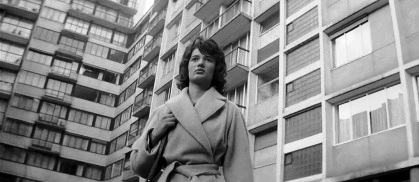
Truffaut, instead of following Charlie within for the moment of truth, instead tracks the glum-faced violinist who was auditioning before him as she leaves Schmeel’s apartment. The sounds of Charlie’s thunderous romantic strains momentarily make her pause, and continue to resound on the soundtrack as she leaves the building and heads out into the streets, presumably, to a life of anonymity, whilst Charlie has been anointed, with the suggestion, ever so ethereal, that something is wrong. The hints of machinating fate Truffaut offers in this disorientating interlude soon takes shape but offers in its moment an islet of mysterious beauty that suggests another level to Charlie’s journey, the power of music, celebrated again by Truffaut in parentheses with his film. Truffaut returns to the musical interlude motif late in the film, during Charlie and Léna’s flight from the law, shots of the car’s progress along misty highways and into snowy alpine hills set to a languorously romantic song about two lovers who signify their continuing ardour with signs like going bareheaded. Similarly dreamy is a bedroom sequence, as Charlie and Léna make love and sleep peacefully together, counterpointed in aching dissolves with the images of Edouard’s old concert posters on the walls – past, present, and future all in flux. The soft edges of such sequences stand in contrast with the violent filmic syntax elsewhere, as in the rush of shots depicting Edouard’s plunge back into his hotel room and out to the veranda only to see Therese dead far below on the pavement, a moment that communicates the suddenness and horror of such a loss in volubly immediate terms. Truffaut even displays outright contempt for standard movie grammar, as in the concluding moments when the criminal Saroyans and their nemeses flee in cars, Truffaut hacking up the action into summary shots, as if contemptuously farewelling these halfwits and bad seeds who leave human wreckage in their wake.

Truffaut’s admiration for Hitchcock, which he would later try to work out in more belaboured terms in his fascinating misfire The Bride Wore Black (1968), is first sighted here during Charlie’s fight with Plyne, drawing on Dial M For Murder (1953) as a desperate fight for life sees a blade sunk into a spine, in a moment charged with perverse intimacy. But Hitchcockian erotic overtones are swapped for the weird spectacle of apparent masculine bonhomie, as Plyne affects to embrace Charlie after their hot heads have cooled, only to then start throttling him, a spasm of sexual-nihilistic disappointment turning the bar owner deadly as Plyne grunts out his fury for Charlie despoiling his idealised, virginal version of Léna. Earlier on Charlie had given Plyne a sympathetic ear when he confessed his crush on the waitress, revealed in his gruff pathos as he readily admitted he was far too ugly to charm her (“Perhaps it’s glands,” Charlie suggests; Plyne replies, “No, it’s my face.”). Charlie’s defensive killing is witnessed by neighbours, but he thinks he won’t be able to prove the circumstances, so Léna and Mammy hide him in the café cellar and then help him flee to his parents’ house in the Alps, which has already been taken over by Chico and Richard as their hideout. Meanwhile Ernest and Momo kidnap Fido, and force him to take them to the same place.

Aznavour’s lead performance was one Shoot the Piano Player’s great coups, bringing to the part surprising physical wit, his weirdly charming molten-plasticine face, and definite comfort with playing the instrument central to the character’s life and way of mediating the world. Although not at the time an experienced actor, he perfectly embodies Charlie’s bipolar nature and wears his sad-sack suppliance as assuredly as one of the trench coats he wears. Some of his best moments come during his first walk with Lena, counting off steps with his fingers behind his back as he tries to work up the courage to take her arm, before starting to suggest they get a drink together, only to find she’s already flitted off into the night. But the whole cast is excellent, particularly the uncanny trio of ladies around him, Mercier, Berger, and Dubois, each a study in a diverse types demarcating different classes and ways of looking at female archetypes. Mercier the black-haired gamine, Berger the classical cool, continental blonde, and Dubois the fresh-faced, brightly smiling urchin: Berger is particularly effective delivering Helene’s long, confessional monologue, prowling around the hotel room in an inescapable shot, pinioned like a butterfly in a collection. Mercier, who would later find great fame playing the cult heroine Angelique in French films, brings an insouciant delight to her role as a featherlight character happy to play bedmate to Charlie and part-time mother to Fido, but who hits the bottle out of guilt after the hoods snatch Fido from under her nose in a vignette of throwaway pathos.
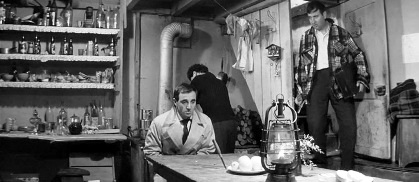
Dubois, who was Truffaut’s discovery for the film (her real name was Christine Herze), has her finest moments breezily handing Charlie the mission of giving her a better life, which Charlie seems to accept with his familiar deadpan stoicism, only for her then to state, with a show of lancing vulnerability as she farewells him to work, that the only thing she really asks of a man is to tell her when things are over. Later, when Lena drops him off at his parents’ mountain house, Charlie is stricken as he tries to work out how to cast her out of his life now that he seems to have been claimed by the family curse, Aznavour’s face calcified by the conflicting desires to cut himself off from her as he’s sure he’ll bring her doom, and the urge to not let her go, resolving with the unspoken wish, “I wish she’d let me finish drinking that bottle.” The drive into the mountains shifts the film’s gear into a more rarefied realm, charged with an ironically dissonant sense of romanticism and melancholia that cuts across the grain of madcap energy seen in the rest of the film, as Charlie settles down to wait out the night with cigarettes and weltschmerz as his brothers crow that their brother has finally joined them. The dawn brings good news, as Lena returns to tell Charlie he’s been vindicated by the witnesses and can return to the world. But it also brings the two hoods, with the canny Fido snatching a chance to give them the slip.

A gunfight between the two gangs breaks out, with Lena, sprinting through the snow to try and reach Charlie’s side, gunned down accidentally. In spite of Truffaut’s improvisatory shooting style, Shoot the Piano Player manages to coherently encompass its manifold impulses, starting off with shots of Chico running and building to the climactic moment when Lena dashes through the falling snow. The film is offered as an embodiment of perpetual motion until suddenly it doesn’t – the gun cracks, Lena falls, and slides down the snow-crusted hillside like a pathetic toboggan, coming to a halt in anaesthetising snowfall, the streetwise yet innocent young lady finding an unexpected fate worthy of some Thomas Hardy heroine. Charlie and Fido dash to find her, but recover only an ice-caked corpse, whilst the battling nitwits speed away to whatever end they deserve. As for Charlie, Truffaut reveals in his final, delicately poignant last shots, he returns to his former place behind the piano with fingers dabbing the keys robotically, playing with stone-faced detachment, hovering again in a place outside of life’s regular flow. Truffaut’s peculiar faith that cinema could be anything that he wanted it to be allowed him to dare offer a film so expansive and unruly in its sense of life and death and how the two sometimes overlap, affirming even in the midst of tragedy a romantic’s conviction that life without love is meaningless, be it human or artistic.
15th
03 -
2017
|
2 comments »
Director/Coscreenwriter: Marko Škop

By Marilyn Ferdinand
Most movies about alcoholics tend to put drunken behavior front and center, offering actors a golden opportunity to give the kind of dramatic performances that awarding organizations love (e.g., Oscar wins for Nicholas Cage in Leaving Las Vegas [1995] and Susan Hayward in I’ll Cry Tomorrow [1955], and Oscar nominations for Dudley Moore in Arthur [1981] and Lee Remick and Jack Lemmon in Days of Wine and Roses [1963]). I’ve generally felt that, whether in fiction or real life, people under the influence are the farthest thing from entertaining, but who they are is another matter. Thus, while the title character of Marko Škop’s feature debut, Eva Nová, is addicted to alcohol, her story is complicated, compelling, and deeply moving.

Emília Vášáryová plays Eva, a famous Soviet-era actress in her early 60s to whom we are introduced on the last day of her third trip to rehab. She gives a recitation as her farewell gift to the women in her therapy group, and one of them gives her a tiny plastic camel to remind her that she can go without a drink as long as a camel can go without water. She returns to her flat, goes to a cabinet where she stashed a bottle of vodka before her hospitalization, and dumps it down the sink, turning her head away so as not to catch the scent of liquor. It is a fragile time for Eva, and the emptiness of her apartment seems to weigh on her heavily.

The next day, she boards a train to the countryside to visit her son, Dodo (Milan Ondrík), who lives with his family and Eva’s sister, Manka (Žofia Martišová), in the house where the older women grew up. Dodo’s wife, Helena (Anikó Varga), is not happy to see Eva but invites her in for a cup of tea anyway. Eva’s grandson, Palko (Alexander Lukac), just looks down and refuses to speak with her, and she meets her seven-year-old granddaughter, Noemi (Michaela Melisová), for the first time. When Dodo and Manka return to the house, Dodo refuses to let her stay with them and deposits Eva, her suitcase, and the box of chocolates she brought as a gift on the street. She’s forced to stay at a cheap hotel. The next day, when she checks out, we see that she has eaten all the candy.

This detail of the empty candy box is one of many telling moments that director Škop and Vášáryová use to build an indelible portrait of a vain, weak, older woman whose hungers outstrip her ability to fulfill them. But Eva Nová does more than this—it interrogates the place of women in Slovakian society, and arguably, other societies, and how the ages-old bugaboo against actresses aging plays into Eva’s problems. Vášáryová herself is a legend of Slovak and Czech theatre, film, and television who has claimed the titles of Actress of the Century by the Slovak Journalists Syndicate, as well as First Lady of the Slovak Theatre. Škop strategically positions photos of a younger Vášáryová in Eva’s apartment and uses clips from her films; thus, the actress not only accesses her character’s struggles with alcohol and the damage she has caused to her personal relationships, but also draws on the challenges Vášáryová herself faced at one point in her career trying to continue to work in an industry that worships youth.

Škop has said that he got the idea for Eva Nová from interviewing French superstar Annie Giradot, who covered up her struggles with alcohol, depression, and disillusionment by acting a version of her screen persona for him. Vášáryová is in almost every scene, a true star turn for the actress playing a character 12 years younger than herself (Or is she? Eva may be lying about her age.). Škop’s shooting style is very simple, with straight-on shots of understated moments reminiscent of Chantal Akerman’s technique and close-ups that bring us into the space of these characters. The latter technique is especially important for Eva so that we can evaluate the relative truthfulness of her interpersonal interactions, an opportunity we realize we need when we watch her rehearse an apology to her family in the mirror before she turns up on their doorstep.

Škop doubles down on his mirror imaging when Eva encounters the much younger, pregnant wife of her long-time lover at an industry reception, both dressed in red, their repeated images in the bathroom mirrors subtly evoking the horrifying hall of mirrors in The Lady from Shanghai (1947). Her lover rejected her and her bastard son, and denied her the child he is now having with her replacement. By now, Eva has gotten drunk and abusive, and she is dragged out of the reception as the paparazzi snap the kinds of pictures that made her a pariah in what is the most dramatic scene in the film. Then the film reverts to its air of quiet despair. At home, Eva’s bra strap has crawled back onto her shoulder from its hiding place down the sleeve of her off-the-shoulder dress, another detail of her fight against her aging body.

Although Vášáryová is in nearly every frame of this picture, she does not suck air from her supporting cast. Ondrík is very effective as a man who is beyond bitter with his mother, but bullying to his breadwinner wife and his daughter, whom he trains to repeat that she loves him in an awkward, creepy scene. Martišová is matter-of-factly disgusted with her sister, telling her that she is still paying off the headstone for their mother and rejecting any help other than financial when Eva tries to ingratiate herself. Only Helena gives Eva a break, with Varga hinting at why her character may feel more kindly disposed toward her mother-in-law when Eva confirms that Palko must definitely be Dodo’s son.

Still, Vášáryová shows Eva to be a survivor doggedly determined to keep control of her life. She endures the comedown of working as a shelver in a grocery store and performing a soliloquy for a group of dementia patients at a nursing home. She hangs on to the house where Dodo and his family live after it becomes hers on Manka’s death, refusing to sign it over to Dodo and agree to disappear from his life. In the end, she finds a precarious solidarity with Helena in a final tableau that suggests that women may only have each other to lean on in the end.
Eva Nová screens Wednesday, March 15 at 6:30 p.m. at the Gene Siskel Film Center, 164 N. State St.
Previous coverage
: Master dance filmmaker Carlos Saura offers up another fascinating look at dance styles from Spain, this time, jota, a folksy, upbeat style from his native province of Aragón. (Spain)
Portrait of a Garden: This contemplative documentary shows a year in the life of a 400-year-old estate garden and a loving look at two master gardeners trying to pass on the wisdom of many years of working with plants, soil, and climate. (The Netherlands)
Tomorrow, After the War: A detailed look at wartime betrayals that threaten the tranquility of a small village when a Resistance fighter returns home and starts digging into a murder case. (Luxembourg/Belgium)
My Name Is Emily: A teenager coping with the death of her mother and separation from her mentally ill father manages to be both sincere and funny when she sets off with a would-be boyfriend to spring her father from the asylum. (Ireland)
10th
03 -
2017
|
2 comments »
Director/Screenwriter: Carlos Saura

By Marilyn Ferdinand
Eighty-four-year-old Carlos Saura has been making movies since 1956, with 47 directing credits to his name, including his masterpiece on childhood trauma in fascist Spain (1976). Nonetheless, Saura lamented during a personal appearance he made some years ago at the Gene Siskel Film Center that the only films he’s known for seem to be his dance films.

I understand how this can be frustrating to a consummate film artist, but in fact, Saura originally aspired to be a dancer, and his own enduring love of the form has resulted in a significant number of the best dance films on the planet, from his incredible flamenco trilogy Blood Wedding (1981)/Carmen (1983)/El amor brujo (1986) to his dance-specific documentaries, including Flamenco (1995), Tango (1998), and Fados (2007). Jota joins the dance documentary group, which are filmed dance recitals created on a soundstage that simulate a live performance in a theatre for the movie-going audience. In choosing to train his gaze on jota, Saura has chosen a dance form close to his heart and roots, a rhythmic, lively dance from his native province of Aragón in the northeastern part of Spain.

The opening title card informs us that the original dance incorporated Arab and Asian elements, and exerted a strong influence on flamenco. Of course, like all art forms, as jota traveled to other parts of the world, it changed, acquiring embellishments, as well as different pacings and stylings. Very cleverly, Saura opens the film with a youth dance class conducted by jota star Miguel Ángel Berna so that we can learn the basic steps that comprise jota in its purest form. After this lesson, it becomes relatively easy to recognize the characteristic heel-toe combination and low kicks that comprise the basic steps of jota in the performances to come. Incorporated into these performances, of course, is the characteristic music that is also considered jota, including in classical pieces by Luigi Boccherini and Pablo Sarasate.


Saura takes a historical look at jota, beginning with a bride’s song from Aragón’s Ansó Valley. The dancers are all in traditional dress from the region and dance a simple, circular jota as they honor the bride. Saura also introduces the music of jota with an Aragónese cantada performed by singers Nacho del Rio and Beatriz Bernad, and accompanied by Miguel Ángel Tapia on piano. Their loud, lusty singing, what Saura has called the “barbarous voices” signaling the independence of Aragónese women, takes place in front of a wall of historical posters and pictures, including one for the film Goyescas (1942) starring Imperio Argentina, who will be shown later in historical footage singing and dancing jota.

There are strikingly dramatic sequences in the film, for example, La Tarántula, which, unlike the Italian tarantella, builds slowly with a dancer laying on the floor covered in a white gauze slowly rising as a group of women dance around her and, finally, spreading her diaphanous, winglike “body” as they all fall to the ground. In another, Berna, dressed all in black, postures solo in front of a four-way mirror. The most affecting of the sequences shows a boy sitting in a classroom look up at rear-projection screens behind his teacher’s desk and watch archival footage of the Spanish Civil War—the battles, overhead bombers, frightened citizens running for cover, and dead children. Not only is Saura going through the history of jota and of Aragón, but also his own history.

Nonetheless, most of the film is a joyous celebration of dance and community, with the requisite number of flamenco jotas. My favorite sequence was the jota from Galicia, which gathered musicians playing everything from the to thumb cymbals and featured Carlos Núñez on the Scottish bagpipes and two dancers, one of whom leaped into the circle to dance barefoot, snapping his fingers because he lacked castanets.

The film ends with what I can only call the lounge lizard version of jota, called modern, and a fiesta of people of all ages dancing together to the sounds of the professional singers and musicians, while gigantic, papier-mâché figures circulate among them. Despite being confined to the soundstage, Saura finds visually varied ways to increase audience interest, with mirrors, overhead shots, projection, impressionistic painting, and color screens backing the dancers. This film, called J: Beyond Flamenco in English presumably to capitalize on the familiarity and popularity of flamenco, preserves the more folksy jota form and entertains us with it in all its many forms.
J: Beyond Flamenco screens Saturday, March 11 at 6:30 p.m. and Thursday, March 16 at 8:30 p.m. at the Gene Siskel Film Center, 164 N. State St.
Previous coverage
Portrait of a Garden: This contemplative documentary shows a year in the life of a 400-year-old estate garden and a loving look at two master gardeners trying to pass on the wisdom of many years of working with plants, soil, and climate. (The Netherlands)
Tomorrow, After the War: A detailed look at wartime betrayals that threaten the tranquility of a small village when a Resistance fighter returns home and starts digging into a murder case. (Luxembourg/Belgium)
My Name Is Emily: A teenager coping with the death of her mother and separation from her mentally ill father manages to be both sincere and funny when she sets off with a would-be boyfriend to spring her father from the asylum. (Ireland)
8th
03 -
2017
|
no comment »
Director: Rosie Stapel

By Marilyn Ferdinand
There are few things I can think of that are as restful and exhausting, rewarding and frustrating, and the very definition of partnership as cultivating a garden. Like the fabled Garden of Eden, human beings can find peace and contentment surrounded by nature, but the minute they start thinking they are the masters of their surroundings, the garden will chew them up and spit them out like pollen from an blossom. Gardeners must be patient, humble, and vigilant to partner successfully with their plants, soil, and climate for bountiful harvests and blooms.
Rosie Stapel seems to have cooked up the idea for Portrait of a Garden, her directorial debut, with Daan van der Have, one of the two featured gardeners in this lovely documentary, and the location choice is more than appropriate. There aren’t many places on earth more plant-mad than the Netherlands. Just as you’ll rarely see a Parisian going home for dinner without a baguette or two in hand, the Dutch provide a brisk business for their ubiquitous city and village flower markets.

The Dutch estate garden featured in Portrait of a Garden was founded in 1630, and has seen its ups and downs in the intervening 400 years. Van der Have and pruning master Jan Freriks had a good deal of restoration work to do when they dug their hands into the soil some 30 years ago. The 85-year-old Freriks is something of a rock star in the horticultural world; his books are known and loved by the estate staff, tree nursery owner and gardening enthusiasts they meet during the film. Freriks is handing down his knowledge to Van der Have, who is no spring chicken himself, in hopes that his skills built over a lifetime of observation, experimentation, and practice won’t die with him.

Stapel takes us through one year in the life of the garden and its tenders, beginning in fall. We first meet Van der Have and Freriks as they work on a wall of espaliers, energetically applying their pruning shears to maintain the flat profile of the trees against their natural inclination to branch and spread. We’ll see them throughout the film sawing away at tree limbs and twisting the branches of pear trees over the lengthy arch of an arbor they have been working to create for some years. They’ll reminisce about Van der Have tempting Freriks out of retirement with the chance to work on an estate garden where heirloom varieties of edible and inedible plants are grown and survivors from the earliest days of the garden still leaf and bloom.

It’s fascinating to watch the various techniques the two men and the other garden staff use in their work. White caterpillers of metal hoops and polyester tissue protect the tomato beds from birds and other animals. A multipronged hand hoe is raked across a bed to create perfectly spaced rows for planting. Thin cotton strings are pulled to hoist individual bean vines up to hang from a crosshatching of string above them. Bales of hay are spread by hand to keep beds warm during the cold winter and early spring. Stapel films the work straightforwardly, with slow, swooping boom shots and slower time lapse photography than audiences are used to seeing. The latter technique works quite well to preserve the relaxation the garden engenders in the viewer, even as the people on screen work hard at the many tasks they have to keep up with daily. Her ingenious shots are complemented by the meditative solo lute of Jozef van Wissen, who scored this film as well as Jim Jarmusch’s Only Lovers Left Alive (2013).

At harvest time, Stapel’s experience in film art direction and production design comes to the forefront. She shows gardeners harvesting armfuls of luscious-looking rhubarb for the chefs who work in the estate restaurant. Then it’s a veritable card deck of fruit and vegetable varietals, shot overhead and labeled like still lifes at the , showing off the richness of our floral heritage. Freriks sees agriculture and gastronomy becoming less diverse because of industrial farming and the decline of growers who use cross-breeding techniques to develop new hybrids that can strengthen a plant line; the estate itself uses only organic pest control such as crop rotation, soil replacement, nontoxic pesticides, and visual inspection to protect the plants against damage or destruction.

Van der Have dreams of having a banquet under the pear arbor when the branches finally meet and the fruit hangs heavy above him. Freriks, however, hates that kind of thing. He prefers his plants and knowing that the work he started long ago as a steward of the earth will far outlast him. Rosie Stapel has ensured that the man himself and some of his words of wisdom also will be accessible for a long time to come.
Portrait of a Garden screens Friday, March 10 at 2 p.m. and Sunday, March 12 at 3 p.m. at the Gene Siskel Film Center, 164 N. State St.
Previous coverage
Tomorrow, After the War: A detailed look at wartime betrayals that threaten the tranquility of a small village when a Resistance fighter returns home and starts digging into a murder case. (Luxembourg/Belgium)
My Name Is Emily: A teenager coping with the death of her mother and separation from her mentally ill father manages to be both sincere and funny when she sets off with a would-be boyfriend to spring her father from the asylum. (Ireland)
6th
03 -
2017
|
no comment »
Director/Coscreenwriter: Christophe Wagner

By Marilyn Ferdinand
Most countries in Europe suffered a lingering malaise after World War II that extended far beyond rebuilding physical, cultural, economic, and governmental structures. Most difficult to navigate was rebuilding trust and national unity. Human nature being what it is, feelings of loss, betrayal, and cruelty burn in the breast with something akin to an eternal flame if not confronted openly. In tiny Luxembourg, a landlocked country sandwiched between France and Germany that owes much of its national culture to both those neighbors, a return to normalcy often meant hiding from wartime crimes. In Tomorrow, After the War, director and coscreenwriter Christophe Wagner attempts to lance the wounds of the past.

A thin layer of snow covers the open fields through which newly freed Resistance fighter Jules Ternes (Luc Schlitz) trudges to his small village following the defeat of Germany and liberation of the lands they occupied, including Luxembourg. He tries the door of his family home, apparently as empty as the streets nearby. Suddenly, his sister Mathilde (Eugenie Anselin) comes around the corner and calls his name. They embrace, and she informs him that their father (Jean-Paul Maes) has not returned from the labor camp to which he was sent as punishment for Jules joining the Resistance. Jules gets more unwelcome news when Armand (Jules Werner), a shady functionary of the village government, comes in and kisses Mathilde, his fiancée.

Jules tries to pick up his life as it was before the war. When he learns his old boss, a Jew, was deported to a concentration camp, he hires on as an auxiliary police officer. He also resumes his romance with Léonie (Elsa Rauchs), who works for a German family who are running a successful farm confiscated during the war by the Nazis. She says they were not Nazis and lent money and protection when possible to locals in need. Of course, the family’s prosperity and nationality now mark them as targets by Luxembourgers wanting payback against Germans and collaborators. Jules, besotted with Léonie, is caught in the middle, a position that becomes even more uncomfortable when the family is found murdered. His probing into the crime, motivated by strong, personal feelings, turns up information that conflicts with the official story, jeopardizing futures throughout the village.

Tomorrow, After the War is fairly derivative of the better detective shows one might find on TV, with its accumulation of clues and lies to be uncovered, and a few sex scenes that no film seems able to do without these days. Nonetheless, Jules is no standard-issue moody detective. He was an ordinary man before the war who became a cop afterward—and not even a full-time cop at that—because there were no other jobs to be had and the chief of police (André Jung) put him on as a favor to Jules’ father, with whom he fought during World War I.

The very ordinariness of Jules gives the film a foundation to look realistically at the compromises that have to be made when life is not proceeding as usual, a lesson that should have ramifications for those of us who haven’t experienced a whole world in upheaval—yet. Almost all of the characters in this film bear some degree of guilt for their actions or complicity in the world order that overtook them during the war years. With one exception, none of them appear to be guilty of much more than wanting to live, however painful their circumstances have been, and none of them is headed for sainthood.

To underscore the real choices that have to be made in extremis, the film depicts violence quickly and effectively. For example, Jules’ comrade is shot in the head for refusing to give up the location of his Resistance cell to their Nazi captors, a graphic horror that terrorizes Jules. His father, semi-crippled in body and mind, is a verbally abusive drunk whose only “crime” was surviving the Battle of the Somme. The murder victims are shown in economical, but vivid detail with shotgun wounds and buzzing flies destroying the pastoral in which they lived.

The cinematography is exceptionally good, with breathtaking landscape shots that add to the moodiness of the story and fine attention to detail, for example, placing an abandoned German tank in exactly the same position as one shown in a still photo of the period. I liked how the opening scene in the snow seems to suggest a world purified after so much bloodshed, interrupted by the figure of a dead horse lying in the field as Jules passes by. As Jules seems to be putting his life back together, a lovely scene of him and Léonie cycling in a bath of sunlight offers them and us a reprieve from the background gloom in which their rekindled love began.

For me, the pièce de résistance is Mathilde and Armand’s wedding. All of the conspirators are gathered to celebrate a festive occasion at last, but Jules, too aware of the thin veneer of civilization all around him, has a final confrontation with his father. Heroism is the ideal, but neither his father nor Jules can live up to what the world expects of them. In the homely scene of a village wedding, we realize our real aspirations are none too lofty. In the end, if we grab for something more ambitious and ideological in dangerous times, we might very well end up paying the ultimate price.
Tomorrow, After the War screens Saturday, March 11 at 4 p.m. and Tuesday, March 14 at 7:45 p.m. at the Gene Siskel Film Center, 164 N. State St.
Previous coverage
My Name Is Emily: This film about a teenager coping with the death of her mother and separation from her mentally ill father manages to be both sincere and funny, as she sets off with a would-be boyfriend to spring her father from the asylum. (Ireland)
« previous page
