16th
10 -
2013
|
2 comments »
Producer/Director/Writer: Damon Vignale
By Marilyn Ferdinand
On a break from the festival, I started watching a classic Italian film on TCM, Pier Paolo Pasolini’s directorial debut, Accattone (1961). This film is highly regarded and bears all the visual stamps of its singular director, but as it progressed, I got more and more agitated. It seems that a fairly normal activity for the Roman men the film depicts is to hire a prostitute, have their way with her, and then beat her up. One such incident involves pimp Accattone’s whore, and we are meant to sympathize with the financial hardships he suffers when she is sent to prison.
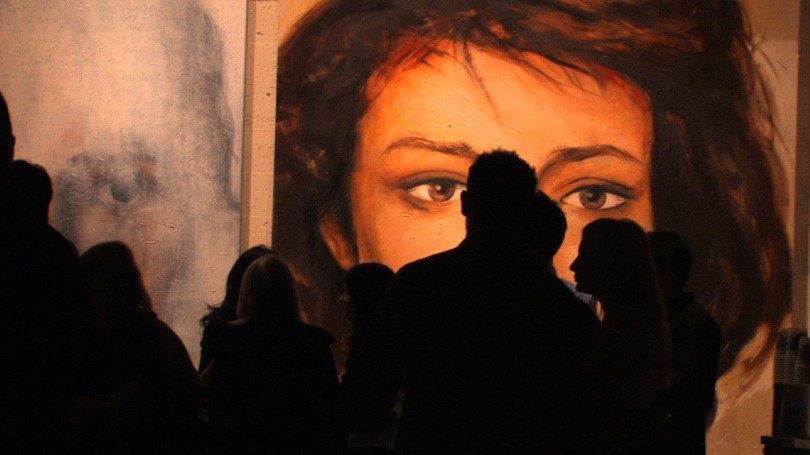
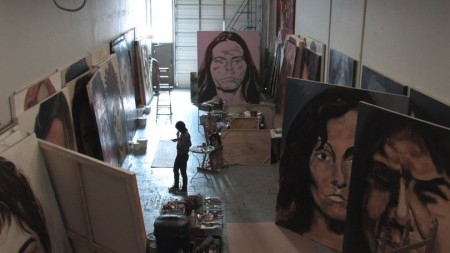
Coming on the heels of viewing The Exhibition, I just couldn’t watch the violently entitled, self-pitying men in Accattone without strong feelings of revulsion. The Exhibition is a 360-degree look at the broad range of issues surrounding a Vancouver-area farmer who admitted to killing 49 women, the vast majority of them First Nation prostitutes, during the 1990s and 2000s, and a successful artist named Pamela Masik who undertook a project to paint huge portraits of all of the victims in what she calls “The Forgotten” series. Director Damon Vignale told the audience at the screening I attended that he was not on any particular mission when he decided to make this film, his first documentary; rather, the impetus came after his strong reaction to seeing one of Masik’s canvases. That’s not hard to imagine. Even when viewed on a movie screen without the immediacy of standing below the towering images, the power of the faces, which Masik may have left intact or slashed, reassembled, or defaced, is overwhelming.
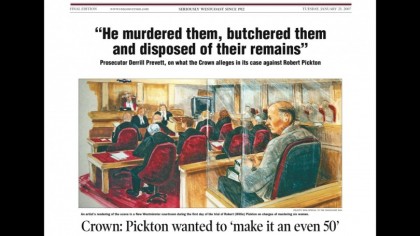
There are many ways to take in the story Vignale has to tell. He covers the police incompetence and frank lack of interest in exploring a lead to the killer, Robert Pinkton, which allowed his killing spree to continue and cost 16 more lives. He interviews surviving family members and friends to burrow into the stories of several of the girls and understand the grief and anger they feel. We see, yet again, that violence against women continues as a universal problem for which there are no easy answers, and that prostitutes, particularly from minority groups, are often considered expendable. He reveals various aspects of Masik’s life: a single mother to an eight-year-old boy, head of an art program for women at risk, and creator of a varied body of art, from beautiful canvases that resemble Monet’s water lilies to others that are too sexual for her gallery to show.
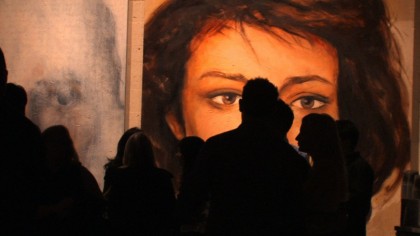
For me, The Exhibition offers another exposition of an issue I find an eternally fascinating conundrum: the line between expression and exploitation. Masik has poured $150,000 of her own money into the creation of “The Forgotten,” and is emotionally connected to these women because of her own history of abuse. Her portraits are not memorials, but rather seek to confront viewers with the violence these women experienced in their own lives and especially in their deaths. She says she wants to reverse the stare, to make the observer the observed in a kind of accusation for their lack of concern for the fates of women on the margins of society. Masik is also aware that she is inflicting her own injuries on the images of these women, slashing the canvases, sewing some of the wounds and leaving others dripping with red paint, cutting out faces and reassembling them in some imitation of the butchery they experienced at Pinkton’s hands. At some level, Masik understands that her artistic impulses are coming from a dark place that may not just wake up a blasé gallery hound, but also somewhat cruelly stir the emotions of those more closely involved with the victims.
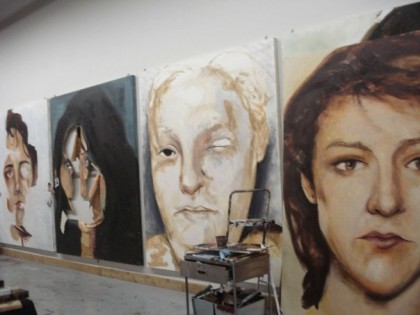
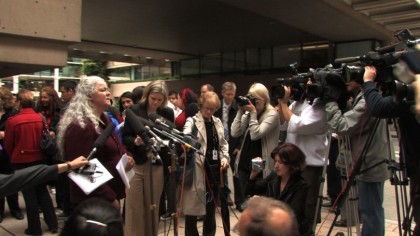
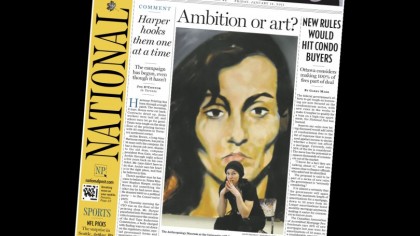
The Museum of Anthropology at the University of British Columbia planned to exhibit “The Forgotten,” but protests from the , victims’ families, and First Nation representatives caused the museum to cancel the show. We sympathize with Masik, who seems to have the best of intentions in trying to raise people out of their torpor with regard to violence against women, but the issue isn’t just one of the perceived dishonor to the memory of these particular women. Image appropriation is more than a superstition or a copyright question—it is an integral part of creating social attitudes that have lasting consequences. Feminists have long objected to the objectification of women and the dictatorial way in which women are pushed to conform to each generation’s feminine ideal. Images of Native Americans, in particular, have been used as sports mascots and advertising logos, and Vignale includes information about how European settlers set about the systematic destruction of Native American culture and identity. It may seem a bit absurd to outsiders that anyone would complain that Masik didn’t show these women looking attractive or dignified, but given the degradation they suffered in life, perhaps Masik’s personal impulse to expose that ugliness, memorialize THAT, is indulgent and insensitive. Perhaps it creates another image of prostitutes and Native Americans that plays into a cultural stereotype, reinforcement rather than redress.
Artists are well-known cannibals, chewing up and spitting out the world around them in acts of creation that seldom take their “raw material” into consideration. The idea that the culturally sophisticated have the right to use and consume whatever material they want, whether the less sophisticated understand or approve of it, has been examined here before in my review of The True Meaning of Pictures: Shelby Lee Adams’ Appalachia. Masik says at the top of the film that she was naive about the reception the show would get. I believe her, but at the same time, she is self-aware enough to know that she uses her art to work out her personal issues as well as to make statements and a very good living. Is what she did exploitation? I don’t have the answer, but I know we should all keep asking the question.
The Exhibition has no more screenings. It will be broadcast nationally in Canada in the coming months. www.chicagofilmfestival.com
Previous coverage
Melaza: Economic uncertainty causes a young couple in love to make ingenious and risky arrangements to keep afloat in this lovely, surprisingly funny slice of life under communism. (Cuba)
H4: Shakespeare’s Henry IV Parts I and II are given a contemporary spin by this spirited African-American production starring the great Harry Lennix as the title character. (USA)
: The final breakdown of an unhappy marriage between an artist and her architect husband is chronicled in painful detail. (Turkey/The Netherlands/Germany)
: A biopic about the renowned Romany-Polish poet Bronisława Wajs, aka Papusza, is rendered in stunning images, with a strong emphasis on Romy life during the 20th century. (Poland)
: The Belgian criminal justice system is put on trial when a man who was denied justice for his murdered wife takes the law into his own hands and dares a jury to convict him of premeditated murder. (Belgium)
: This film explores the choice a war photographer is forced to make when her sexist husband threatens to leave her and take their two children with him if she doesn’t stop putting herself in harm’s way. (Norway)
: Renowned Polish director Andrzej Wajda offers an informative and exhilarating look at the life of Solidarity founder, former Polish president, and Nobel Peace Prize winner Lech Wałęsa. (Poland)
: A young man who has lost his friends in a car accident comes to terms with his grief through an encounter with a blind collector of rare prints. (Brazil)
: A lake in summer is the setting for a close exploration of the mating rituals of gay cruisers and the fatal attraction that envelopes one of the regulars to the lake. (France)
19th
05 -
2009
|
7 comments »
Director: Cindy Sherman
By Marilyn Ferdinand
A long time ago, January 15, 2006, to be exact, I posted a short essay on Cindy Sherman, a photographer whose work I greatly admire. At the time, I mentioned that I had ordered Office Killer, her directorial debut (actually, her only film as a director to date), and promised to review it. Reminded of this promise unfulfilled by viewing an exhibit of Gordon Parks’ photos and making plans to see a film he directed, I felt moved to rewatch Office Killer and carry through my original intention. Office Killer, a darkly humorous horror movie, isn’t the greatest thing out there, but certainly for fans of Sherman’s photography, the film is a richly rewarding experience.
The staff of Constant Consumer magazine are about to have a very bad day. Editor-in-chief Virginia Wingate (Barbara Sukova) is talking to bean counter Norah Reed (Jeanne Tripplehorn) about the massive layoffs Reed is recommending to save the troubled publication. A verbal skirmish during which Reed paints herself heroic for “saving your ass” and Wingate retorts that Reed knows “shit” about editing a magazine, ends with Wingate delegating the layoffs to this self-styled Joan of Arc.
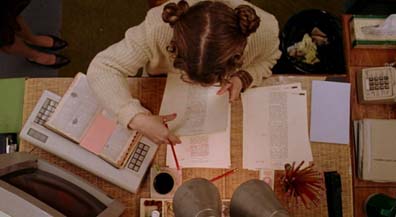
Norah makes her way to the copyediting department and hands out pink-slip-filled envelopes informing staff that they will be working part time from now on. “At least no one has lost their jobs yet,” says fatherly senior copy editor Mr. Landau (Mike Hodge). “Let’s get back to work.” Mousy copy editor Dorine Douglas (Carol Kane), her head bent low over the galley proofs she’s marking up, leaves her envelope unopened. When she finally gets around to reading its contents, she is shaking a replacement canister of dry ink for the photocopier. Her shakes get so vigorous, she spews the ink all over herself. Sympathetic Norah runs to her aid.
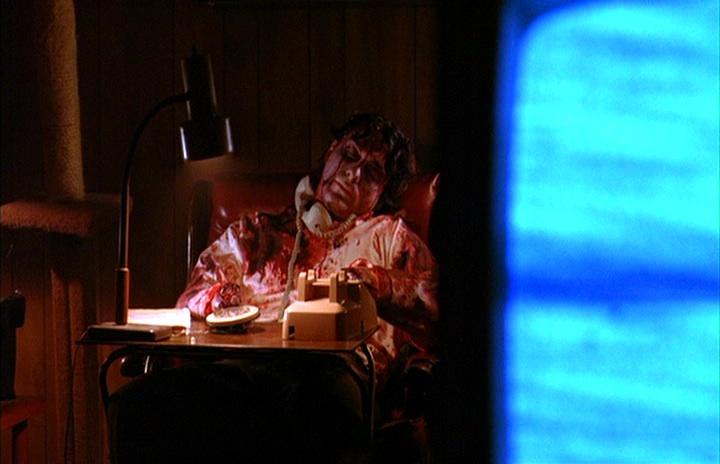
Star writer Gary Michaels (David Thornton), a slimy, imperious jerk, and his bit on the side, Jill Poole (Molly Ringwald), work together and haven’t met a deadline in weeks. Because of this, Dorine is assigned to work with him on deadline night to see that he finishes. Dorine’s new computer, installed by Norah’s boyfriend Daniel Birch (Michael Imperioli), gives her the error message from hell and starts beeping as though counting down a missile launch. She retrieves Gary from his office, where he tries to feel her up and cuss her out at the same time. He shuts off the power so that he can work on the electrical connection and calls Dorine to hold a flashlight for him. Instead, he shines the light in her face, blinding her, and causing her to back up into the fuse box, restoring the electricity. Gary is fried. Dorine picks up the phone to call 911, but then doesn’t speak to the responder. She carts Gary down to her car on a mail trolley, stuffs him in her trunk, takes him to the home she shares with her invalid mother (Alice Drummond), and sits him down in the rec room. The combination of having her job threatened, this accidental death, and a mind warped by a sexually abusive father (Eric Bogosian) send Dorine on a killing rampage to populate her home with additional “playmates.”
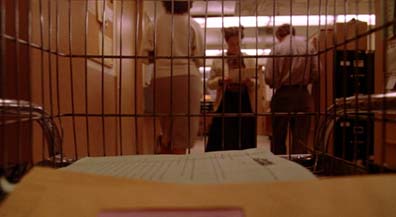
Office Killer takes the familiar viewpoint that offices are prisons that recreate the traumatic pecking order most people experience in their adolescence. Sherman emphasizes the cell-block quality by including medium shots of window banks in buildings with shaft-like courtyards, the human inhabitants of the office so small it’s hard to see them at all. She also opts for low angles that put her characters behind the “bars” of wire in-boxes, between walls, in door frames. None of this is particularly new or revolutionary: just take a look at The Ipcress File, and you’ll see ingenious framing to your heart’s content.
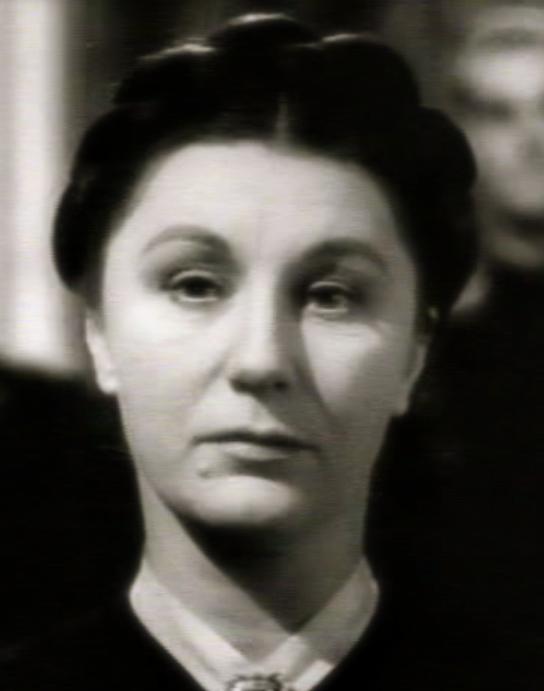
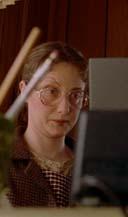
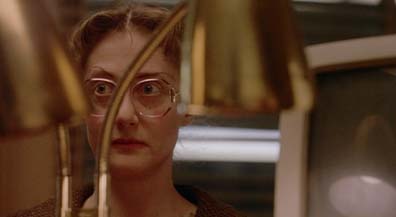
What Sherman adds to the visual mix is her brand of tabloid/tableau, particularly in the way she captures Dorine’s face. Dorine’s eyebrows are deliberately drawn in a high, thin, arching line to emphasize a wild-eyed derangement that Carol Kane’s naturally large, round eyes accentuate. Dorine is the quintessential sexual hysteric who goes over the edge, the perfect Sherman cinematic type. Compare Dorine with Judith Anderson’s Mrs. Danvers in Rebecca, and you’ll recognize the type Sherman is playing with.

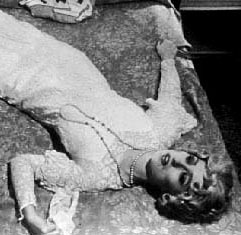
There are many other shots that scream Sherman to me. Take a look at the dead body and a still from Sherman’s series above; she loved to shoot reclining forms looking rather lost. She also creates a low-angle, almost fisheye look at scenes from Dorine’s past, again skewing the normal idyll of a 1950s childhood with odd angles and looks that give the entire film the kitschy menace so characteristic of her photography.
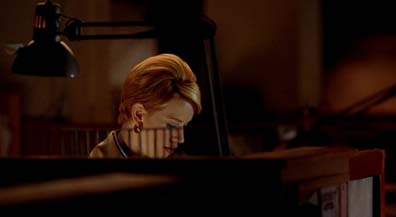
Dorine’s killings are brutal and somewhat random. We are sure she will go after Jill, particularly after Jill bounces a wadded-up piece of paper off her head and screams insults at her. Will it be when Jill, having just been fired because she left Dorine alone to finish a story the vanished Gary never filed, boards an elevator to the covered garage below? Jill, as the only person who recognizes Dorine as a dangerous looney, manages to keep her guard up. Others are taken just because Dorine wants them to be part of her family, though she seeks revenge in the end against the woman who cut her job in half. Sherman revels in gore in a way that would make Stuart Gordon more than proud.
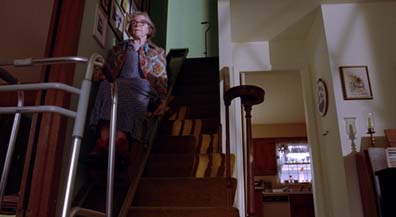
Carol Kane gives a memorable comic performance with just the right amount of menace to make this a fairly proper horror film. She hates taking care of her invalid mother, unplugging the chair lift so that her mother can’t come downstairs to annoy her. When she arrives home one night and finds her mother dead, she goes into a grief-stricken panic over her mother’s body and then switches on a dime, intoning malevolently that she hopes her mother and father will be very happy dancing together in hell. It’s a hilarious moment among many that mine her vocal and facial dexterity.
Another great comic performance comes from Barbara Sukova, who twists her genuine German accent into a parody of Madeleine Kahn’s parody accent in Blazing Saddles. Michael Imperioli is a believably likeable guy who takes the hero role, and Ringwald is perfect as a bitchy, ambitious writer. Her scenes with Kane are among the best in the film.
Office Killer is just a little too funny to be truly menacing, and the jabs at office culture were pretty careworn even in 1997, when the film came out. But Sherman’s visual compositions and some highly entertaining performances and death scenes make this film one worth checking out.
8th
02 -
2006
|
4 comments »
Director: Sean Penn
By Marilyn Ferdinand
Failure is a part of life—a painful part, to be sure, but usually not fatal. Sometimes it comes from overreaching our abilities, sometimes from making promises we can’t keep. But what if our failure is an offense against God? Does that kind of failure inflict a mortal wound, the literal or proverbial bolt of lightning sent to strike us down at this ultimate offense? That is a question that is central to Sean Penn’s fascinating third film in the director’s chair—an actor’s paradise and an audience’s troubling fever dream.
When we first meet Jerry Black (Jack Nicholson), he is mumbling and stumbling about a dusty gas station, his scabbed and weathered face turned upward. Crows are crossing the placid sky and slowly merge with his face. Next we see a fish emerging from a hole in the ice and a hand fumbling for a bottle of Glenfiddich in the supports of the tent placed over the hole. Then we see an SUV drive into a city—Reno, NV—and Black emerge from it with his catch in a cooler and pass through the doors of the Reno Police Department building and into his office in the homicide division. His long-time secretary tells him she has already unplugged his refrigerator and packed everything but his pictures, and then begins to rattle off his appointments for his final day at work, oblivious to the fact that he has just recited them out loud to her. There will be a retirement party for him at the Luau. Jerry looks out his window and down at the sidewalk far below. An old person in a walker is being guided by an aide. It unsettles him.
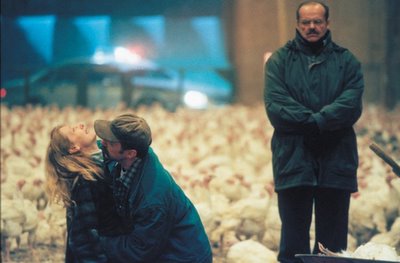
At the party, Jerry looks dizzy and disoriented among the colored lights and glowing tiki torches. As he is delivering a farewell speech, word comes of a murder—a young girl has been found in the woods with her throat brutally slashed. Jerry decides he wants to go out on the job one more time. The victim’s parents are removing a dead turkey from their vast flock when Jerry shows up and delivers the news. Mrs. Larsen (Patricia Clarkson), a religious woman, asks Jerry to swear on the cross her daughter made that he will find her killer or risk his eternal salvation. A very reluctant Jerry gives her his word that he will.
The Reno police think they have the killer, a retarded Indian named Toby (Benecio del Toro). Jerry isn’t convinced, even after Toby confesses and commits suicide by grabbing an officer’s gun and shooting himself. Although retired, Jerry starts investigating and sets up an elaborate sting operation that entails him using as bait the little girl of a barmaid (Robin Wright Penn) who has come to him for protection against her abusive ex-husband and ended up moving in with him at the gas station he has purchased. One day, the little girl gives him the news he has been waiting for for well over a year—she has been talking with a man who calls himself The Wizard and has arranged to meet him in the park the next day.
Penn populates his film with small, jewel-like cameos from the likes of Helen Mirren, Lois Smith, Harry Dean Stanton, Mickey Rourke, and Sam Shepard. Their contributions give heft to the proceedings without overwhelming it. Penn was most in danger by casting Nicholson as the lead. Would we have another raving lunatic performance from the king of the temper tantrum? Against all expectations, Nicholson plays Jerry with almost too much subtlety. Descriptions of him being a drunk and crazy don’t ring true, but we have the benefit of seeing that his hunches could be right and that the pledge he has made is a very heavy one for him, one that could cause him to betray the trust of a mother and child to catch a serial killer. It matters not whether we in the audience believe in God; what is important is that Jerry, as a newly retired person who dealt with death every working day of his life, sees the shadow of his own death nearing. And as they say, there are no atheists in foxholes.
This film, shot by Chris Menges, is absolutely gorgeous. The snow-covered mountains of Nevada and beautiful mountain lakes could make one believe in a divine presence all by themselves. Penn stacks the deck by populating the small town Jerry adopts as home with religious folk whose faith impresses Jerry and us as being sincere. Penn also chooses a lot of bird’s eye shots to suggest a heavenly presence who is watching the proceedings. There is a whiff of a Greek tragedy about this film, with Jerry’s hubris in making such a grim pledge receiving its just punishment.
The Pledge is not an easy film to watch, and it’s not a happy one. But it does have an interesting morality tale to tell and cautions all of us that sometimes failure is simply not an option. l