25th
02 -
2009
|
8 comments »
Director: Laurent Cantet

By Marilyn Ferdinand
Laurent Cantet doesn’t make a lot of films, but when he does, everyone should sit up and take notice. The only one of his four feature films I saw before The Class was Time Out (L’Emploi du temps, 2001). Loosely based on The Adversary (L’Adversaire), the gripping, true-crime book about , this absolutely brilliant film paints a mournful picture of a confused white-collar worker who lies and runs financial cons rather than admit to his family the shameful truth that he was fired. The Class, the first French film in 21 years to win the Palme d’Or at the Cannes Film Festival, is an equally enthralling film that deals in many ways with the same themes as Time Out. François Matin (François Bégaudeau, author of the book on which the film is based) is a middle-school French teacher who lies to himself and others about what kind of system he is part of to keep the house of cards that is an inner-city school from crashing down.
The film begins at the start of the school year with the school staff introducing themselves to each other by name, subject taught, and years of service at the school. One of the more experienced teachers goes over a new teacher’s class list, making comments like “Nice … Nice … Not nice … Nice” and so forth. From the very beginning, newcomers to the school—including us—are indoctrinated to label students and accept teachers’ perceptions. The rest of the film will be spent largely in François’ classroom, where his attempts to motivate and discipline his classroom will both succeed promisingly and fail miserably.

On the first day of class, François totals up how many minutes of the one-hour class are wasted—five minutes standing in line to get into the class, five minutes to sit down and pull out class materials, five minutes to settle down—and tells the class if they can’t get down to business quickly, they will be far behind other middle schools in Paris. Esméralda (Esméralda Ouertani) says the schools lie—classes aren’t really an hour long. François admits she’s right, that the classes are 55 minutes long. This is only one of the challenges, both large and petty, François will have to negotiate.

François’ school has a diverse student body, with students from former French colonies, such as Mali, Morocco, and St. Barts, mixing with other immigrant and white French students. World Cup loyalties have students participating in a classroom debate argue heatedly about their respective countries’ teams. A goth student named Arthur (Arthur Fogel) defends his look as others jeer, and François challenges his statement of individuality by saying that millions dress the same way as Arthur does.

François is not so sanguine about being called on his hair-splitting, however. During a staff meeting, the two student representatives giggle and talk without apparently listening to the comments of staff on the grades and recommendations for each student. They weren’t nearly as unattentive as the adults imagined, however; Esméralda has informed Souleymane (Franck Keïta), a chronically unprepared Malian jokester that François called him “limited.” François, angered at having Souleymane learn what he said, tells the girls that they behaved like skanks in the meeting. François tries to parse the difference between “being skanks” and “behaving like skanks” to an outraged class whose b.s. meter is in the red zone. Souleymane rises to leave class, hurt by François’ remark and angered at how unreasonable he is being with the girls. François tells him he can’t just leave class and tries to stop him; in the process, Souleymane’s backpack strikes Esméralda’s friend Khoumba (Rachel Régulier) and opens up a cut above her eye. François feels he has no choice but to hold an administrative hearing that 12 times out of 12 has resulted in the expulsion of a student, even though Souleymane’s friends say his father will send him back to Mali.
Souleymane’s far from the only student on a bubble—Chinese student Wei, a good student who predictably excels in math and science, may be deported along with his undocumented mother. Teachers are prepared to testify at her deportation hearing, but the same courtesy is not extended to Souleymane in his “deportation” hearing—as one teacher puts it, Souleymane’s lack of preparedness in class means, “he’s already left us.”

Teaching is not perceived to be an easy job. Sometimes teachers unlock the doors of interest in relatively indifferent students, but the system is set up not only to teach but to socialize. Multicultural student bodies complicate the development of an orderly society. François isn’t as hidebound as some of his more hardline colleagues, but when push literally comes to shove, François finds that his own cultural indoctrination goes deeper than he thought. He won’t abide insolence, but he fails to see how his own approach often fails to reach students. He is bewildered when Khoumba refuses to read aloud at his request, believing he has the right to make her do as he says, and at the letter she leaves in his locker that reveals her feelings that he is out to get her. Another student sits quietly during the whole film, looking sad and lost. She talks to François near the end of the term and says she hasn’t understood anything all year. He replies that her grades are fine, but she insists in desperation that she has learned nothing at all. What is it that she wants to learn, needs to learn? François and the school system he upholds have no idea.
This film, shot in handheld DV, is like a documentary on the life of this school. We never leave the school grounds. According to Cantet, “All the adolescents in the film were students at Françoise Dolto Junior High in Paris’ 20th arrondissement; all the teachers teach there. With the exception of Souleymane’s mother, whose role is the most fabricated, the parents in the film are those of the students in real life.” Yes, this is how a public school in Paris operates, but it is hard to say that it works all that well. The reasons for that aren’t always clear.
I was part of an interesting discussion on a feminist blog that called for the dismantlement of the school system. This is going to be a bit shocking to people not used to the language of radical feminism, so be forewarned:
Teaching—at least from the “actively benign” echelon on up—is about enlightenment. Schools are about education, i.e. appeasing the state through indoctrination with a male-generated, patriarchal canon. A teacher who so strongly identifies with her profession that she cannot or will not grasp the underlying patriarchal structure of the institution to which she has devoted herself may well be offended when I say “School? It’s gotta go!”; this is completely understandable and, of course, regrettable. Still. School? It’s gotta go.
I don’t call her a bad teacher. I don’t suggest that she isn’t making a difference in kids’ lives. I’m not even saying she isn’t managing to squeeze a little actual enlightenment in through the chinks. I aver only that, because the interests of the megatheocorporatocracy—which .. is the American school system’s governing body—are not served by an enlightened citizenry, there will be no enlightened citizenry.
I actually liked learning and still do. Although I’m not in favor of abolishing the classroom, school gave me some problems. Teacher’s pets, grades, competition, and most of all, learning the way the teachers insisted I learn—all these attributes of schooling created a lot of tension in me, a lot of rebellion, a sense that they were feeding me something (though I think it was a lot more than patriarchy) I didn’t think I was there to learn. I totally related to Souleymane’s delight when François posted his photo-laden self-portrait that used only captions as an example to the rest of the class—not the traditional essays language teachers always seem to love—and then his disappointment at being called “limited.” These moments may have been missed by François, but they certainly didn’t go unnoticed by me or many other people in the audience.
This film title’s literal translation is “between the walls.” According to Cantet, the title was changed for American distribution because “distributors were initially afraid of the image of prison that it could give to the film.” Interestingly, the feminist blog called schools “concentration camps,” and the writer was taken to task over that characterization. I wonder what the distributors’ excuse was? l
24th
02 -
2009
|
no comment »
Director: Philippe Claudel

By Roderick Heath
Jean Renoir regarded the most vital instrument in the filmmaker’s arsenal to be the human face, and Philippe Claudel’s use of Kristin Scott Thomas is new proof that he was right. The haute couture beauty Thomas had when she debuted in 1986’s dreaded Prince vehicle Under the Cherry Moon has weathered into something far more interesting. In her first shot in I’ve Loved You So Long, her hooded eyes, glazed upper lip, and pinched mouth communicate a moral and physical fatigue that’s been mostly turned inwards, working a slow, acidic cruelty that only partly shows on the exterior of a woman so plainly once a thoroughbred champion.
During Scott Thomas’ spell in the 1990s as a prominent actress, she could never shake off her well-bred typecasting and retained a certain dispassion even as a romantic lead. Her best parts and performances came as a violently repressed spinster in Angels and Insects (1995) and as a drug-addled, chicly masochistic Lady Anne in Richard III (1995). I’ve Loved You So Long extends that ill-used suggestion of unfathomed depths and hidden reefs, the high-class clothes horse of The English Patient and Random Hearts long forgotten. It’s hardly a one-woman show—the whole cast is admirable—but the dramatic integrity of the film grows from her ever-so-slightly worn visage.
Scott Thomas plays Juliette Fontaine, a half-English, half-French former doctor who’s just been released from prison after 15 years. The hows and whys of her imprisonment are the onion that is slowly peeled as the film progresses. Juliette is immediately taken in by her sister Lea (Elsa Zylberstein), who has not seen Juliette since her imprisonment, when Lea was still a teenager. Lea is a successful professor of literature married to Luc (Serge Hazanavicius), another academic, and has two adopted Vietnamese children (she describes hers as a “real Benetton family”). But Lea has a backbone and a sense of family responsibility that’s not at all fragile, and she’s determined to aid her sister’s reintegration. Luc is edgy about his sister-in-law’s presence for reasons that soon become clear—Juliette’s incarceration was for the murder of her 6-year-old son. She first admits this fact in a coldly challenging fashion to a pushy, grumpy boss of a business where she applies for secretarial work; he promptly throws her out. However, apart from such stark admissions, Juliette generally maintains the silent, boding poise of a sphinx.

The focus of I’ve Loved You So Long is on the processes and catalysts that make Juliette a functioning person after leaving behind the static balance she had achieved in jail. With the outside world initially working nails on a blackboard for her, Juliette occasionally lets slip her otherwise tightly held frustration and irritation, snapping at P’tit Lys (Lise Ségur), Lea’s humorously garrulous elder daughter, or attacking her sister for constantly using the tiptoe euphemism “inside” for prison. Mostly, she maintains her determined silence, assuming a rueful half-smile as she expects and receives the snubs, wounds, and petty agonies of her experience as inevitable and part of the contract she’s made with life. Throughout the film, she is perpetually sucking on cigarettes with a wince as if recovering from a battering where the bruises are invisible but all too tender. When she’s shepherded by Lea and Luc to a weekend gathering of academics, artists, and their families, the pushy, tipsy host presses her for an explanation for her mysterious reappearance. When Juliette states the truth, the gathering cracks up in hysterical laughter, convinced she’s delivered the perfect retort.

The exception is Michel (Laurent Grévill), a coworker of Lea’s who, having spent a time teaching prisoners, recognises Juliette’s bewildered, pained view of the world. A bit of sad-sack and job slacker, Michel has his own ghosts. He forms a tentative relationship with Juliette, bonding over their regard for the tragic artwork of Emile Friant. Another friendship is with police captain Fauré (Frédéric Pierrot), a talkative, distracted, similarly damaged man who’s recovering from a hurtful divorce and knows everything there is to know about the Orinoco River, which he’s never visited. Juliette is increasingly drawn into the day-to-day lives of Lea’s family, with Luc eventually trusting her with the care of their children and his stroke-addled, constantly reading, mute father Papa Paul (Jean-Claude Arnaud).
Juliette is likable, in a counterintuitive fashion, precisely because she maintains a stringent veneer and refuses to play the hopeless victim. She’s an intelligent, impassive woman who earns enmity from coworkers, when she finally gets a job, for being eternally uncommunicative. She proceeds with an antiseptic honesty in the rare moments when she does speak out, for example, in a droll moment when she’s propositioned by a leather-jacket-clad stud, accepts, and later cuts his ego down in one brute slash (“Was it good?” “Not really, but it doesn’t matter.”) or when seeing off her intrusive social worker. What is made vitally clear is that she accepts no lies, no short cuts, and no easy solutions, intuitively suggesting what proves to be of great consequence.
Claudel is a philosophy professor, and like Michel, worked with prisoners. Therefore, the film has the fixed intensity of something deeply felt and considered, and makes a serious engagement with various matters of human conscience and social mechanism, especially the schism between private justice—guilt—and public. It’s also a little too apparent in the film’s moments of expositional intellectualism, such as when Lea loses control with a student and delivers an explosive monologue on the distance between the “hypotheses” of art and nature of real, individual crimes and criminals that is a footnote away from being an essay. The story and emotional framework of the film isn’t so far from a classic women’s picture—the travails of a flawed but essentially noble heroine who pulls through thanks to sisterly love—and would be corny if Claudel did not present it with a careful, dispassionate French realism. Claudel does tell his story with the layers and patience of a good novel, with an unerring feel for performance and pace.

The film, like Lea and the others who get close to Juliette must do, circles matters warily, before penetrating with gentle concision, neatly capturing the intricacies of day-to-day life in Lea’s household, and how much the peaceful islands Juliette finds—the familial warmth of the country chateau getaway or the classical music that pervades Papa Paul’s study where Juliette falls asleep— mean to her. Around the main drama is a detailed world that evokes cultural and political arguments (Luc and Lea’s best friends are an Iraqi doctor and his wife; the academics constantly engage in fraught arguments over art and contemporary culture) as intricate decorations for the main problem—how the world responds to criminals, especially a female criminal who seems to have ruptured one of our few remaining sacred notions. It is, in short, a film that wants to be engaged.
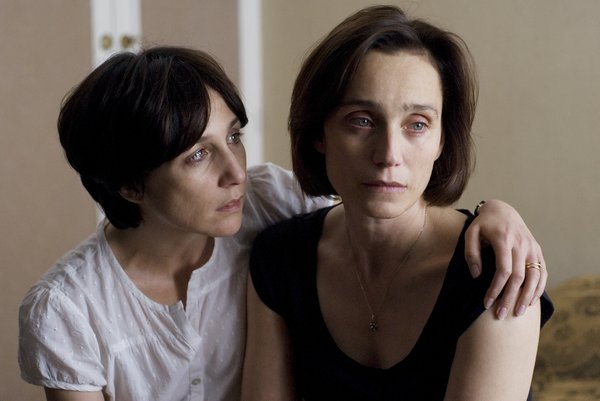
Juliette evokes a classic feminine martyr like Hester Prynne in her acceptance of public castigation as part and parcel of a deeper, truer, private culpability. Her parents had declared her dead when she was convicted and tried to erase her from Lea’s mind, a program of “brainwashing” that Lea eventually proves through the diaries and letters did not succeed. Instead, it’s their mother (Claire Johnston) who has been “brainwashed,” as an Alzheimer’s sufferer. When Lea coaxes Juliette to visit her in the nursing home, their mother thinks Lea is an intrusive nurse, but recognises and desperately clings to Juliette, thinking, in her addled state, she’s still the bright, young girl she raised. Juliette stands in a tragicomic confusion about whether to hug her before the old woman forgets who she is again and shoves her away.

A great deal of the film’s weight comes from the indistinctness of Juliette’s act, and therefore her deepest nature. Up until the end, empathy is tempered by doubt. Although the crucial revelation is long delayed, it’s not too hard to guess, and learning the nature of her guilt when it’s finally, agonizingly, coaxed out of her proves to be the film’s emotional climax. Lea discovers entirely inadvertently that Juliette’s murder was a mercy killing of her terminally ill son. When confronted, Juliette distraughtly rejects Lea’s faintly outraged statement of the obvious fact that this could have made all the difference in terms of the way people treated her. Instead, she declares that losing a son dwarfed all other considerations and that letting herself be imprisoned was as much a willful retreat from a pointless life, as it was an imposed punishment.
In terms of how one responds to this as an ethically questioning artwork, it’s a problematic revelation, and not just because it offers some troubling plot holes, but because it lets everyone off the hook: Juliette, whose act is rendered sympathetic; the justice system, whose draconian moralism is not confronted because Juliette hid her motivation; and Juliette’s supporters (and the audience), for caring for Juliette, whatever she did. But as a situational study of the nature of guilt and character (and not mere victimised innocence, a la The Shawshank Redemption), it still holds weight because Juliette holds herself powerfully, almost masochistically, accountable. It becomes clear that a great deal of the damage done to her as signaled by that initial look of an exhausted inner struggle is largely self-imposed. To this extent, then, expectations of conventional artistic morality and personal morality are inverted. Although the film doesn’t reach its potential, it’s still a substantial, intense experience.
22nd
02 -
2009
|
8 comments »
Director/Coscreenwriter: Mario Monicelli

By Marilyn Ferdinand
One of the Oscar-nominated films this year, The Reader, shows the horrible consequences illiteracy can have on the lives of those who cannot read, causing its female protagonist to make a morally repugnant choice to keep her shameful deficit a secret. The Organizer is another film in which illiteracy plays a very large role, but shame isn’t something its victims feel; rather, the shame is largely on a society that exploits them by keeping them so exhausted that they haven’t got the energy to learn and so poor that they can’t wait to leave school and start earning some money.
The film, which takes place in the late 1890s, deals with the struggle of textile workers in Turin to improve their working conditions and wages. Under the opening credits, workers are heard singing a rousing labor song, “Marcia della cinghia” (“March of the strap”). Among them is Omero (Franco Ciolli), a young man of about 18, who has had to chop through ice to get water to pour from a pitcher into a scrub basin; after testing the water with his finger, he decides to skip washing before he sets off for a 14-hour shift at the factory.
Close-up, repetitive images of the shivering looms interspersed with workers tending to the turning gears, pushing gigantic metal spindles along the shop floor, and pushing fabric through sewing machines are scored by the screeching and drumming of the machines in action. Workers are given a mere half hour for lunch (in Italy!) and then answer the whistle to return to work. Nearing 8 p.m. and the end of their work day, workers nod at their posts. A sudden howl of pain has workers rush to one machine where Pietrino (Antonio di Silvio) works to free his ensnared hand. At the hospital, several of his coworkers take up a collection to help while he is recuperating from amputation. A Sicilian worker merely makes a “phsst” sound through his teeth when asked to contribute. The workers complain about all of the industrial accidents caused by the long hours, then hurry home, complaining about the sleep they’ve lost that night attending to their friend.
A group of workers meet the next day and decide to protest by blowing the whistle one hour early. The men and women, most notably the powerfully built Pautasso (Folco Lulli) and the equally powerfully built Adele (Gabriella Giorgelli), write their names on a piece of paper. The name drawn will be the one who sneaks up to blow the whistle. When the name is drawn, it is merely an “X.” “Who signed with an X?” Four men raise their hands. Pautasso shrugs and says, “I’ll do it.” Unfortunately, at 7:30 pm, the foreman comes to the boiler room, causing the workers who agreed to shut down the machines to keep them running when Pautasso blows the whistle. With the machines moving, the rest of the workers stay where they are. Pautasso is caught and suspended for two weeks.

After work, as Pautasso storms out of the manager’s office with his daughter Maria (Edda Ferronao) in tow, stopping only to throw rocks at his “comrades,” a train pulls up. A bearded, ragged man evades a railroad conductor, and drops from the car in which he has stolen a ride. He goes to see his colleague Maestro di Meo (François Périer), a grade-school teacher in town who tries to teach the illiterate adults in Turin to read and write in the evening. Di Meo puts up Professor Sinigaglia (Marcello Mastrioanni) in a backroom. The next day, the still-disgruntled workers meet to form a committee to deal with the factory managers. Instead of leaving work early, they decide to go in one hour later. Sinigaglia joins the group when young Raoul (Renato Salvatori) proclaims skepticism at their chances of success against the bosses. Sinigaglia agrees with Raoul that they should not risk failure for so little, and agitates them to go on strike. So begins a month-long action that will see two of the workers die—one in an attempt to keep poor, unemployed men from another town from scabbing their jobs, the other in a march on the factory to demand their rights—and more collections taken on their behalf, racist-laced anger at the Sicilian who asks to go back to work melt when they see how incredibly poor he and his family are, and a new union organizer made.

Monicelli, best known worldwide for his comic caper Big Deal on Madonna Street, has a deft hand for both the fine details and broad strokes of comedy and uses them to flesh out a story that in other hands has been told with tragic seriousness. Mastrioanni’s character is chronically hungry. Right after his first appearance, he is seen spotting and grabbing hold of a sandwich one of the workers has left on a table. The worker comes back to retrieve the sandwich—when he sees it in the professor’s hands, his friendliness melts away and, glaring, he confiscates it from the sheepish organizer and stares back suspiciously at him as he climbs the stairs to the street. In another scene, a streetwalker named Niobe (Annie Girardot) takes pity on the professor, who has had to flee from his billet in Raoul’s apartment to avoid arrest, and tells him he can stay at her place. We watch the professor eye her as she removes her clothes behind a curtain and washes. When she settles into her big brass bed and eyes him in his long johns on a hard window seat, she hardly has the words out to invite him into her bed before he dashes to her side.
The factory owner is another piece of work. Obviously inspired by Mr. Potter from It’s a Wonderful Life, he revels in his own nastiness, hitting his blindfolded, piñata-seeking granddaughter with his cane as he whizzes past her in his wheelchair to whine to his managers about the money he is losing to the strike. He invites them to join the birthday party, then reconsiders when he sees they’re not dressed properly. As he slams out of the room, the nonplussed managers merely look down at their suits.
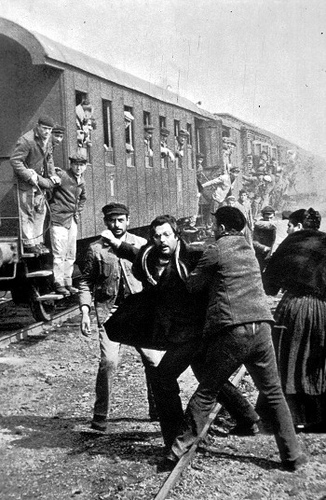 The community of workers is large, and Monicelli finds room to tell more than a few stories. While he highlights some families, the sense of shared fates is strong, particularly in the seemingly endless collections they take. When the striking textile workers steal coal from an idle coal car, the professor tries to persuade the railroad workers to strike in solidarity. His request is refused with the remark, “I’m letting them steal coal, aren’t I?” Nobody can really afford to be without work, yet as we learn early, “hands don’t grow back.” Mastrioanni’s character represents idealism, but based on a very real need that simply could not go unanswered. Education, as well, is given a lot of attention in the film, with Omero beating up his underperforming younger brother for wanting to quit school and join him in the factory. “I’d rather kill you than see you do what I do,” he says, a desperate statement that shows how deadly serious this often light film really is.
In fact, The Organizer reveals many familiar patterns of labor films, and in that vein, distances the audience from deep pain by creating slightly shallow characterizations. The idea, I think, behind this common genre strategy is to allow viewers to project themselves into the masses of workers, deliberately emphasizing in Brechtian style a movement over individuality. It is the problem of a few individuals who want to keep the good life for themselves that creates the misery of the many, and labor films seek to put these facts in high relief. It may be a bit detrimental to the cause, however, to allow audiences to skim the depth of despair and avoid truly mourning the loss of good men and women to poor working conditions and craven capitalists who value their property over human life.
In addition to the many wonderful comic/tragic performances of which Mastrioanni’s is only one, composer Carlo Rustichelli lends his considerable gifts to this film, punctuating the score with the types of comic moments for which he is known, particularly in his work with Pietro Germi. His tempos and Monicelli’s lively mise-en-scène keep this somewhat complex film humming with energy. His “Marcia della cinghia” is superb—I’d be surprised if it weren’t sung at labor rallies now as a legitimate populist march of solidarity.
Mario Monicelli has made buckets of movies, his most recent in 2006. Eric Rohmer announced his retirement this year, and he’s five years younger than Monicelli. Here’s hoping Monicelli will buck the “trend” and give us more films like The Organizer.
19th
02 -
2009
|
5 comments »
Director: William Dieterle
Screenwriters: Heinz Herald, Geza Herczeg, and Norman Reilly Raine

By Marilyn Ferdinand
As part of its 31 Days of Oscar series, Turner Classic Movies aired the Best Picture winner for 1937 last night: The Life of Emile Zola. Not only was the film honored as the Outstanding Production, as the award was called in 1937, but it beat out eight other films for the award. If I had read the nominees before seeing the picture, I might have wondered whether the Academy was again looking to be high-minded in its choice—after all, the incredible The Awful Truth and the noteworthy A Star Is Born and The Good Earth were also in contention, plus a couple of my personal favorites, Lost Horizon and Stage Door. Now, having seen Zola, I must agree that it was a very worthy winner for its year—or any year.

Like any self-respecting biopic, Zola creates fictions from real details, such as the friendship between Zola and Paul Cezanne, and spins them to dramatic purpose. The film opens with the impoverished Zola (Paul Muni) and Cezanne (Vladimir Sokoloff) sharing a drafty Paris garret. To keep warm, Zola tears apart the bourgeois novels lining a shelf and burns the pages in their potbelly stove; what they were doing in the home of such a literary purist as Zola is never explored, nor need it be. This act of destruction and the presence of Cezanne are devices used to establish Zola’s young idealism and link him back to it after he becomes rich and famous.

Zola’s mother (Florence Roberts) and his fiancee Alexandrine (Gloria Holden) come to the flat and inform Zola that he has been offered a job as a clerk in a publishing company. He now feels able to marry Alexandrine and establish a home for them, but he still barely pays the bills on his meager earnings. One night, as Zola and Cezanne share a dinner out, a prostitute seeks shelter at their table from the police, who are making one of their periodic sweeps of the Pigalle district. Zola hears Nana’s (Erin O’Brien-Moore) sad story and turns it into his first bestseller, Nana, a racy but sympathetic look at the problems of the poor and outcast. He brings a copy of the book to her stuffed with a share of his royalties and his profuse thanks.
His accounts of social injustice continue for a time, but eventually cease. Zola produces one hit after another, shorthanded in the film by showing the covers of each book in succession, and segueing into a visit from Cezanne to Zola’s mansion. Zola is eager to show off his expensive objets d’art to Cezanne, who merely announces that he is leaving Paris and does not intend to write. “Artists should remain poor,” he says in quiet admonishment to the complacent Zola. Again, we are made to feel the prick of conscience that the fictional Cezanne represents.

At about this time, career soldier Alfred Dreyfus (Joseph Schildkraut) is accused of treason for smuggling Army secrets to the Prussians. He maintains his innocence but is convicted and transported to Devil’s Island for life. Several years of fruitless attempts to exonerate her husband have Dreyfus’ wife (Gale Sondergaard) appeal to Zola to intercede. Now a respected man of letters soon to be elected to membership in the Académie Française, Zola rejects her petition by saying that his rabble-rousing days are over. Yet he finds himself pouring over the documents that she says prove her husband’s innocence and the guilt of another officer, Major Walsin-Esterhazy (Robert Barrat). Zola looks at the letter about the Académie Française and predictably tears it in half.
Zola begins a campaign to exonerate Dreyfus and bring the real spy and the conspirators in the cover-up to justice when he goes to the newspapers and reads his famous tract , which is quoted in part in the film. He courts a slander trial, which eventuates, in hopes of bringing the case back into the public consciousness, but the court will not allow Dreyfus’ court martial to be mentioned. Zola loses the trial, which was heavily slanted by the Army and the courts to go against him, but escapes to England to avoid prison and continues to write articles critical of the Army and the courts. A new French government brings in reforms and reopens the Dreyfus case. Eventually, Dreyfus’ conviction is overturned, and he returns to Paris, where he is restored to his family and military career. Zola never meets Dreyfus, because the writer dies of carbon monoxide poisoning from a faulty heating stove in his study the night before they were to meet.
All of the dramatic conventions of a biopic can be found in The Life of Emile Zola, and normally that would be enough for me to pick to pieces any day of the week. So why do I stand in such admiration of this film? Again, The Word. The screenwriters have done a superlative job of creating dialogue (though cribbing some from Zola, of course) and situations that crackle with drama, yes, but also truth.

I’d go so far as to say that Zola’s slander trial is the best courtroom scene ever filmed. The entire proceeding teems with the active participation of the entire courtroom and the throngs of Parisians out in the streets. A much looser affair than Americans are used to seeing in any of our courtroom dramas, witnesses take the stand and replace each other almost at will. Swearing in seems optional. The defense calls Mme. Dreyfus, but the chief justice refuses to allow her to answer a single question. Indeed, he plays favorites with alacrity, a believable face of bias and government corruption acting believably, repeating “The question cannot be put,” in a successful effort to prevent Zola’s defense attorney Labori (Donald Crisp) from building a case. According to of the time, accuracy was a watchword in building this scene, save for the fact that the impassioned defense summation to the jury was made by Labori, not Zola. This is an inaccuracy that works brilliantly, however, and puts the capper on a lively and varied performance by Paul Muni, though one not without its hammy moments.

The humiliation of Dreyfus—stripped of the signs of his military rank and paraded in front of the regiment and the public at large—was horrifying to watch. Dreyfus maintained his strict military discipline even in this dark hour, and the perfunctory behavior of the soldiers during his incarceration and then at his release seems otherworldly. By contrast, when Dreyfus’ cell is unlocked for the last time, he walks out, then back in, out and back in—a truly human, wonderfully acted and directed moment that could have been dispensed with in a film more interested in bones than flesh. It is fitting to me that Schildkraut won the Oscar for Best Supporting Actor, whereas Muni was denied a golden boy.
The final eulogy, delivered by Cezanne, is perhaps the work of the Oscar-winning screenwriters (I can’t find evidence to the contrary):
Let us not mourn him. Let us rather salute that bright spirit of his which will live forever, and like a torch, enlighten a younger generation inspired to follow him.
You who are enjoying today’s freedom, take to your hearts the words of Zola. Do not forget those who fought the battles for you and bought your liberty with their genius and their blood. Do not forget them and applaud the lies of fanatical intolerance.
Be human. For no man in all the breadth of our land more fervently loved humanity than Zola.
He had the simplicity of a great soul.
He was enjoying the fruits of his labor—fame, wealth, security—when suddenly, out of his own free will, he tore himself from all the peaceful pleasures of his life, from the work he loved so much because he knew that their is no serenity, save in justice; no repose—save in truth.
At the sound of his brave words, France wakened from her sleep. How admirable is the genius of our country. How beautiful the soul of France which for centuries taught right and justice to Europe and the world.
France is once again today the land of reason and benevolence because one of her sons, through an immense work and a great action, gave rise to a new order of things based on justice and the rights common to all men.
Let us not pity him because he suffered and endured. Let us envy him. Let us envy him because his great heart won him the proudest of destinies: He was a moment of the conscience of man.

The only serious fault I can find with this film is that it neglects to mention that Dreyfus was a Jew and that Zola spoke out against the anti-Semitism behind the Dreyfus Affair. At a time when the Nazis were already killing Jews, this film could have—and should have—been more frank.
15th
02 -
2009
|
2 comments »
Director: Emanuele Crialese

By Roderick Heath
In a primal setting, a primal rite: Salvatore Mancuso (Vincenzo Amato) and his elder son Angelo (Francesco Casisa) struggle up a rocky mountainside bare-footed, with stones clenched between their teeth. They fight their way up to a crucifix mounted on a hilltop. They spit out the saliva- and blood-smeared stones and beg for divine guidance—should they remain in their exhausted, inhospitable land, or flee?

Simultaneously, two young women, Rita (Federica De Cola) and Rosa (Isabella Ragonese), are pursued by Salvatore’s other son, Pietro (Filippo Pucillo), who everyone assumes to be a deaf-mute because he never speaks. He tries to delight or repel them, or both, by decorating his hair with snails. But they’re too fretful to be long distracted. As they’re soon confessing to their terse, old mystic of a grandmother, Fortunata (Aurora Quattrocchi), Rita is tormented by a feeling like she has “a snake in her stomach” and has so ever since they were approached by local merchant Don Ercole (Filippo Luna) to be mail-order brides for established men in America. He sent them a set of novelty photos showing money growing on trees and gigantic chickens—the squirming of the snake in Rita’s belly is restless discontent and anxiety. Fortunata performs a piece of folk magic, affecting to tug the offensive animal out of her stomach. But Fortuanta’s attempts to tame the beast of discontent are failing, as Pietro races to presents the amazing photographs, which she ordered him to burn, to his father and brother as they pray on the hilltop, providing exactly the sign they were seeking.

Salvatore sells their animals to finance emigration. Don Ercole sells them clothes belonging to a dead man—a baron, no less—and tells them not to bother putting on their shoes until they get to a city. Salvatore, given to occasional, surreal fantasies, imagines a field where gigantic carrots and other vegetables are being dug out of the ground, energizing him to take the two girls and his grandmother as well. Fortunata dissents, not wanting to leave the spirits of their relatives. In protest, Salvatore digs a hole in the ground and almost completely buries himself, demanding to know what’s so damned great about this arid, poverty-stricken, backward place they live in. He lies covered in dirt all night, dreaming of silver coins raining from the sky. In the morning, Fortunata resurrects him, emerging from the hut to tug his hand from the earth, and soon the whole rag-tag clan is making their way towards a seaport.
Nuovomondo is a film with a feel and respect for mystery: third-time feature director Crialese’s conception drags us from the edge of history through to the dawn of the very modern era. Fortunata, Salvatore, and their family live in a peasant world with a preternatural instinct for magic and mysticism; eventually they will be confronted by a different, no less awesome magic in the skyscrapers of Manhattan. But they also refuse to leave behind their own magic, a refusal that will present difficulties in breaching the “golden door” of its English-language title. Nuovomondo, like its characters, straddles Old World and New, its style blending the sparse, hushed intensity of European masters with a distinct impetus, a refusal to retreat into hopeless circularity or narrative impasse, as befits a film about determination and hope. The final passages are toned by the effervescence and attitude of Nina Simone. The inscrutable poise of the opening segues into a linking series of enigmas through the narrative: cinematographer Agnes Godard’s camera, Crialese’s direction of it, and his script maintain a strict measure of control over what the viewer is absorbing. The Mancusos are innocent, but they’re also tough and shrewd and refuse to act like victims, even if it hurts. Characters and incidents enter the frame unannounced and threaten to leave again, a tactic which emphasizes the nature of dislocation and the intense nervousness, the perceived lack of control, a note of threat and anxiety that contradicts any clichés of reflexive nostalgia and propaganda.

When the Mancusos and their charges reach their city of embarkation, it’s a bustling, filthy dive full of cheats and criminals, as well as decent and helpful folk. One man tries to force them to buy useless medicine; others warn them about the scam and of the troubles they can expect at Ellis Island. When they’re being processed at the outgoing emigration post, a new character enters the tale. First casually observed leaning against a pillar and then creeping into the corners of the frame is the comely, red-headed form of Lucy Reed (Charlotte Gainsbourg), an inexplicably stranded Englishwoman without any apparent friends or support. She attaches herself to the Mancusos, only to be caught out as they move to get on the boat, pretending to speak no Italian for a pushy, sleazy official. She’s as intent, and desperate, on getting to America as any of the peasants around her, and she’s told in no uncertain terms that to get through customs she needs to be attached to a man.
Lucy proves a tantalizing and potentially valuable passenger on the migrant ship. Don Luigi (Vincent Schiavelli, in his last role), a marriage broker of a higher class than Don Ercole, promises her a convenient union in New York. Lucy is the object of endless, mostly derogatory, speculation by others passengers, but she keeps tight-lipped, forming tenuous friendships with Rita and Rosa, stirring the prickly Fortunata’s wrath when she objects to the matriarch’s constant negative mumbling, and being a convenient lust-object for Pietro and Angelo, the latter sneaking about the cabin at night, breathing in the odor welling off her. For Salvatore, she’s something more—a perfect fantasy partner for a new fantasy world where he imagines floating with her in a river of milk that rumor has it flows in California. Salvatore shaves off his moustache and looks 20 years younger. Rather than accept one of Luigi’s sheikhs, Lucy will ask Salvatore to marry her at Ellis Island to help her get through. He agrees with all the courtly civility of a cavalier, for though both deny any chance of love in their union, Salvatore cuts away a lock of her hair, “so that we won’t lose each other.” “I don’t believe in magic,” Lucy replies. “With time, I’ll teach you about it,” he promises.

Describing the story of Nuovomondo inevitably falls short for a film that is as successful a piece of magic-realism as recent cinema has produced, and has traits much like its characters, alive to fleeting textures and cagey about declarations. There is an extraordinary texture to almost offhand sequences, like when Fortunata “exorcises” Rita, tugging what looks awfully like a joke-shop serpent from inside her; when the passengers on the ship are flung about by a storm like laundry in a washing machine; when they stumble out battered upon deck the next day, a young woman lurching blearily with her dead baby, dropping it overboard before collapsing like a dishrag; when Lucy walks the deck, exchanging quizzical, teasing glances with Salvatore who reverently stalks her, her red hair shimmering in the sun and time slowed every so slightly; Salvatore’s humorous fantasy visions; the immigrants frantically brushing out their hair and trying to assemble a veneer of cleanliness for their arrival; a furiously exuberantly ceilidh; and a fog-laden arrival in New York Harbor with all but the highest panes in the immigrant station frosted, forcing the men to climb up them to get a first view of the city.
The gilded cliché of the “immigrant experience” has of course been portrayed before, exploited by the varying agendas of films like The Godfather Part II (giving cred to gangsters) and Titanic (providing picturesque drinking buddies). Nuovomondo strikes far harder and echoes far deeper not least for being intricately modest. It evokes, in spirit if not execution, Charlie Chaplin’s infamous boot in the pants to the immigration official in The Immigrant (1917) in its ground-level humanism. There’s a total rejection of the grandiose in its sensibility, even the ambling epicism of Tarkovsky and Angelopolous, whose influence can be detected in the style, along with dashes of Fellini’s quirk: the context is instead utterly personal, with an close-quarters feel for moral and physical consequence. The film doesn’t romanticize what the Mancusos are leaving, whilst acknowledging it will always dominate their psyches; nor will what they find fulfill their dreams, even though it can hardly be worse.
Ellis Island, once reached, is an Escher-sketch tangle of halls, departments, degradations, and bureaucratic hoops, moments of stripping and being paraded and prodded. Candidates are expected to arrange blocks of wood into shapes as a test of intelligence despite the fact few of them have any concept of abstract puzzle—Salvatore immediately arranges them into a model of his farm. Fortunata, bewildered by a new world that values geometry, not magic, asks the officials if they are God to decided who enters the new world. Crialese’s layered direction recognizes that small gestures can lay the world waste and open up vast futures: the most crucial moment in the film, and also the most showy, is when Crialese halts every motion in the frame, with Lucy and Fortunata only moving slightly, absorbing the import of Fortunata’s slight nod to Lucy—her acceptance of her as a member of her family.

The film builds to an excruciatingly tense climax in which the women of the party are arrayed, in their forlorn attempts to look like brides with veils and good dresses, to be sold off to their matches, and Lucy sits stoically, but with increasing anxiety waiting for Salvatore to get through his processing, with Luigi and his prospective beaus waiting to snatch her up when she gets desperate enough. There’s already been the spectacle of Rita submissively and glumly acknowledging her pudgy, middle-aged beau, and Rosa berating hers for not matching his description of himself, but likewise submits. Meanwhile, Fortunata and Pietro are threatened with deportation, leading Fortunata to demand Pietro do what he least wants to.
Crialese is aided by a superlatively understated cast and Godard’s astounding camerawork. It’s specifically by resisting the tendency to spell things out in blazing neon letters, its firm control on what it wants to reveal and say and not trying to tug tears, that gives Nuovomondo the impact it finally possesses. It builds to a final moment that ranks with that of Terence Malick’s own vision of The New World (2005) and Emir Kusturica’s cap of Underground (1995) among the most transcendent moments in recent cinema. l
11th
02 -
2009
|
8 comments »
Director: Fred Zinnemann
Screenwriter: Robert Anderson

By Marilyn Ferdinand
, the man who wrote the screen adaptation of Kathryn Hulme’s fictionalized account of her lover Mary Louise Habets’ experiences as a nun, died on Tuesday at the age of 91. Anderson, who always considered himself a playwright (movies were what he did for money), produced serious-minded works that respected the intelligence and maturity of audiences to deal with such hot-button topics as homosexuality, aging, and the loss of faith. Called “a gentleman in an age of assassins,” Anderson produced such sensitive and powerful works as Tea and Sympathy and I Never Sang for My Father. The Nun’s Story is a rich and rewarding look at religious life that eschews pious platitudes to explore both its mysteries and its cold, hard facts.

Gabrielle van der Mal (Audrey Hepburn), the eldest daughter of a renowned Belgian surgeon (Dean Jagger), is about to embark on a long journey that she hopes will take her into a close relationship with God and enable her to do His work as a nurse in the Congo. The film opens as she fingers her engagement ring, then resolutely removes it and places it on the desk in her bedroom along with some other items atop a note that says, “Return to Jean.” She hears her father plinking out some Mozart on the piano in the drawing room. She quietly descends the stairs, comes up behind him, and joins him at the keyboard. When he turns to face her, he says “Your hat is on crooked.” “I’ve been trying to practice putting things on without…” The words “a mirror” are left unsaid. The pair goes into town and views the convent across the square. “I can see you poor. I can see you chaste. But I can’t see you obeying their Rule,” Dr. van der Mal says. “You don’t have to go through with it if you don’t want to.” Gabrielle merely looks down, deflecting his implied question with a demure but determined gesture. They walk to the door and enter a room filled with parents and daughters. After some tearful farewells, the would-be nuns pass behind the door of the inner sanctum and into a world where they will be taught to create internal silence to better devote themselves to prayer and learn obedience to the Holy Rule.

The film takes us on the journey from Gabrielle to Sister Luke at a deliberate pace, missing few fascinating details that form the strict lives of discipline and striving for perfection that make a girl into a nun and a nun into a representative of Christ on Earth. At first, the postulants learn mere behaviors, such as hiding their hands when they are not being used for prayer or work, standing near the walls as they move through the halls as an act of humility, writing their transgressions in a small notebook, publicly accusing themselves of everything from being late to prayer, to feeling proud about doing a task properly and talking during the Grand Silence. Observing how they live, for example, sleeping in a common room with each bed surrounded by curtains, and their behavior, from using the sign language that allows them to communicate, to bowing and kneeling before higher-ranking nuns, to donning their habit for the first time in a rote and ritualized way, compares favorably with the experience I had viewing the lives of real Carthusian monks in Into Great Silence (2005).

In short order, Simone (Patricia Bosworth), Gabrielle’s closest companion in the convent, gives up her vocation, while assuring Gabrielle that she is strong enough to complete the journey. “I’m the weakest of us all!” Gabrielle protests, saying she is constantly in error. Nonetheless, Simone’s prediction comes true as we watch the truly beautiful and awe-inspiring investiture of Sister Luke and her fellow novices as brides of Christ, again, with the close, unhurried observation of a way of life that has been centuries in the making.
Sister Luke is sent for training to an institute for tropical medicine to prepare her for working in the Congo. She’s an outstanding student, but put upon by Sister Pauline (Margaret Phillips), a veteran of the Congo and an average student who fears Sister Luke will take her place. Sister Luke takes her problem to Mother Marcella (Ruth White), who tells Sister Luke she has been given a golden opportunity to prove her humility; Mother Marcella then asks her to fail her final exam. The scene in front of her examiners is one of high drama, as Hepburn so evokes Sister Luke’s inner struggle that she actually breaks a sweat. That the charge from Mother Marcella was a particularly cruel Gordian Knot makes no difference; for passing her exam (in fact, placing fourth in a class of 80), Sister Luke is denied a posting to the Congo and is sent instead to work in a sanatorium for the mentally ill. The waste of her talent seems stupid, considering the great need of the Congolese and their overworked medical staff.

After a somewhat harrowing stint at the sanatorium, including being attacked by a dangerous patient called the Archangel (Colleen Dewhurst) for disobediently tending to her without help, Sister Luke finally gets posted to the Congo. Her happiness while moving among the natives in the black hospital and holding the babies of Congolese mothers breaks her nun’s proper reserve. Yet still she is to be tested. When she learns she is to work at the white hospital under Dr. Fortunati (Peter Finch), she is devastated. The scenes in the Congo are a bit too picture-perfect, but this idealization is tempered by filming real lepers in a downriver leper colony Sister Luke visits.

Sister Luke buries her disappointment in work to such an extent that she weakens her entire system and develops early-stage tuberculosis. Hepburn’s darkly circled eyes, drawn face, taut and nervous frame, and constant edge of fatigue work brutally to reflect Sister Luke’s worry that should her disease be uncovered, she will be sent back to Belgium for good. Fortunati, initially jaundiced about working with yet another nun, then surprised at her competence and increasingly reliant on her great skill, manages to keep her in country and cure her TB. Unfortunately, when an important benefactor who has fallen ill must be sent back to Belgium, Sister Luke is the only logical choice to accompany him. With World War II brewing, she fears she will never be able to return to the Congo. And indeed, Rev. Mother Emmanuel (Dame Edith Evans), the highest-ranking nun in the order, refuses to send her back. Her struggles in Belgium, her painful war losses, and her acknowledgment that she has never found the internal silence to become a great nun finally force her, with all the determination she had when entering the convent, to give up her vocation and return to the world.

This 2.5 hour film has the time and the ambition to take us all the way into Sister Luke’s world and experience with her the joys, disappointments, and, most of all, the pain of trying to bend her will to that of God and the sisters. Dr. Fortunati tells her that he’s worked with nuns as long as he can remember and found there are two kinds: the obedient ones without a stitch of imagination and the worldly ones. Sister Luke, he says, is the latter and not cut out to be a nun. When Rev. Mother Emmanuel refuses to allow Sister Luke to work at the local hospital when she returns from the Congo, her reason is that Sister Luke must attend to her vocation—she joined the order to become a nun, not a nurse, and her spiritual life must always come first.
Herein lies the conflict Anderson and Zinnemann have highlighted in obvious and subtle ways—Gabrielle wanted to become a nun, but she wanted to practice medicine in the Congo even more. In the strict and arbitrary world of the convent, God is the only master. Like army training, all convent exercises, teachings, and assignments are designed to root out individuality and create vessels to carry out God’s wishes. There was nothing half-hearted about Gabrielle’s attempts to become Sister Luke—all or nothing, she says, was her Rule before she entered the convent—and we can see through Audrey Hepburn’s remarkable performance the deep sincerity in Sister Luke’s dedication to being a nun, the automatic behaviors she has adopted over the two decades of her vocation and her anguish at all her faults.

The supporting performances are wonderful, particularly all of the ranking sisters whose guidance rules the lives of Sister Luke and her fellow sisters. Mildred Dunnock is here a placid and patient mistress of the postulants. Dame Peggy Ashcroft is a compassionate, but obedient head of the mission in Aftica. And Dame Edith Evans is old-school Catholicism at its best, firmly guiding her nuns in a clear-eyed manner than can look, but is not meant to be, cruel.

Peter Finch is young and dashing—a prototype of the rude doctors we see on TV all the time. Other viewers of this film detect some sexual tension between Hepburn and Finch’s Dr. Fortunati, but I didn’t see it. Hepburn’s Sister Luke truly seems modest, even asexual, to me. When a native man asks her why a young woman like her doesn’t have a husband, rather than try to explain the difficult concepts of Catholicism, she says quite believably, “I do have a husband. But, He’s in heaven.”

Zinnemann’s direction is very full-bodied, more so than many of his films. There’s hardly a stock type in the film, and he strives to bring as much realism as Hollywood would allow to his African scenes. I was incredibly impressed with the cinematography of Franz Planer, who is a master of shadow and color, creating beauty in every scene while still somehow making everything look real. There’s very little of the crescendo-music-soaring-looks-heavenward that many religious films are made of. His work with Hepburn’s radiant face brings out so many looks that have nothing to do with glamor and everything to do with the truth of her character.
Finally, of course, is The Word. Read this remarkable exchange between Sister Luke and Rev. Mother Emmanuel:
Rev. Mother Emmanuel: Have you struggled long enough to say surely that you’ve come to the end?
Sister Luke: I think I’ve been struggling all these years, Reverend Mother. In the beginning each struggle seemed different from the one before it. But then they began to repeat, and I saw they all had the same core: obedience. Without question, without inner murmuring. Perfect obedience as Christ practiced it. As I no longer can.
Rev. Mother Emmanuel: Yes?
Sister Luke: There are times when my conscience asks which has priority. It or the Holy Rule? When the bell calls me to chapel, I often have to sacrifice what might be the decisive moment in a spiritual talk with a patient. I’m late every day for chapel or refectory or both. When I have night duty I break the Grand Silence because I can no longer cut short a talk with a patient who seems to need me. Mother, why must God’s helpers be struck dumb by five bells in the very hours when men in trouble want to talk about their souls?
Anderson truly made this film more than the sum of its many magnificent parts.
The Nun’s Story was nominated for eight Oscars the same year that cleaned up. It won not a one—yet more evidence that even back in 1959, the Oscars were a joke. On Oscar night this year, skip the broadcast and watch this movie; it’s long, but not as long as the Oscars, and infinitely more deserving of your attention and admiration.
9th
02 -
2009
|
37 comments »
Director: Billy Wilder

By Marilyn Ferdinand
Will I be excommunicated from film blogging if I admit that I really don’t like Billy Wilder’s films very much? Yes, even Some Like It Hot. There’s this je ne sais quoi about him—oh, who am I kidding. I don’t like how he treats women. He doesn’t seem to like us very much. He doesn’t usually present us with dignity. His best films tend to be about male courage, male bonding. Hell, he even has Joe E. Brown preferring a fake woman—even when Jack Lemmon reveals his deception—to a real one. “Nobody’s perfect.” That’s right, Billy, including you.
The worst film I’ve seen in some time is Avanti!, so thoroughly reprehensible that I hardly know where to begin. So let’s just quickly dispatch with the plot and then start chewing on Wilder’s fat, little head. Wendell Armbruster, Jr. (Jack Lemmon) races from a round of golf, via his company’s private jet, to an airport, and hops a plane to Italy. His father, the very powerful and well-connected head of the family huglomerate, has been killed in a car crash on Ischia, a spa island near Naples.

On his train trip to his final destination, he briefly and unpleasantly encounters Englishwoman Pamela Piggott (Juliet Mills) and insults her dowdy appearance, and she very believably takes pains to point out to him her overstuffed figure. They find out they are staying at the same hotel, and are on the same mission; Pamela’s mother was in the car, too, and as it happens, shared the suite with Armbruster Sr. that Jr. now occupies for the past 10 years. Some nonsense about paperwork, various attempts at blackmail, recreating 24 hours in the life of the deceased couple including dinner, dancing and a nude swim in the morning, a crime of passion, the inevitable clinch between the children of the elderly lovebirds and the promise to continue on in their parents’ illustrious tradition. Isn’t it just so moving? Doesn’t it just bring a tear to your eye? Or maybe that was just a spitball.
 Seriously, folks, this is the worst kind of misogynistic, stereotypical crap I’ve ever seen in my life! First, Wendell is the quintessential ugly American tycoon, spouting orders, trying to hurry everyone up, hush everyone up, and offend everyone (up?). He’s unbelievably rude to Pamela, commenting openly on her “fat ass” and other insults. Of course, he’s not entirely wrong. I’m not sure they could have found a more revolting travel outfit for her if they had ripped the sackcloth off of Buñuel’s beggars in Viridiana. When she “blossoms” at the dinner she is supposed to be sharing with Wendell, (bringing her own apple to adhere strictly to her diet, what a laugh riot!)—he in one of his father’s suits, she in one of her mother’s dresses—they put her in a long, flowing example of the best faux-hippie attire the Sears catalog had to offer. Her finest wardrobe
  moment was in her altogether, basking on a rock in the Bay of Nipples, I mean Naples, where it is more than obvious that she is not only not fat, but actually has one of the best figures a woman could want. To be fair, Wilder makes sure Lemmon has his nude scenes, too, though all we get are some skinny ass cheeks. To keep the male audience interested, Wilder throws in a gratuitous topless scene of Anna, a moustachioed, Afro-haired Sicilian maid (Giselda Castrini) who’s having it on with Bruno (Gianfranco Barra), the hotel valet who landed at Ischia after being deported from America.

The solicitious, duplicitous concierge Carlo Carlucci (Clive Revill) bobs and weaves to ensure that Senor Armbruster gets anything he bellows for and remains in the dark about his father’s long-term infidelity, pulling out pictures of the family back in the U. S. of A. to put on the nightstand and spiriting the late Mrs. Piggott’s luggage to Pamela’s room—the latter falsehood exploded fairly early by the unfortunate Miss Piggott. Carlucci and staff wax poetic about the graciousness of the deceased couple; Carlucci even offers them both graves in his family plot to obviate the need for all the permits Pamela and Wendell need to get the bodies home, available land, of course, being no problem on a tiny island.

When Wendell refuses to pay the Trotta family $3,500 for damages to their vineyard from the crash, the bodies vanish from the morgue. Wendell is spirited away by a one-eyed man to a nighttime bocce ball tournament and introduced to the Missing Link team, aka, the Trotta family (no women—it seems they sprung from sea sponges). Wendell is further blackmailed by Bruno with nude photos of his father and mistress and with those of him and Pamela in exchange for a visa back to his beloved America to get away from the pregnant, marriage-minded Anna. Of course, the Sicilian spitfire plugs him in Pamela’s room, forcing Carlo to move her into Wendell’s room to avoid police questioning—it is, of course, the only solution in a large hotel, and the police would never check the guest register to see who was staying in the room.
There’s a lot more nonsense, including a phone call from Wendell’s wife asking when the body will arrive for the state funeral she has planned. Pamela answers and spoils Wendell’s lie that she’s an interpreter. When Wendell gets in hot water with the missus, Pamela grabs the phone and tells her not to worry: “I’m short, I’m fat, and I’m not very attractive.” That works for Mrs. Armbruster, who knows how superficial her husband’s taste in women is—after all, he married her. Bruno gets shipped home instead of Wendell’s father. Wendell considers that a good thing—Bruno is finally getting what he wanted: a trip back to America. And the happy new adulterers will find their way back to Ischia every July 15–August 15 for their “health.”

Billy Wilder has dealt with adultery before, most notably in The Apartment, again with Jack Lemmon. In both these films, the heroine has very low self-esteem, and Lemmon is a blustery, overbearing oaf. However, in The Apartment, there is much more humanity and much sharper satire on the American way of doing business. Here, we get nothing but types that, to be fair, are universally insulting and utterly unfunny. The Italians are crooked, shakedown artists who hold adultery in the highest regard. The one Sicilian is ugly and trigger-happy. And poor Pamela is willing to settle for the same life as her supposedly honorable mother had (never letting Armbruster Sr. set her up in London as a kept woman because she “was in love”). Mum kept her manicuring job at the Savoy Hotel, and good ole Pamela will be no trouble to Wendell either. “I’m not all women’s lib,” she says, “I don’t mind being considered a sex object.” In 1972, this sentiment is laughable and aggressively anti-feminist. It is certainly no triumph that a perfectly attractive woman who earns her own living is ridiculed for her imaginary weight problem and pushed into a “happy ending” of long-term adultery, and 11 months of pining away.
The rating for this film on IMDb is 7, which is pretty good. I hope that rating is only for the beautiful scenery. I would hate to think that modern users of IMDb really think this is a good movie. I applaud the three under-18 women who gave it a 1. Right on, sisters!
7th
02 -
2009
|
17 comments »
Producer/Director: Eric Steel

By Marilyn Ferdinand
When I read the synopsis of The Bridge in the 2007 Chicago International Film Festival program guide, I experienced an instant revulsion. “More people choose to end their lives at the Golden Gate Bridge than anywhere else in the world,” it said. There would be actual footage of people jumping into the swift, deep waters below. The hubby went to see it. I did not. Yet, yesterday, when it showed up on IFC, I found myself sampling it, then really watching it—all the way to the bitter end.

My reluctance had to do with wanting to respect the privacy I think a person’s last moments deserve, as well as a sensitivity because I have had a suicide in my family that was very traumatic for me. I am also aware of feeling a certain distaste for the ghoulish aspects of capturing an actual suicide on film, while at the same time finding such footage riveting. It’s like slowing down on the road to look at a crashed car; something in us wants to have an encounter with death. Maybe we really do have a death instinct, as Freud suggested. There is no doubt that as surely as we are given life, that life will end, and we have the dubious advantage of knowing this inevitable fact. Most of us contemplate death, try to understand it and come to terms with our own mortality. Some of us have suicidal thoughts in times of desperation. Most of us want to live, fight to live when death is near. How is it that people—many of them in the prime of life—choose, finally, to give up that fight? And why do so many of them choose to do it in broad daylight on a very populated bridge?

Producer/director Eric Steel was inspired to make this film after reading Tad Friend’s The New Yorker article, “Jumpers.” He lied to the Bridge District authorities about the purpose of his project—supposedly to capture stock footage of one of the great wonders of the world—and spent all of 2004 filming the bridge. He set up fixed cameras on either side of the bridge for panoramic views and used DV handheld cameras with telephoto lenses to film activity on the bridge. Film crews were equipped with cellphones that had the Bridge Patrol number entered into speed dial. Whenever they observed the warning signs described in Friend’s article that someone might be ready to jump, they hit that speed dial. Some people were saved this way, but some people moved too swiftly or defied their powers of detection. A total of 24 people made the jump: 23 were captured on film.

The Golden Gate Bridge is a mesmerizing sight at any time, its seemingly delicate lines contrasted with strong vertical towers, and set in a breathtaking natural landscape. When the frequent fogs that visit San Francisco roll in, the bridge seems to float like a heavenly structure in Mount Olympus. There is a romance to the bridge; indeed, San Francisco is considered one of the most romantic destinations in the United States and is a favorite among honeymooners. Thousands of tourists and residents alike walk the bridge each year, admiring its marvelous form and gazing out to the surrounding vistas of water and hillsides. It is not farfetched to believe that jumpers choose the bridge because of the physical beauty that will be their last sight, the desire to make their deaths somewhat poetic, and, of course, the knowledge that their suicide attempt will almost certainly succeed.
The idea of the romance of the bridge fills a friend of a jumper nicknamed Ruby with rage. Photographed in an identity-protecting shadow, she speaks through tears of her attempts to help her severely depressed friend cope. She speaks of giving him some antidepressants she couldn’t finish taking because they kept her awake. Expressing a thought she finds shameful and that she clearly has obsessed about in the months following Ruby’s death, she says she didn’t want anyone to find her name on the prescription bottle if they came snooping around his apartment—already she feels his death may be inevitable—and she therefore put the pills in a plain, white envelope. She speaks of her last night with Ruby, an outing to a movie during which he sobbed uncontrollably; a conversation about suicide and his various options, which she tried logically to dismiss as “being unfair to the landlord” and other subterfuges; and finally, a refusal to let him come home with her to talk in order to respect his space and his free will as an adult. This “respect” will haunt her the rest of her life, and she vows she will never do it again if a similar situation should face her.
An extremely poignant interview, held in full view for the cameras, is of a couple talking about the suicide of their son. They are plain-spoken about his difficulties and the events on the day of his death. Their words and voices are calm, but they look stunned, like deer caught in headlights. The mother wonders what she did to make him so unhappy, repeating the wrong and misogynistic notion that mothers are to blame for their children’s unhappiness. I wanted to reach through the screen and hug her.
Various survivors express anger, exasperation at the “cry wolf” aspects of their friends’ frequent and lifelong threats, and helplessness. One woman, aware of the enormous pain her loved one was in, admonished him to promise to say good-bye and to put her name and phone number in a plastic bag and carry it on his person so that she would at least know what had happened. Others, remembering how their friend was always upbeat and the life of the party, mused that if it could happen to him, it could happen to just about anyone.
One miracle man who survived his jump talked about his mental instability and about his attempt. He said he stood on the bridge for some time, crying uncontrollably. Some people stopped to see if he was all right, but most walked by without a word, which he might have perceived as uncaring but probably stemmed more from embarrassment and a desire not to intrude. The last straw for him was a woman with an accent, “German, I think,” asking him to take her picture. He did, and thinking about how she hadn’t even noticed his tears, thought “nobody cares” and jumped. This is the kind of impulsiveness that often causes an ill person to attempt suicide even when he or she may still feel uncertain. “As soon as I let go, I knew I didn’t want to die.” He talked about what he thought might save him—going in feet first. In the four seconds it took for him to hit the water, he turned and landed in a half-sitting position. He shattered two lower vertebrae, but the bone fragments missed his heart. He now has to stick to a rigid routine of meds, meals, and sleep. “It’s a hard life for a 24 year old,” his father says.
This survivor provides a valuable window into what “happened” to these sad people—mental illness. Seriously suicidal people are physically ill—very ill. They can’t just snap out of it. They frequently become marginal individuals, unable to sustain loving relationships, hold down a job, or perform day-to-day tasks. As one jumper wrote (and we see the actual scribblings), “I was voted ‘most likely to success.’ What the fuck happened?” and “I’m a fuck-up. I’m a loser.” I used to see people like him on my bus ride home from work loitering outside of nursing homes and halfway houses, a somewhat scary-looking lot who actually didn’t do much of anything, let alone harm anyone. They are the people who well-meaning, but misguided liberals concerned about individual rights had released from these community institutions to mainstream into society during the 1970s. They’re the people the insurance companies had refused for decades to insure and that mentally well individuals scorn, apparently not viewing one’s brain as a part of one’s body. Lacking the funds for proper treatment, many self-medicate with alcohol or cheap drugs like crack cocaine.
The pain of the surviving families is difficult to watch. But it is the actual, filmed suicides that are so hypnotic and haunting. We see one man in a gray sweatsuit and white running shoes pace energetically, talking animatedly on his cellphone. Before you know it, he has climbed up and sat down on the wide rail, crossed himself, and let go. Another man bolts quickly over the rail and runs off the side, as though he didn’t want to think about it in case he might change his mind. One woman climbs down onto a platform. A man with a camera starts photographing her, aware that she’s probably going to jump but distanced from her by the camera. He compares his actions to what war photographers go through, witnessing horror but somehow unable to intervene. Fortunately he “woke up.” Steel’s cameras capture him reaching over the rail, grabbing the slightly built woman by her hoody, and dragging her back to safety and the waiting Bridge Patrol vehicle.

Cut in throughout the film is a man with beautiful, waist-length, black hair blowing in the wind as he walks up and back across the span. He stops frequently, gazes out, lays his hands on the rail. The crew said he looked like someone just appreciating the beauty of the bridge and the scenery. He got off the bridge at one point and sat in a park at one end. The film crew was completely fooled. We, however, watch this man, fairly certain that he will jump because he’s in the film. I found myself both waiting expectantly for it to happen and dreading it. When he finally does it, the image is as beautiful and haunting as the bridge itself, a perfect symbol for the lost souls who fly to their doom.

The deadly seduction of the bridge affects not only the jumpers but, apparently, the Bridge District as well. For years they have fought putting up a suicide barrier, though they have set up barriers to prevent head-on collisions and pedestrian traffic accidents. These, according to Steel, were almost nonexistent problems before the barriers were erected. By contrast, an average of 20 people a year jump to their deaths from the easily breachable bridge. Why is the Bridge District so recalcitrant about suicide barriers? Cost was mentioned, but the other barriers cost as much to erect. I think it has to do with not wanting to mar the aesthetics of the bridge. Announcement that The Bridge was going to screen in several cities finally forced the Bridge District to get serious about doing a feasibility study, but it may still be years before barriers go up.
The Bridge takes a brutally unblinking look at suicide and the plight of the mentally ill that our society must grapple with. The beautiful shooting by San Francisco DP Peter McCandless and the sensitive direction of Steel make this the perfect vehicle for beginning this conversation.
The official for The Bridge contains much useful information. I recommend a visit.
4th
02 -
2009
|
14 comments »
Director: Gregory La Cava

By Marilyn Ferdinand
There are many classic film buffs out there for whom the Pre-Code era of is the source of their greatest viewing pleasure. It’s easy to understand why—it’s a momentous time in film and world history. Sound trickled in, flowed steadily, and quickly inundated motion picture production. With that sound, it was possible to hear the songs and seductions that brought musicals and sex vividly to life—and scared the hell out of the Hays Office. It was also the time when the Great Depression grabbed onto the world economy and plunged it as low as it had ever been experienced in the United States. All types of films explored the plight of the unemployed, from Busby Berkeley musicals to gangster flicks to comedies about slumming socialites.
One type of film that wasn’t particularly common in the United States at that time, but was in its ascendancy in the Soviet Union and Nazi Germany, was the propaganda film. Hollywood moguls interested in churning out mind-distracting entertainment certainly weren’t interested in it. In fact, there’s only one well-known propaganda film from that era done by the only movie mogul who not only had the interest, but also the experience to pull it off—Gabriel Over the White House, a production of William Randolph Hearst’s Cosmopolitan Pictures.

Hearst, of course, was the notorious newspaper baron whose politics and personal preferences trumped truth and impartiality in the heyday of yellow journalism and beyond. In the early 1930s, Hearst used his various bully pulpits to tout what would become Franklin Delano Roosevelt’s New Deal administration.
Gabriel Over the White House, a truly bizarre film on first viewing, centers on the Hoover/Hardingesque political hack, Judson “Judd” Hammond (Walter Huston), who we first see taking the presidential oath of office, change his evil ways, baby, after a coma-inducing car accident puts him in touch with an unseen presence. His mistress, Pendie Molloy (Karen Morley), who also mends her fornicating, father-fixated ways to embrace the more age-appropriate marriage-minded presidential press secretary Hartley “Beek”’ Beekman (Franchot Tone), senses the presence and identifies it as the angel Gabriel.

Hammond is shown before the conversion hobnobbing with his party cronies, all of whom hold cabinet seats, carelessly discarding the problems of massive unemployment and rampant crime as “local matters.” Hammond, the rare bachelor in the White House, is a real bad boy. After installing Molloy as his “private secretary,” and putting off all serious questions at his first press conference with jovial dismissal—and the announcement that all future press conferences will require questions submitted in writing beforehand—he decides to take a joy ride in his limo with several of his staff. He floors it, pushing past 110 mph so as to shake both his security escort and trailing reporters. The car blows a tire and careens off the road. The condition of the passengers in the ill-fated car is never revealed, but the comatose president is not expected to live.

As divine presences always seem to do in movies, the unseen messenger arrives on a gust of wind that ruffles the curtains covering the president’s open bedroom window and fills the room momentarily with light. The doctor, Beek, and Pendie are hurriedly called in from their death watch in an adjacent room by Judd’s nurse. Judd has regained consciousness. He’s alert, but distracted, as though he were listening to a voice beyond the wall. His coldness toward Pendie announces his renunciation of the immoral pleasures of the flesh, and with a vigor and seriousness of purpose never seen in him before, sets about mending the ills of the country. He fires all of his sleazy cabinet members, encourages labor leader John Bronson (David Landau) and his million unemployed men to come to Washington to talk about stimulating the economy, and sends tanks against notorious bootlegger and criminal Nick Diamond (C. Henry Gordon). When the political hacks in Congress rebel against Judd’s sweeping social-welfare proposals, he declares martial law.
In his zeal to fill up the nation’s depleted coffers, he decides to collect the debts the nations of the world owe the United States for supplies and assistance it provided during and after World War I. He deploys the Navy to prevent any interference with his grand plan—to gather all of the leaders of the world on a naval vessel and watch American bombers destroy two American battleships. These planes, rather than some antiquated battleships, represent the military force of the future, and he will not hesitate to use them if the debts are not paid and a new understanding of peace is not reached that very day. The leaders of the world line up to sign and stamp their seal on a peace accord. Hammond enters the room last. Looking not at all well, he stumbles to the table on which rests the document and, with a shaky hand, signs it. Then he collapses and dies, his brief resurrection rescinded now that his divine work has been completed.
 It would have to take someone with the enormous ego Hearst had (or the absurb humor of the Blues Brothers) to promote his politics as a mission from God. The authoritarian way Hammond goes about doing good reminded me of another film that most people see quite benignly, but that I have always contended was rather fascistic—The Day the Earth Stood Still (1951). Gort and the bombers are much the same, as are Klaatu’s and Hammond’s ultimatums. The difficulty in seeing Hammond’s actions in a completely sympathetic light have to do with our understanding of and revulsion against martial law. Doing right by assuming absolute control just doesn’t taste right. Nonetheless, there’s no mistaking the appeal of Hearst’s agenda to a country bent by the Depression, from the proposal for a federal works program Hammond promises to the throngs of jobless men chanting, “We want work,” thrusting their shovels into the air, to the war on crime, with Nick Diamond unmistakably modeled on the real gangster Jack “Legs” Diamond, whose death in 1931 precluded him from suing Cosmopolitan for defamation of character. Many of the programs Hammond outlines actually formed part of the New Deal; indeed, Hearst sent the script to his candidate, FDR, for suggestions and revisions and worked them into the screenplay.

Despite Hearst’s adulterous, live-in relationship with Marion Davies, he preferred to project a moral protagonist in Hammond. Pendie comes off a bit like Mary Magdelan crossed with Jean Arthur’s Clarissa Saunders in Mr. Smith Goes to Washington. The very presence of women seems to be undesirable, and there are only four in the entire picture: Pendie, Hammond’s nurse, Hammond’s sister, and Bronson’s wife—a reformed sinner, a traditional helper, a relation with a walk-on who looks after Hammond’s beloved nephew Jimmy (Dickie Moore), and the wife of a labor martyr. Not a substantial woman in the bunch. And Pendie’s romance with Beek is one of the most bloodless I’ve seen, that is, until Pendie is felled in a hail of machine-gun fire from the Diamond gang, but miraculously lives to tell the tale and trot off into marriage.

Gregory La Cava is a skilled director with such classics as My Man Godfrey (1936) and Stage Door (1937) to his credit. I believe it is his skill in bringing this film to life that disguises its true nature as a propaganda picture. Huston plays the sinner quite realistically, as do all of the crooked pols who surround him. His saint is forceful and rather wooden, appropriately a vessel rather than a man. Franchot Tone, who always seems a bit precious to me, really nails this character, a 1930s version of Tony Snow before Hammond’s transformation, revealed to be a really likeable guy. Karen Morley is better in this film than in most of her output, putting more feeling into her unfortunate, flat voice.
Gabriel Over the White House was an eerie film for me to watch again. Yesterday’s corrupt prosperity, today’s economic collapse, and a president from one of the most corrupt states in the union offering change we can believe in—including a return to some New Deal measures—parallel the world of this ancient Hollywood oddity. This is a timely film to ponder.
1st
02 -
2009
|
2 comments »
Director: Sam Mendes
A Ferdy on Films Pan

By Roderick Heath
Something that adaptation and criticism have in common is that when practised upon on a perfectly ordinary piece of work, be it through film, literature, or theatre, both can encapsulate that piece of work, comment upon, extrapolate, and even dwarf it—and finally, leave few surprises to be had in that artwork. But a great work’s essence will remain mysterious, its qualities appreciated, but not captured. Criticism and adaptation end up charting the edges of a continent.
I haven’t read Richard Yates’ celebrated, apparently invigoratingly negative portrait of suburban malaise which has captivated a sufficient number of people to be acclaimed one of the best novels of the past century. The tale of Frank and April Wheeler, who have lost the joys of their early married life, are embodied in the film by the ironically cast lovebirds of Titanic, Leonardo DiCaprio and Kate Winslet. Frank and April met at a New York ersatz-hipster party; she was a wannabe actress, he was a quick-witted goof. They fell in love. He took a job with the business machines company for which his father was a dead-end salesman. They moved to the leafy Long Island suburbs, had two kids, and that’s where the tale picks up, April still trying to keep her acting flame alive by starring in a pathetic amateur production of The Petrified Forest. She sucks (or so we’re told—the film avoids showing it to us), and neither she nor Frank will let her off the hook for the deadly sin of being unremarkable.

After a concussive fight, April and Frank meander in their private traps: April takes out the garbage and stares wistfully into the middle-distance. Frank seduces a secretary (Zoe Kazan) because he can and dreams up fake names for departments and work solutions that impress and delight both secretary and bosses: he gets an offer of a promotion purely on the basis of one of these inventions. For Frank, such an offer holds the promise of validation and real success, as opposed to efficient lifestyle maintenance. But it comes just as April has dreamt up a more radical plan for them and their kids. They’ll sell up what they have, skip off to Paris, and she’ll support him with secretarial work whilst he…works out what the hell he is. The terror of terrors: he’s meant to be what he is, and April can only wait for the arrival of Betty Friedan. Nonetheless, April’s plan gives both her and Frank a new spring in the step for a while, until that job offer makes Frank take a step back.
It’s a perfectly familiar tale. We’ve all lived out some aspect of it. It nails with accuracy the anomie, the frustration, the slightly ridiculous plans that people who’ve been married and settled for nearly a decade can generate when faced with the shock of realising that youth and the bounty of chance are retreating. It’s set in the years between the massive dislocations of WWII and the paradigm shifts that fuelled the ’60s social revisions. The ’50s were defined by a craving for stability conflicting with a deep-set angst. But the Age of Anxiety wasn’t just anxious because it was conformist. It was about terror—the spectre of the unresolved recent past and the threat of it coming again.
But Revolutionary Road’s portrait of this social background is thin and unconvincing, the historical milieu lacking density. And as played out here, the tale is also familiar because we’ve seen it all before. The figure of the soul-voided, whisky-swilling company man in the gray flannel suit and the housewife who weeps over her dishes have become comforting stock characters, straw dummies for New Agers to slice hunks off when necessary. The images of the era’s domestic pop culture—Robert Young playing suburban Solomon and Donna Reed vacuuming whilst wearing faux pearls—have been so relentlessly satirised and mocked as unreal, mind-warping propaganda that there’s nothing new to be said, whilst simultaneously confirming some awful power still left in those myths, the longing for wise patriarchs and contented housewives. There’s a retreat from modern life in that past world that’s both comforting and fit to patronise.

Be that as it may, too much in the film is stock and obvious, designed to shove the viewer down a preordained path. Amongst the major supporting characters are Helen Givings (Kathy Bates), her husband Howard (Richard Easton), and their son John (Michael Shannon), who each provide a useful type. Bates is a prattling, irritating busybody, and Howard turns off his hearing aid to spare himself his wife’s talk. John, a former mathematician recovering from mental illness and shock treatment, is the all-important Shakespearean Fool who insists on telling the unadorned truth about what he sees in people, thus allowing the dramaturgs to insistently underline what they think about the Wheelers and about ’50s society. Not that there isn’t an element of truth to the notion that intelligent, asocial people were considered generically insane at the time. But there was also a tinny fantasy popular amongst pseudointellectuals at the time that it was a good thing to be insane, too.

There are also the Campbells, Shep and Milly (David Harbour and Kathryn Hahn), the Wheelers’ best friends who are also sort of their own personality cult, wowed by the good-looking couple (particularly Shep, who gets to consummate his crush on April in what is for her a moment of supremely pointless lust), impressed and ennobled by the Wheelers’ blessing them with inclusion in their above-it-all postures. One thing we don’t like to admit, and which a close cousin to this film, Who’s Afraid of Virginia Woolf? confesses, and is built around, is that awful marital conflicts can be perversely entertaining to watch, and, yes, participate in: they’re a survival mechanism.
For all its aspirations to ferocity and tragedy, Revolutionary Road fails to build to anything but a mildly dispiriting aftertaste, and a large part of the problem is its hermetic, self-obsessed relentlessness of purpose. Rather than a hysteria-wracked atmosphere, Mendes’ film is stagy, set-bound, and overdrawn. It’s the sort of film where the set decorators reign supreme. Great period films, especially ones set in the relatively recent past, do not draw attention to their period. Mendes remains a very theatrical director: his cinematic flourishes, like the so-damn-precious pullback that reveals a telling spot of blood of April’s dress, are try-hard. I was never not aware of DiCaprio, Winslet, and their costars (with the ever-reliable Dylan Baker an exception) as actors biting into material. To an extent that’s right: Frank and April are self-dramatists (bullshit artists is the less kind but more pertinent phrase) who relate to othersand to each other, in alternations of well-worn poses alternating with raw contempt. But it’s another thing to be straining for violent confrontation and be mouthing stilted lines of dialogue in a forced fashion.
Classical tragedy is supposed to evoke the smallness of man before the universe. Modernist tragedy tends to be more social—the smallness of man before other men. I was reading Racine’s Phaedra in the days before seeing this film– a work that, admittedly, overshadows just about anything else—and it works in much the same way as Ford’s narrative. The plot, the tangles of desires, conflict, confusion, the attempts to communicate taboo emotions and then take back what’s said, fuse together to create a vacuum of fate, and makes it impossible for the characters to pull out of their crash-and-burn trajectories. But there’s also a deadly simplicity and simultaneous ambiguity to its form that eludes Revolutionary Road. Racine observes faults, but he doesn’t blame. Revolutionary Road, in its way, is as petty and patronising as its characters.

Yates’ novel is by all accounts largely interior, and the script, which seems to have been transcribed by screenwriter Justin Haythe, doesn’t really give a great deal of such insight. Haythe and Mendes want to wallop us with a painstakingly art-directed moral. In this regard, the moral framework of Revolutionary Road comes very close to being adolescently reductive: if you’re not capable of being extraordinary and running off to Paris, then you’re dying like a rat in a cage. By all accounts, Yates’ novel is far subtler and more substantial; Frank and April, far from being identified as victims, are more squarely designated as a pair of faux-boho wankers blaming their own faults on their environment. If they had moved to Paris, they’d find a whole other set of things over which to give each other hell. There’s no actual companionship in their marriage: it’s a meeting of egos, a relationship of personae.
It would be harder—indeed, has proved harder—to make films about variations of today’s angst, such as another Winslet vehicle, Little Children, directed by Todd Field, who had earlier directed In The Bedroom, an adaptation of a book by Andre Dubus. Of, say, some of the folks I met in the America of George W. Bush, trying to live as suburbanites whilst maintaining a grip on their fringe ideals and being driven quietly nuts by the refusal of their society to wise up until the damage was done. Compared with John Turturro’s intermittently extraordinary Romance & Cigarettes (2005), which told a tale of everyday, mundane passions in a completely inventive fashion, and in which Winslet was far more dynamic, Revolutionary Road is barely cinema. Never mind John Cassavetes or Ingmar Bergman, who could do this sort of thing standing on their heads. The confrontations between Frank and Alice, which ought to be mean and inversely exhilarating, have the studied, histrionic force of a well-oiled dance routine, like the tacky tiffs between Michael and Kay in The Godfather Part II extended to feature length. Where Revolutionary Road wants a featherlight, observational touch and a sense of feral invention, it’s strangled in the cradle. Like Elia Kazan, a distinct predecessor, Mendes combines a hectoring force with a capacity to remove subtlety and substitute a kind of textbook extrapolation of meaning that defines middlebrow art. It’s more retrograde than revolutionary. l
