Michael Jackson’s death threw me back to the popular culture through which I first came to comprehend the world: the shiny, grandiose, pop-saturated, money-flush, yet grittier atmosphere of the 1980s. My favourite song when I was six was Jackson’s “Beat It,” in alternation with The Boss’s “Born in the USA.” Such was the ubiquity of that era’s hits that it was indeed possible for kids who had neither experienced the diplomatic niceties of African-American street gangs or the dubious pleasures of being a disaffected Vietnam vet to shout along to those epic choruses without any trace of cognitive dissonance. It was a time of such ambitions and contradictions. The lingering shades of the Counterculture were reduced to jokes fit for Family Ties. Madonna could extol feminism by stripping, Jackson could happily shill for Pepsi, and both could make these look like triumphs for the subcultures that nurtured their ambitions. That epoch met its infamous Gotterdammerung when Jackson’s video gave way to a bunch of sweaty, grotty, substance-altered teenagers dancing to Nirvana in what looked like a dreamscape high school auditorium where Freddy Kruger could turn up and begin butchery. The 90s arrived with the crash of metal in the junkyard and the ring of shattering illusions.
Everything seemed larger in the 80s, and I’m convinced today that this is as much a product of the era’s affectations as it is one of nostalgia. It’s a cliché to note that cinema has long been colonised by the aesthetics of the music video, but the traffic was hardly one-way. If films like Flashdance (1982) and Footloose (1984) were units for selling music to the public and their musical sequences rendered essentially music-video-like, discarding the relationship between viewer and staged act found in most classic musicals in favor of the synchronised pulse of music and film, then the affectations of the great 80s stars reveal a yearning to borrow the glamour, class, the awe-inspiring scale of cinematic icons. Behind this lay egotism and also a genuine yearning to prove that the pop stars of the day were the rightful heirs of the movie stars of the past. Such an ambition could make sense for someone like Jackson, who had the manifold gifts of an old-school song-and-dance man: small wonder he was pals with Fred Astaire.
There was more to it, of course. The popularity of figures like Jackson, Prince, Madonna, and Springsteen reflected once-radical perspectives, but they communicated in a new argot that was inclusive rather than combative. Many of the pop music artists of the time had grown up on and internalised the ideas and theories behind pop art, and, with differing degrees of deliberation, exploited the dissonance between image and fact, identities declared and assumed. Thus, it made perfect sense for each of them to reach towards still-powerful icons of cinematic history, and try to remake themselves into cinematic heroes, albeit with hints of irony. Jackson’s beyond-popular album Thriller is often cited as the singular example of a cultural phenomenon that defined an era for just about everyone; but that now-deceased monoculture deliberately constructed an analogy between itself and a previous one, that of the Golden Age of Hollywood. As in that era and it carefully constructed mystique, this era in pop set about constructing a vision of elitist triumphalism that was actually for consumption by the masses, but instead of being artfully constructed by rich, white men, it was the province of new voices on the make.
Whether or not all of this is strictly responsible for the phenomenon of epic music videos that told substantial stories—or at the very least, employed staggering levels of money and creativity in reproducing cinematic effects—or if that was just a by-product of the video form’s swelling ambitions and crucial connection to the new industry, I can’t really say, but these white elephants were everywhere. I recall the news reports and atmosphere of held breaths before the debut of Black or White back in 1991, an ersatz-event I avoided like the plague.
But , all 14 minutes of it, is still a brilliant piece of showmanship, with John Landis in the director’s chair and Rick Baker on make-up, both men fresh off their mini-classic An American Werewolf in London (1981), and Landis’ The Blues Brothers (1980), which had proven both his ability to film choreography and awareness of the intricacies of pop music. It begins as a mock-horror film set in the 1950s in which Jackson and his girlfriend (Ola Ray) are stuck in the middle of nowhere after their car runs out of gas—no, really—and then Michael warns his smitten girl that he’s not like other guys. Yeah, Mick, no kidding? The full moon sees him transmogrify gruesomely into a werewolf. Only this proves to be the movie that a theatre audience is watching on screen, everyone cringing in fright except for Jackson, who beams delightedly, munching his popcorn. His girlfriend (still Ray) clings to him and then freaks out sufficiently to flee the theatre, forcing him to follow and escort her home through the dark streets, launching into the song as his half-mocking, half-reassuring ode to the pleasures of being scared. Teens could relate: this was, after all, the great age of Saturday night nooky inspired by the latest Friday the 13th film.
The clip is uniquely clever in how it constructs a narrative to suit the unusual lyrics and extended musical structure, turning the instrumental bridge, usually death for the clip director to fill out, into the climax in which Jackson turns into a zombie who takes command of a cohort of the dead and leads them in some killer moves. The song isn’t much—a great Quincy Jones synth-bass track allied to some dumb lyrics about how your man is good to hold on to when scary movies get scary—but the clip is more than just a jokey pastiche. The nostalgic cultural continuity in linking 50s innocence and 80s knowingness mainly edits out the fractious time period in between and revels in the roots of modern youth culture. The fact that Michael alternates between cuddly nice guy and threatening ghoul, gets at the heart of the complex creature and icon Jackson was. Landis matches the song’s delight in Vincent Price’s camp contribution, in which his mock-Poe lines suggest resisting the boogie is tantamount to being un-dead, with a sequence of the undead clawing their way out of the grave that’s a brilliant recreation of classic horror imagery. (The movie theatre sports posters for Price’s House of Wax (1953) and for Landis and Baker’s first collaboration, Schlock! (1972).) Then, of course, there’s the epic piece of choreography that’s the centrepiece of the clip, with its line-dancing zombies with make-up as vivid as anything from a George Romero film, and yet whose movements are sinuous and electric. The message, that Michael Jackson can make a corpse dance, was hardly arguable at the time. In the clip and in his success, Jackson is the man single-handedly corralling America’s demons into line.
The follow-up was Martin Scorsese’s even longer, more elaborate, though less fanciful clip for , in which Jackson plays a young man attempting to rise out of the ghetto, but, when push comes to shove and local thugs threaten him and his girlfriend, reveals that he’s…well, bad. The videos for Thriller and Bad sport the same essential joke—the gentle, meek Michael transforming into a weirdo capable of taming hordes of zombies and street toughs. Scorsese considered Bad a legitimate part of his oeuvre, a continuation of the same ideas expressed in New York, New York (1978), where street-level grit and fantasy coalesce in a dance number that’s more embarrassingly dated than Thriller’s—so much so that it was the target of the devastating Weird Al Yankovic parody .
Thriller was followed in epic, if not equal, success by Bruce Springsteen’s Born in the USA. Springsteen, like Jackson, was a figure of 1970s music reinventing himself—beefed up and wielding a synthesiser. But his song writing was still based in the same telling observations of everyday life and sense of working-class drama, and his tradition was still one of lefty populism. Springsteen’s clips were less inflated than Jackson’s, but he hired his own big guns: John Sayles for “Born in the USA” and “I’m On Fire,” and Brian De Palma for “Dancing in the Dark.” Springsteen’s bout of fitness nuttiness had given him a brawnier physique, and he matched this to a power-pop approach to his usual meaty fare of aching small-town frustration. Sayles’ video for “Born” is a dud, and, with its blue-collar mythos and final recreation of Annie Leibovitz’s worship-the-workingman’s-ass cover shot, probably added to the confusion between the song’s cynical lyrics and the shout-along chorus with some variety of Reaganite propaganda. But Sayles’ clip for “I’m On Fire” was a moody mini-classic that presents Bruce as a mechanic contending with the erotic promise of a rich blonde who’s demanding his services both for her car and herself; he finally shies away with his self-respect intact.
Prince would have shagged her brains out and then sweet-talked her daddy into giving him a record deal. But there’s the difference. Prince’s heroes, like Madonna’s and Jackson’s, were on their way somewhere. Springsteen’s were trying to cope with seeing the same face in the mirror every day. De Palma’s flashy completely ignores the song’s dissonantly mournful lyrics and takes its cue from the slippery, bouncy music, presenting a faked concert performance, where a 20-year-old Courteney Cox gazes ardently up at Bruce until he finally plucks her out of the crowd and lets her dance on stage with him, thus fulfilling the dreams of every girl in the crowd. As with Jackson’s clips, it would seem like utter wankery without Springsteen’s self-mocking grin, the sense that it’s the most public and private of jokes for the most eminently average of rock idols.
Prince himself was a one-man multitude, and his affectations of glam first drew him to make Purple Rain (1984), an updated spin on a 50s rock flick where a slightly fictionalised self enacts his own rise from scenester to superstar, and then Under the Cherry Moon (1986), an attempt to make a pop-arty tribute to classic glamour and screwball aesthetics. Cherry Moon, though awful, betrayed, like many video clips of the 80s, the influence of Francis Coppola’s pop-arty films of the decade, One from the Heart (1981), Rumble Fish (1983), and The Cotton Club (1985), with their flashy photographic effects and deliberate artificiality.
Prince’s lack of discernable acting talent hamstrung his efforts, while Madonna was able to sustain enough illusion of talent to achieve a career. Madonna’s efforts to court the status of classic stardom was even less shy. saw her aping Monroe whilst being pursued by Keith Carradine’s initially imperious, but finally awed and boyish filmmaker, thus netting her a rich but altogether modest guy, both affirming and undercutting the song’s crass lyrics. In Vogue, Madonna rattles off a familiar litany of stars, and underlines their meaning for her—“faces on a movie screen”—a reductive instinct on Madonna’s part, but also an honest one: for most people most of the time, the star is the point.
Her colossally expensive video recreated whole sets and iconic images out of Fritz Lang’s Metropolis (1927), creating perhaps the most ambitious fusion of pop art and pop music. The director was David Fincher, picturing a hellish, futuristic city where Madonna’s oppressed blonde is desired by both a hunky factory worker and a sleazy magnate. The worker imagines her dancing in all her trademark lingerie-clad provocation, the boss chains her up to control her, but her symbolic black cat escapes and alerts the worker to her situation. There’s an interlude where she breaks out and cavorts in a Dietrichesque suit and blonde bob, and dances in gender-bending fashion. The encapsulated tale is oddly similar to that in “I’m on Fire,” (except it presents the bottled blonde as being as entrapped as the worker male), but also its assault on gender codes is complete in the overtly industrial-queer fetishism layered upon the regulation pop feminism.
The appeal of making music videos for directors of the caliber of Scorsese, Landis, De Palma, and Sayles, and the recording artists who hired them, was in the aura of mutual reputation, and also, particularly for Scorsese and Landis, the chance to stage sequences like those in the musicals they grew up with. The conceptual clarity and unity of space, chronology, and staging in these clips is largely at odds with the opportunistic imagery of most video clips, and, indeed, the fragmentation of later musical movies like Moulin Rouge! (2001) and Chicago (2002); most directors who cut their teeth in the video clip form proved to be skilled image-makers and terrible storytellers. But an inventive talent like Fincher could expand his abilities in this short form long before taking the reins on colossally expensive Hollywood vehicles; only three years elapsed between Express Yourself and Alien 3 for Fincher. By the early 90s, the terms of reference changed in music; many cutting-edge video clips were still quoting movies, but it was more likely to be completely different fare: the surreal films of Cronenberg, Lynch, and experimental directors.
That the efforts of pop artists to live up to earlier eras of cool and fuse new music with retro class and ambitions has not entirely disappeared is confirmed by a project like Outkast’s eccentric period musical Idlewild (2006), and works of outsized multimedia ambition like Daft Punk’s anime movie Interstella 5555 (2003), made with one of Japanese animation’s masters, Leiji Matsumoto. But the age of the music video as event, and the idea of the galactic superstar, died long before Michael Jackson did.
Director/Screenwriter: John Byrum
Cinematographer: László Kovács
By Marilyn Ferdinand
When the hubby and I got together, I was worried that we wouldn’t stick. “I’m too bourgeois for you,” I said. Watching Heart Beat, based on Carolyn Cassady’s memoir of her marriage to and life with Neal Cassady, the real-life inspiration for the character of Dean Moriarity in Jack Kerouac’s On the Road, I thought of these fears anew. Cassady (like the hubby) was a charismatic wild child who, in being immortalized in the jazz-inspired prose of Kerouac, banged the bongos for what became known as the Beat Generation. That he never set out to be a symbol, that he tried to have it all—freedom, sexual and otherwise, and domesticity with Carolyn—when conformity and fidelity were national obsessions, is something that Heart Beat seeks to explore. That its often shallow, underwritten screenplay never really pulls it off, miraculously, doesn’t cripple this film. The poetry and poignancy of the post-WWII generation is created with amazing beauty and clarity by the assured hands of renowned cinematographer László Kovács and production designer Jack Fisk.
The film begins with the atomic blast at Bikini Atoll and pages through black-and-white stills of typical 50s scenes of tract housing, happy families, television, all to the lushly orchestrated song “Love Is a Many Splendored Thing.” Carolyn (Sissy Spacek), in the voiceover narration that will punctuate the film, describes herself as a typical postwar American, waiting for Prince Charming to sweep her off her feet. “That was before I met Jack and Neal.” Then we meet them, too.
Jack Kerouac (John Heard) sits tapping away on his portable typewriter, a cigarette wisping smoke into the air, a print of Edvard Munch’s The Scream a symbolic urging at his back. Neal Cassady (Nick Nolte) is shown adjusting his large frame in his brown suit as he walks out of prison and runs off to steal a car to get back to New York. The trio of friends is completed by Alan Ginsberg, called Ira Steiker in this film and played by Ray Sharkey, who, with Cassady, barges into Kerouac’s apartment. Ira heads for the icebox, while Neal swills chianti from the bottle and reads the newest pages from Jack’s book.
The famous cross-country journey that will become On the Road sees Neal pick up Stevie (Ann Dusenberry), a beautiful teenage runaway who is meant as a fictional placeholder for Cassady’s real first wife LuAnne. The trio pulls into San Francisco and shares a room in a flop house. Neal is acquainted with a rich eccentric (Tony Bill) who invites all three to dinner at a posh restaurant; all wait for Carolyn, his fiancee, to join them. Carolyn enters, a slow-motion vision of tasteful elegance, and the spark is struck.
Jack loves Carolyn, but Neal steals her away. Heartbroken, Jack goes to New York to try to sell his book, meeting with nothing but rejection. He joins the merchant marines, traveling anywhere but San Francisco. When, at last, he can get no other outgoing ship, he returns to the city by the bay, only to find that the Cassadys have moved to the suburbs where they are raising three children on Neal’s earnings as a railroad conductor. In typical fashion, Neal greets Jack at the door, and takes off with him on an all-night bender. When Neal goes off to work the next day, Carolyn confides what a rough time she’s had with her bridled, but unbent husband. In a previous scene, for example, she came home to find Neal in bed with Stevie and Ira the day she found out she was pregnant with their first child. Jack, still in love with her, takes her to bed. “My best friend and my best girl,” Neal says when he finds out, not really displeased. Share and share alike.
When Jack finally sells On the Road, he goes off on a publicity tour. Pretty soon the Beat Generation is launched as a bonafide marketing phenomenon. One night, Neal enters a jazz club populated by poseurs in berets asking if he’s got any “boo, mary jane, tea, marijuana, man.” He flees, only to be tricked by an undercover cop into sharing a joint. Neal goes back to prison for narcotics possession, Jack drowns in his celebrity, and Carolyn, thinking to set Neal free, divorces him. We catch a glimpse of Neal driving Ken Kesey’s Merry Pranksters to Mexico. At the end of the line, Jack implores Carolyn, “What did we do wrong?” “We didn’t do it wrong. We just did it first.” Curtain.
There are a lot of things wrong with this film—the script, for one, though that may have more to do with Carolyn Cassady’s flat, boring writing style setting the tone right at the start. We see the characters do a lot of things, but they don’t really seem to interact. I never really believed Jack and Neal’s friendship, Carolyn and Neal’s love, Jack’s heartbreak. Byrum even inserts a straight-arrow couple named (get this) Bob and Betty Bendix (Steven Davies and Jenny O’Hara), who go from bewildered, to bemused, to vaguely turned on by the changes in the Cassady household. For a minute, I thought my DVD had suddenly switched over to MeTV, and an episode of “Bewitched” featuring the ever-flummoxed Gladys Kravitz was on.
The lack of a substantial script hampered most of the performances, leaving us with types and quirks instead of people. Ray Sharkey is reduced to behaving wildly inappropriately, shouting his anger-filled poetry in public places and cursing the philistine publishers who won’t give Kerouac the time of day. Nolte, strangely uninvolved and almost completely devoid of the charisma that must be conveyed, mainly uses his imposing body and gestures to get his character across. Heard comes off a little better because Kerouac was shy, writery. Unfortunately, the center of the story, Carolyn, suffers from the hopeless miscasting of Sissy Spacek. She is neither lovely nor sensuous enough to inspire such devotion; if she had been given better, more mature lines, that would not have been an issue. But Carolyn starts conventional and stays conventional. She’s as boring as the 50s that bred her. To be fair, however, real people are never what the legend makes them out to be, but there was something special about these people that Byrum never locates.
The only person in the cast who left a strong, emotional impression on me was Ann Dusenberry, who shades Stevie deeply. When Stevie senses that Neal is about to leave her, her sadness is just under the surface, covered by the rueful shell she adopted when she first laid eyes on Carolyn. She simply gives the best performance in this movie.
There are some good observations in the script, mostly in the second half of the film. For example, Jack goes on a talk show where he is grilled for writing about drugs and free love. This scene seems very contemporary, showing Bill O’Reilly as part of a continuum begun with this unnamed talk show host, nicely played by John Larrouquette. When, however, we see Jack dining with the host, talking on the phone to Neal about how the host is just posturing for the camera and isn’t really that uptight, it seems both true and a sad commentary on how serious our television personalities take their personae these days. The scene in which Neal is duped by the undercover cop (Ray Vitte) shows the generous nature that was part of Cassady’s personality, joyous in his celebrations of music, sex, and friendship, pained and disappointed by this betrayal.
Luckily, the look of this film takes up the slack. For example, production designer Fisk presents the first of several strokes of genius across three scenes, beginning with Carolyn’s first meeting with Jack and Neal. Spacek is dressed in angelic white and photographed by Kovács in a way that makes her seem to float through the room. In the next scene, she is met by Jack and Neal outside her home and taken dancing. She is wearing a black dress with white polka dots. In the following scene, the three attend an art exhibition. The enormous abstract paintings are black and white, and Spacek wears a black dress adorned with a large white-diamond broach. The black-and-white world of the 50s, from television to lifestyle and attitudes, is slyly suggested in Carolyn’s settings and wardrobe, and communicates Carolyn’s essential nature. Kovács shoots her sandwiched between Jack and Neal, both wearing white shirts and brown jackets, a harbinger not only of the unconventional “marriage” these three people will form, but also of an attitude they represent that will squeeze the pulp out of the conformist 50s.
In another noteworthy scene, Neal retreats from dinner with the Bendixes to smoke a joint. He sits on the backyard swing intended for his children. In the background are the staggered windows of three homes, darkened save for the glow of three TV sets showing “The Ozzie and Harriet Show.” This isn’t the first film that will show a man trapped by conformity altering his mental state, but it certainly is the most poetic.
In the scene that dazzled the socks off me, Neal has been part of a lively bacchanal in a jazz club. The scene is alive with movement, Kovács’ camera darting around the room and finally resting on Neal, whose overflowing joy results in a kiss with a woman not his wife—a spontaneous act so reminiscent of the famous Alfred Eisenstaedt photo of a sailor kissing a nurse that appeared on the cover of Life magazine on VJ Day. When the time for celebration is over, the scene moves into the street outside of the club. Neal emerges, crosses into the steep street lit only by a flashing neon sign and a circular pool of light from a street lamp, and climbs haphazardly up the asphalt toward a lapis half-moon of sky. This visual poetry is the epitome of Beat, and satisfaction for people who come to this movie looking for what Kerouac and Cassady represented to a generation. Heart Beat is a poem that barely needs its words.
No freak show speculations or gawking at the face that changed strangely through the years. Only admiration for the wonderful music, my music, the music of my adolescence and young adulthood. The Jackson 5 were all over the airwaves when I was growing up. My dance studio played the first copy of “Thriller” I ever heard, and I was one of the “early adopters” of that album. I outgrew his music, even as he never grew up. But I’ll never stop loving it. Here’s a ubiquitous song from 1972 that was the first one I thought of when I heard the news. Only Michael Jackson could have made such a corny song this vital:
This review is part of Ten Days’ Wonder: The Claude Chabrol Blogathon hosted by .
What do Claude Chabrol and the Coen Brothers have in common? They’ve both sought inspiration from Homer’s Odyssey. While the Coens provided an impeccably turned-out riot of music and over-the-top adventures with O Brother, Where Art Thou? and Chabrol turned out a delicious mess of a revenge story, both films treat their respective social strata—rural America and the nouveau bourgeois—with a certain condescending humor. While This Man Must Die’s tone changes may have more to do with Chabrol trying to develop Nicholas Blake’s pulp mystery into a sophisticated French thriller, there’s no question that Chabrol takes full advantage of the melodramatic aspects of genre to make his cast look ridiculous.
This Man Must Die opens with the central crisis that will set the plot in motion. An American sports car—a Mustang—is speeding down a curvy, single-lane road. A boy is fishing from the ocean shore. He climbs an access road with his catch proudly displayed in his net and heads toward the center of town, smiling. The boy and car collide. The woman passenger screams, but the man bellows at her and drives off. A high, overhead shot shows the boy, a small body sprawled in a large, empty, gray square. In the next scene, a close upward shot captures the faces of curious onlookers until a man, mostly hidden from view, parts them, stoops below camera level, and rises with the boy in his arms. A cry of despair escapes him.
In the first genre touch of the film, a chalk outline of the boy with a red splotch of blood emerging from the tracing of the boy’s head gives us our only relatively close view of the crime. Was the outline drawn before the body was moved? Probably not, but we’re not concerned with police procedure here. Chabrol wants to shock us into caring about his protagonist in the same way he plucks at our heartstrings through his manipulations of the boy’s father, Charles Thenier (Michel Duchaussoy). He shows Charles returning home after a three-month stay in a hospital—shock and depression—warning his maid not to speak of the boy, crying into a teddy bear left in his son’s room, and playing a home movie of his son from infancy to the end of his life. The absent mother (dead? divorced?) is seen only in these films; if she still existed, she would only slow the plot down.
With no witnesses or physical evidence, the police investigation goes nowhere. Charles, however, has dedicated his life to tracking down and slaying the man responsible for his son’s death. He scours the car repair shops and junk yards looking for the telltale dent without success. In another genre convention, chance moves him closer to his target. Charles’ car gets stuck in the mud, and he learns from the man who will tow it out that the same thing happened on the same day as the fatal accident. The car held a television star named Hélène Lanson (Caroline Cellier) and an unpleasant man.
Charles keeps a notebook in which he writes his angry, murderous thoughts in red. He writes, “I hadn’t considered it might be a woman. But I will show no mercy.” He locates the television station where she works and hangs out at a bar she frequents until she shows up. Under the assumed name of Marc Matthieu (coscreenwriter Paul Gégauff’s pen name was Martial Matthieu), Charles courts her and slowly extracts details that convince him her brother-in-law Paul Decourt (Jean Yanne) was behind the fatal wheel. When he is at last invited to Decourt’s estate in Brittany for a weekend, he savors the thought of his coming revenge.
A mansion near a seaside cliff, a well-to-do family, an indulgent mother of a monster hated not only by Charles, but also by his wife, son, and probably his business partner—how did we suddenly enter an Agatha Christie novel? Chabrol, by focusing on Charles, skews the standard mystery story, but also, perhaps inadvertently turns the film into a comedy of sorts. His characters are typically shallow bourgeois and totally mockworthy. Charles starts by laughing at the perfectly dreadful taste of the room to which he is shown. Paul is a caricature of evil, a Snidely Whiplash twirling his metaphorical mustache with malice and greed. Paul’s doormat wife Jeanne (Anouk Ferjac), in an endless attempt to find something to do with her life, writes poetry so bad that I actually don’t blame her husband for reading it aloud to mock her. Hélène, who, when confronted by Charles as someone who not only had an affair with Paul but also was in the car that killed his son, talks about her own suffering. Even Paul’s son Philippe (Marc Di Napoli), on two days’ acquaintance, tells Charles he’d rather have him for a father; perhaps we can forgive a needy boy for such an instant attachment, but would he really confess to killing his father to save a near stranger, even if he feels his life is over already for having defective Decourt genes? The situations and motivations are so ridiculous that it’s hard not to laugh.
The biggest laugh of all is that Charles, spouting some bullshit philosophy in a letter to Hélène, sails away to “find my own punishment.” Yup, and I have some farm land in Death Valley I want to sell you. Chabrol has taken us from an affecting tragedy, to a paint-by-numbers revenge story, to a drawing-room murder mystery, and finally to Homer. His lying, sneaking Odysseus, having completed his mission, sets sail—perhaps to return to his home-movie version of Penelope? That this might be his “punishment” is just another twist of the knife to the bourgeois sensibilities Chabrol has been murdering all along.
Cherchez la femme. And so France seems to be. In 2007, La Vie en Rose (La Môme), a biopic about troubled singer Édith Piaf, won a boatload of Césars, France’s Academy Award. Last year, it was Séraphine, a biopic about troubled primitive artist , also known in the art world as Séraphine of Senlis, the town where she lived and worked. Séraphine was pushing 50 by the time art critic and dealer Wilhelm Uhde discovered her in 1912. He barely had a chance to encourage her before he had to flee France to escape reprisals from both French and German troops at the start of World War I. He rediscovered her in 1927. After a promising reception for her work and a blush of prosperity to ease her meager existence as a housekeeper, Séraphine’s fortunes again went south when the Great Depression killed the art market. A lifelong mental imbalance became a full psychotic break in the early 1930s. Séraphine died in a mental institution in 1942, her paintbrush long idle.
While there is no shortage of crazy/tormented artist biopics, the novelty of Séraphine is that the artist it considers is relatively obscure today. For now, the vogue in primitive art (see or for recent examples) has benefited Séraphine Louis, bringing her eerie, obsessively rendered depictions of flowers, fruit, and leaves to light for new generations in France and for those in other countries who are lucky enough to attend a screening of this film. Unfortunately, despite its triumph at the César Awards, Séraphine has not gotten a lot of buzz; this unusual, self-taught artist might return to relative obscurity—if she emerges at all in the first place—in most of the world. But for now, the spotlight is turned her way with a film that is both illuminating and illuminated from within by the committed performance of Yolande Moreau in the title role.
Like Séraphine herself, the film hides her unsuspected depths for quite a while. We first spot Séraphine scrubbing a wooden floor when her mistress, Mme Duphot (Geneviève Mnich), tells her to open the shutters on the first floor for a new tenant. We move from a close-up of a brush moving across a bald and spotless floor to shutters opening one by one. A portrait is removed from the wall.
The new tenant, Wilhelm Uhde (Ulrich Tukur), examines his new surroundings with his sister Anne-Marie (Anne Bennent). The next day, Uhde is awakened by unexpected noises in the kitchen. Séraphine is cleaning on orders of Mme Duphot. Surprised but not displeased, Uhde asks her to finish up and pays her the 10 sous she asks. For some time, we follow both Séraphine and Uhde as they go about their work—Uhde writing an essay about Picasso based on a portfolio of drawings he owns and Séraphine beating laundry on the riverbank, cleaning homes, and working in a butcher’s shop where she fills a small bottle with blood. She goes to church, and praying and doing the equivalent of winking at God, blows out several votive candles and pours the turpentine fuel into a bottle. Later, she goes through a meadow tearing at wild flowers to put in her basket. It is only later that we see her grind the flowers into a powder and mix it with her other collected ingredients to form paint. She sits, illuminated by candlelight, and forms circles on a board with her fingers.
These routines continue and expand until Mme Duphot rather improbably asks Séraphine to bring a painting of hers for Madame, a member of the local art society, to evaluate. She dismisses the painting as odd and places it under a table. When Madame asks Uhde to dine with the art committee, he reluctantly agrees. Bored at first, he spies Séraphine’s painting and buys it on the spot. Séraphine, no longer a mere servant, becomes his new discovery. Séraphine develops an attachment to Uhde, becoming jealous of Anne-Marie until she learns they are siblings. “I will never marry a woman,” is reassurance to Séraphine and the only signal we get that Uhde is homosexual. When he has to flee France, Séraphine is distraught and tries to extract a promise from him that he will return. He tells Séraphine to work hard to develop her gift.
We meet up with Uhde and Séraphine again 13 years later. Uhde rents a home in Chantilly with his sister and lover Helmut Kolle (Nico Rogner), a painter. Convinced that Séraphine has died, he nonetheless checks out an art show in Senlis, where he comes face to face with two large canvasses that bear witness to Séraphine’s continued existence and amazing progress as an artist. Séraphine, old, haggard, living on charity, yet still relentless in pursuing her art, accepts Uhde’s return as nearly inevitable. After a short period of prosperity, Séraphine loses Uhde’s patronage to the market downturn and soon also loses her mind.
Emotion is in short supply in this film. Tukur plays Uhde as an important man who doesn’t wear that importance on his sleeve. He mainly wants to be left alone, hence his move to small-town France from Paris. He is gracious and quiet, somewhat troubled, and ultimately businesslike in his handling of his protege, which is more realistic than the usual codependent relationships that are normally found in films such as this. Rogner has a small role, but with a single look, he shows the resentment of a lifetime when Uhde tells an ailing Helmut to move from his bed to the guest bed because people are coming to call. Bennent portrays a loving sister with the kind of knowing playfulness that balances her brother’s melancholy. When they must flee their rented digs in Senlis, she sees Uhde look despairingly at his collected canvasses and quickly pulls one from the stack—a Rousseau—to help him leave the rest behind. It is small moments like this that elevate this film from formulaic biopic to a believable life story.
The portrayal of a simple, yet complicated character like Séraphine is not an easy job; indeed, Séraphine seems borderline autistic for most of the film. Yet Moreau somehow finds a way. Her Séraphine is not exactly sympathetic—she’s childish, brusque, a figure who causes unease in Uhde and in us with her undercurrent of madness. Yet, she is, literally, a tree hugger, a person who delights in seeing the sun filter through leaves, an observer who tries to help others, as when she helps conceal Madame’s son’s affair with the chambermaid from his mother. She never becomes self-pitying when she becomes too old to make a living, but she also doesn’t thank those who give her money and food. If anything, she goes further inward, toward God and the art her guardian angel commanded her to make.
There are some awkward moments in the film. In a really odd scene, Anne-Marie looks at one of Séraphine’s paintings and asks her if she was ever in love. Séraphine says she was and still thinks about her soldier, hoping that if she’s thinking about him that he might be thinking about her. I still don’t know what that was all about. Another misstep was to have Séraphine wearing the same clothes throughout the movie. As poor as she was, it simply strains credulity that she wouldn’t get anything else to wear for 13 years. And the removal of the portrait from the wall near the beginning of the film, deliberately shot as some sort of cue to the audience, goes nowhere.
While not everything works and the tone is rather subdued, Séraphine truly is a fine achievement. Provost directs his wonderful cast skillfully to bring subtlety to a subgenre overburdened with histrionics. It’s certainly not easy to convey the religious experience that creation often is, but Provost and Moreau pull it off spectacularly well.
After the high-wire act of All About My Mother (1999), Pedro Almodovar seems have been attempting a return to the artist he was before Women on the Verge of a Nervous Breakdown (1987) established him as everyone’s favourite cuddly genre-and-gender-warping Spaniard. Truth of the matter is, Pedro’s always been a hit-and-miss filmmaker, and the distance between his best and worst movies seems less a matter of the ingredients he puts in—which are more or less consistent—and more of the confidence with which he attacks them. This confidence can make his wildest fancies seem organic rather than contrived to keep ahead of expectations. Thus, Bad Education and Volver finished up as occasionally interesting, but finally rambling, clumsy concoctions, the work of an artist trying to feel his way out of his usual affectations but only chasing them around like a dog after its own tail. His efforts to emulate Hitchcock are painful to me.
Likewise, Dark Habits, his fourth feature-length film, and Law of Desire, his seventh and the one that gained him some international repute, are both looking older than they actually are. Part of that’s obviously because of their low budgets, but it’s also because Almodovar the filmmaker wasn’t yet up to pace with Almodovar the ideas man. Both films are provocative in a playful, dated fashion and disappointingly slack in the pacing and lack of zesty design that make films like Women on the Verge or Tie Me Up! Tie Me Down! (1990) seem to float like silk in the wind. Nonetheless, although they never quite catch fire, they’re both intriguing and absorbing in their own right, and reveal glimmerings of Almodovar’s best instincts.
Dark Habits follows a Yolanda Bel (Cristina Sánchez Pascual), nightclub singer, junkie, and former teacher who runs from the police after her sometime boyfriend Jorge (Will More) dies from injecting a bad batch of heroin she bought. She finds in her purse a card given to her by the Mother Superior of a skid row mission who is a fan of hers, so she decides to head to the mission and hide out there. The mission itself has fallen on times as hard as her own: once a shelter for the desperate demimonde, now no self-respecting junkie or prostitute will come there, and the money promised by a wealthy, fascist Marquess to sustain their operation has dried up because his widow, the Marquesa (Mary Carrillo), glad to be free of her asshole husband, doesn’t want to pay up. The Abbess, Julia (Julieta Serrano), has given her nuns absurdly penitent names: the irascible Sister Rat of the Sewer (Chus Lampreave) writes trashy but widely beloved novels based on the lives of the women who used to come to the mission. She publishes these through her sister, who happily keeps all the money and acclaim. Sister Damned (Carmen Maura) raises a pet tiger. LSD-dropping Sister Manure (Marisa Paredes) is a murderess for whom the Mother Superior lied on the stand to protect, causing the guilty sister to feel bound in everlasting repentance to her. Sister Snake (Lina Canalejas) is in love with a priest (Manuel Zarzo), who’s a musical fan.
Abbess Julia herself is the film’s dominant character: a drug-abusing, conniving, closeted lesbian, she’s as lovable and intriguing as she is two-faced and occasionally cruel. In love with Yolanda, she’s haunted by two other women. One is Merche (Cecilia Roth), a former nun who returns to the Mission briefly, on the run from the cops, and is taken away the next day. The other, Virginia, was the Marquesa’s daughter, a wayward girl who became a nun herself, and ran away to Africa and was thought to have been eaten by cannibals. The obvious joke—that these ladies of mercy and religion are variously crazed and depraved—is leavened by Almodovar’s genuine interest in them as people, and his delight in the hazy boundaries between sin and sanctity, a purgatory where Julia is the queen. This dialogue of impulses is a key to Almodovar’s whole oeuvre. His inability to hate anyone sees the initially obnoxious Marquesa become a figure of sympathy, and Yolanda, to aid her, must finally outwit Julia, who, desperate to keep her mission going, tries to blackmail the Marquesa into coughing up funds in return for information about Virginia’s fate: yes, she’s dead, but her son has been brought up, Tarzan-like, by apes.
In much the same way, neither Almodovar nor the main protagonist of Law of Desire, Pablo Quintero (Eusebio Poncela), can bring himself to hate Antonio Benítez (Antonio Banderas), who kills Pablo’s former lover Juan Bermúdez (Miguel Molina) in a crazed effort to secure Pablo’s ardour. As the title indicates, Pedro feels that desire has its own laws, and adherence to such laws will occasionally have such a result. Pablo is a writer and director, and his transsexual sister Tina (Carmen Maura) often acts in his erotic movies and stage plays. Juan, Pablo’s long-time lover, is flirting with girls, feeling uneasy with the uncommitted Pablo and finally moving away to reconsider his life. Pablo, as an artist, struggles to assert control over the strange gaps and absences in his life by inventing personae on the page, and dictating for Juan the perfect kind of letter he’d like to get from him. Enter Antonio, a shadowing, shadowy momma’s boy who claims to be largely straight, but aggressively seduces Pablo. Right at the point when Pablo finally realises he really loves Juan, Antonio get onto his motorcycle one night, and travels out to the coastal bar where Juan is working. Their confrontation concludes with Antonio pushing Juan off a cliff into the sea.
A constant motif of Almodovar’s is the act of writing, of creativity, and its intricate relationship to sexuality, fellowship, and coping with life. So many of his protagonists are scribbling out sketches for stories that invoke the past and set a template for the future, often scrabbling to rewrite basic matters of identity and history. Just as often, these creations take on a life and velocity of their own. Simultaneously, the commonly accepted boundaries between real-life individuals become as porous as in the imagination. Families are composed on the spot, sexuality reaches an ecstatic flux, and biology comes in a constant second to love. Pablo’s on-the-page character, whom he adopts as a pseudonym for writing letters to Antonio to fool his mother, is mistaken for a real person by the police investigating Juan’s death, and they believe she may have killed him.
Pablo finally is so horrified by the way his fantasies and life become intertwined and result in two deaths that he hurls his typewriter from the window of his apartment, and the infernal device explodes in flames. On the other hand, Julia berates Sister Rat for stealing the lives of their mission’s former charges for fiction, and yet Rat’s books simply reflect how Julia and all her kind are people who withdraw from life and rely on other, engaged, passionate people to supply them with a purpose. The characters in Almodovar’s films rewrite their lives with perpetual energy. A major subplot in Law of Desire is Pablo’s relationship with Tina, whose teenage affair with her own father before her sex-change has left a gaping hole in hers and Pablo’s lives, a yearning that Pablo expresses through his plays and films. Antonio becomes almost an aggressive personification of the emotional mines that keep detonating under Pablo’s life.
Law is fondly recalled as a landmark of both gay cinema and the early cult of Antonio Banderas. Banderas, dripping charisma and other bodily fluids, tackles his part with a raw gusto, bringing to his character a boyish enthusiasm that counteracts his noxious acts. The comparison with the prissiness of his relationship with Tom Hanks in Philadelphia (1993) isn’t complimentary. Almodovar’s highly un-Moral Majority outlook is delightfully realised in scenes such as when Tina’s adopted daughter Ada, (Manuela Velasco), left in her charge after her mother, who had an affair with Tina and then left the country, finds Pablo’s gay porn and dismisses it as a comic book. Law’s unabashed homoeroticism and nuanced feel for gay relationships is still amazingly rare on the mainstream screen (it’s streets ahead of all the yearning canoodling of Brokeback Mountain, too). Even Almodovar hasn’t really pulled it off in his later works, hiding to a certain extent in the loopy Sirkian colours and comedy. But Law is never quite as tight or tense as it wants to be, and the attempt to build Hitchockian dread anticipating when things will turn sour doesn’t come off. One scene in Law anticipates his later, troubled Bad Education (2003)—when Tina encounters a priest who had an affair with her when she was still a teenager—confirms that the relative inertia that afflicts both films is founded in an anxious appraisal of some vividly personal themes.
Both films are loaded with Almodovar’s expertly weird supporting characters, like the two cops who investigate Juan’s death, one of whom is a prissy young homophobe and the other an older, grizzled, laissez-faire dude. There are also the nearly inevitable moments of cabaret-mime: in Dark Habits, Yolanda lip-synchs a saucy ditty, with several of the nuns pretending to back her up, for Julia’s entertainment at her climactic birthday party (“It was so obscene!” Julia congratulates Yolanda gratefully), and in Law, Tina and Ada do the same in a staging of Cocteau’s The Human Voice. These are amongst the flourishes that make Almodovar seem like the almost caricatured paragon of queer aesthetics. Law’s funniest moment is its opening sequence in which a young man on a bed is directed by an unseen voice to undress and act as if masturbating, and then the camera finally cuts to the two actors who are actually post-dubbing this scene, pretending to be in the throes of passion. It’s a seemingly irrelevant, but funny moment that Denys Arcand stole for his Jesus of Montreal (1989), but it neatly introduces an ironic dialogue that conflates watcher and watched, artist and subject, film and audience, top and bottom.
Law of Desire is by far the most interesting and well-realised of the two films. Dark Habits never quite focuses its narrative, remaining a bunch of amusing ideas in search of a story. Almodovar’s distrust of story would crystallise into something far richer, and Law of Desire’s hesitancy seems in part informed by how unsure he is to play the material—as psychodrama or black comedy? Carmen Maura is present in both films, and though she doesn’t get much to do in Habits, she hits the screen with authority as the quick-witted, two-fisted Tina in Law, where her self-determining spunk contrasts Pablo’s more passive self-indulgence. Other members of Almodovar’s stock troupe who appear in small roles include Cecilia Roth and Marisa Paredes in Habits and Rossy de Palma in Law. The major weakness of Law is Poncela, who’s a drippy and uncharismatic presence. It’s hard to believe all this bother revolves around him, really. l
Zu: Warriors from the Magic Mountain made the reputation of director Tsui Hark, and in so doing, redefined the genre, the staple of Hong Kong cinema. Hark had shortly before gotten in trouble with the governing authorities with his politically minded Violent Encounters of the First Kind (1980), which was heavily cut by censors and flopped at the box office. Determined to conjure a blockbuster, Hark imported Hollywood technicians to beef up Zu’s special effects and production values. His efforts paid off: Zu made $15 million, a colossal sum for a Hong Kong film of the time, and became the kind of movie that still makes most Western efforts to do fantasy-adventure look limp, dull-witted, and wholly uncool. Watching Zu could be daunting to anyone without a feel for the genre and this specific style of filmmaking. Somewhat akin to watching the whole The Lord of the Rings trilogy compressed into a 90-minute film, Zu charges ahead at a breakneck pace and doesn’t particularly care whether you keep up. It’s also a hard film to approach because there are several extant versions, often with whole new plots inserted. So, I’ll just have to take it as I saw it.
The explanatory opening assures us that the title mountain, Zu, is the subject of many legends from Chinese mythology. And now here’s one we made up. In an era in which the nations of Wu are battling for supremacy, Ti Ming Chi (Yuen Biao), a messenger for the Blue Wu, falls in with a chubby warrior (Samo Hung) from the Red faction. They overcome their mutual antipathy when both are attacked by a third faction, and each disillusioned with their cause, end up trying to keep each other alive during a free-for-all-battle. Cornered on a cliff, Chi falls off, and Fatso is captured. And that’s just the first five minutes.
Unharmed in his fall, Chi wanders the countryside until he find himself in a forbidding realm of perpetual darkness, and is assailed by red-eyed, reanimated corpses. He is saved by the timely intervention of a warrior monk, Ting Yin (Adam Cheng). Yin has been called to aid a great old monk, Chang Mei, in battling an evil sect that has been sacrificing children to awaken the Blood Demon, a terrifying flying sheet with a sword in its mouth and cymbals in its hands. Also called in by Chang Mei are two other monks, Abbott Hsiao Yu (Damian Lau) and his student Yi Chen (Hoi Mang), and the trio, with Chi mostly trying to avoid being killed, do battle with the evil sect and vanquish their creepy head priest (Hark-on Fung).
Too late! The Blood Demon, being a sheet, doesn’t like being awakened, and he assaults our heroes, infecting Hsiao Yu with a poison that will transform him into the Demon’s avatar. Chang Mei (Hung again) arrives and manages to temporarily entrap the Demon with his incredible sticky eyebrow power, and a magic, star-powered mirror that can hold the beast for 43 days, until the alignment of the stars change. The heroes are given a mission: first, they must go to the Ice Countess (Brigitte Lin), who is priestess of a hillside fortress temple, to have Hsiao Yu cured, and then locate the cave of Lei Yikkei “The Wonder Girl,” a great mystic who is the current keeper of the twin swords of Sky and Earth, the only weapons that can truly defeat the Demon.
Hark’s a director who puts pace and vivid action ahead of story coherence – a tendency that had reached an apogee with the unwatchable Time and Tide (2000). Zu itself treads the edges of bedazzling incomprehensibility, but miraculously keeps it footing thanks to a solid sense of physical context. Hark’s rapid editing is as much about masking the ropy special effects (in a subgenre that’s often referred to by the less poetic name “wire fu”) in an era long before the balletic CGI of the likes of Crouching Tiger, Hidden Dragon and House of Flying Daggers, as it is to keep things rocking. He imbues the proceedings with a lysergic intensity, and his direction is as close to a perpetual motion machine as any in cinema. Hark, like a lot of other Hong Kong directors of the era, were taking up the challenge thrown down by Hollywood filmmakers like Spielberg and Lucas in supercharging the momentum and imagery of fantasy cinema, and riposted with their own manic energy. That Zu doesn’t take itself very seriously and is filled with self-satirising humour are big plusses. The plot and the approach to it is summed up when a confused Chi asks who the members of the sect are; Yi Chen replies sarcastically, “They’re the bad guys. We’re the good guys. Get it?” Later, when Chi asks Chang Mei if he’s a good guy, Chang testily snaps, “Of course I’m a good guy! Do bad guys wear white?”
When they reach the Countess’ temple, they find the warrior-priestesses there a mob of prickly, crypto-lesbian separatists who detest any male presence, provoking Yi Chen into decrying “It’s women like you made me become a monk!” The Countess won’t heal anyone if she doesn’t come out for her daily consultation before a sacred blue flame, relit each day, burns out. She gets so angry when Ting Yin saves her from fainting whilst healing, that she fights Ting Yin, duelling him whilst they each fly on carved elephants. They’re hot for each other, of course. But Ting Yin, in saving her again from a fall, accidentally ingests the poison she’s taken from Hsiao Yu, and he is soon transformed into the Demon’s avatar, forcing the Countess to try to hold him in by freezing the entire castle, herself, her fellow priestesses, and the visitors in a great block of ice. Only Chi, Yi, and Mu Sang (Moon Lee), one of the younger, more hot-headed priestesses, escape, and when the ice fails to keep the Demon Ting Yin trapped, they have to locate the cave where Lei Yikkei resides.
Hark uses that pretext to take the film any crazy place he damn well pleases. John Carpenter acknowledges Zu as a primary inspiration on his Big Trouble in Little China (1986), and the influence isn’t too hard to spot in the style of action, his employment of colour and set-décor effects, and the self-mocking humour. Zu has a joie de vivre and a loopy passion that barely, if ever, finds its way into Hollywood attempts to do the same thing. Most intriguing and delightful about the film is its cheekiness, a constant flow of invention and humour that takes digs at clichés of genre, gender, and generations. The narrative culmination involves the joining of Ti Ming Chi, Yi Chen, and Lei Yikkei into an attuned gestalt mind to battle the Demon, the complete annihilation of gender, generational, and psychic barriers necessary in completing a symbolic union of earth and sky that’s asexual. “Are we still men?” the two lads ask in panic after Lei Yikkei transforms them into super-warriors in cut-off blouses.
They are, yes, but it’s fascinating that here a level of ambiguity in identity, sexuality, and everything else has to be reached to achieve a heroic end. Compare it to, say, Mel Gibson’s The Passion of the Christ (2003), where the ultimate in evil, Satan, is defined by sexual ambiguity. Asian cinema’s long had a notably larger and more interesting roll-call of female heroes. Yu’s narrative is about tension, unity, and division as it manifests in all situations and concepts: the combat of good and evil, men and women, nation-states, and schools of philosophy and religion. The younger heroes learn the hard way that they, not their self-involved, fractious elders, have to take up the baton and effect real change. Ti Ming Chi is a male virgin, and his purity is crucial to his triumph; the Buddhist ideal of annihilation of differentiation of form has to win the day. This doesn’t stop Chi, Yi, and Mu Sang flying off at the end presumably for some variety of magical threesome.
Zu is a glorious romp that tries a bit too hard, but better trying too hard than not trying at all. It doesn’t have quite the heady mix of erotic poeticism and high adventure of Ching Siu-Tung’s great A Chinese Ghost Story (1987) and A Chinese Ghost Story II (1990), works probably influenced by Hark’s film; the tragic romance between the Countess and Ying Tin doesn’t get much time to register in Hark’s, unlike the crucial one in Ching’s — but it is wilder and more spectacular. The visuals are appropriately delirious, conjuring amazing sequences like when the young trio encounters Heaven’s Blade (Norman Chu), who has chained himself on guard at the gate of hell and does battle with the Demon Ting Yin, the heroes desperately dangling from the shattered chains. And there’s the breathless finale in which the Countess sacrifices herself to destroy the Demon Ting Yin, Mu Sang tries to unite the human armies, and the united Chi and Yi destroy the Blood Demon. It’s also worth noting the veritable who’s who of stars of the era: Lin, nominated for Best Actress at that year’s Hong Kong Film Awards, is strikingly charismatic; 17-year old Moon, in her first film, stakes her claim to being the star she was for years after; and the men are all slick and amusing physical presences.
Great fun. l
Philosophy, sophistry, symbolism, and 1980s fashion disaster. Henry Jaglom’s Someone to Love’s got it all and Orson Welles, too. Join Wednesday, June 17, over at as we take up the middle film of Henry Jaglom’s navel-gazing trilogy starring himself and all his friends. Don’t worry if you haven’t seen the film; you can’t be any more confused about it than I am. l
There are few film buffs who don’t have some affection for Roger Corman, the shlockmeister from American International Pictures who produced careers for budding filmmakers almost as fast as he did movies. No one would confuse an AIP film with great art, but Corman’s sense of the bizarre and sensational, his ability to make decent B pictures for so little money, and his knack for attracting some pretty decent talent have earned our respect. X is one film from his vast oeuvre I hadn’t caught up with until our local revival house showed an outstanding print of it last night. It is a surprisingly compelling, even moving picture. It might even be the best Corman ever made.
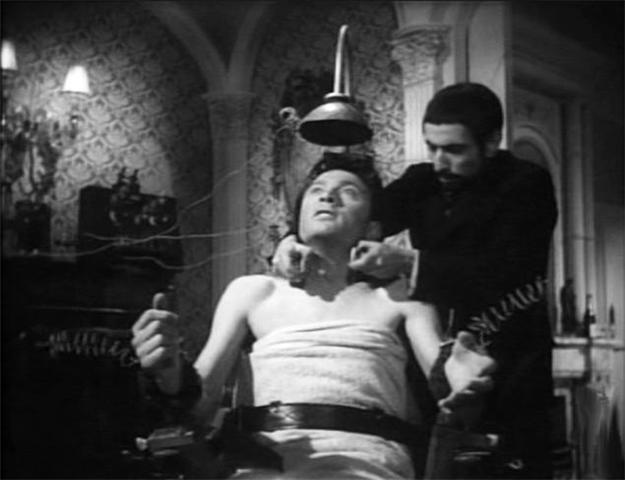
Dr. James Xavier (Ray Milland) is a physician who has temporarily abandoned his practice for research. The film opens with him in the chair of his optometrist Sam Brant (Harold J. Stone) having his eyes examined. Brant says there has been no change since the clean bill of health he gave Xavier three months before. “No change yet,” says Xavier. “You intend to experiment on yourself, don’t you,” scolds Brant. Xavier explains that the human brain processes only 10 percent of the known wavelengths in the universe. He wants to extend the range of human vision, perhaps look directly into the human body to diagnose diseases that standard X-rays can’t reveal.
Xavier returns to his lab, where he is visited by Dr. Diane Fairfax (Diane Van der Vlis). Fairfax works for the foundation that funds his work, and she says the foundation is ready to pull the plug because of a lack of results. Xavier says he’ll show her results that will knock her socks off. He places a drop of a compound he’s developed called “X” into each eye of a test monkey, and shows how the monkey can see through several sheets of paper. Suddenly the monkey dies. An autopsy reveals no organic damage; Xavier says the animal must have died of shock because it could not adjust to all the new images it was seeing. Fairfax is convinced.
Xavier starts to experiment on himself. With his new X-ray vision, he sees directly into a patient he is supposed to help operate on. His vision shows she was misdiagnosed, but he can’t get the chief surgeon to listen to him. In the operating room, Xavier cuts the surgeon on the hand so he cannot continue operating. Xavier takes over and goes after a tumor in another part of her thorax. Despite proving he’s right, he’s threatened with sanctions and his research funding is pulled.
A tragedy Xavier causes has him on the run, using his new sight, renewed by regular doses of X, to support himself in a carnival sideshow as “Mentalo.” His partner in the carnival, Crane (Don Rickles), finds out he’s not just pulling a stunt and sets him up as a healer who accepts donations. When Diane tracks Xavier down through the patients who visit her after getting diagnosed through him, they decide to head for Mexico or Canada where he can continue his research. Before they leave, he heads to Las Vegas to win the money he’ll need to set up shop elsewhere, but fate has something different in store for him.
As science fiction plots go, this one certainly isn’t the most farfetched. Despite the silly lab Xavier has, rigged with bottles containing colored liquids and tubes, the scene with the monkey is handled in a fairly believable way. In 1963, the general public might not have bought that the doors to perception could be opened with eye drops, but subsequent knowledge of how powerful a single drop of LSD could be lend some veracity even to this simple plot device.
Corman, of course, can’t keep cheese off the menu. His opening credits feature a close-up of an eye floating in formaldehyde. He knows what audiences would do with X-ray eyes, and throws them the bone of a party in which Xavier sees everyone naked (he even has Rickles voice this desire later in the film). He covers Milland’s eyes with white and black contact lenses, and gives us POV shots from Xavier’s eyes that employ colors suggesting theatres may have handed out 3-D glasses before the film. The scene in which Xavier spots the tumor inside his patient looks like nothing discernable to me; other scenes employ fluoroscopic images of skeletons moving and models of internal organs. Naturally, everything is cheap and looks it.
What really makes this picture the engrossing experience it is is the commitment of Ray Milland to this role. Xavier doesn’t become an evil scientist; he stays committed to trying to perfect X, make it more controllable, even as he seems to develop an addiction to it. Milland, an Academy Award winner for his star turn in the only Billy Wilder film I wholeheartedly endorse, The Lost Weekend (1945), has considerable acting chops. Even though his career dipped into B pictures, he brings a force and grace similar to what Christopher Lee and Peter Cushing lent to the best of the Hammer horror films. Even with a basic script and players who were not his match (though Rickles’ combination of his insult act and self-interested huckster was better than I thought it would be, and the character of Dr. Fairfax was a strong, intelligent woman, not just a loyal woman at her man’s side), Milland gets us on his side so quickly and thoroughly that we don’t feel that dread many scifi/horror films sell regarding the folly of science. He tempers Xavier’s idealism with practical ambition, his undercurrent of belief in the benefits of his work a spur to staying out of the reach of authority, and his mad dash in a stolen car a cause for concern at what might happen to him.
I know I’m a little behind my fellow bloggers in singing the praises of this B movie with an A heart, but I’m glad I now know what all the fuss was about. If you are like I was, it’s time you found out, too.
In the 12 Movies I Need to See Meme, one of the films I put on my list was The Wrong Box. My memories of the Robert Louis Stevenson book, written with the wicked wit that the Scottish do so well, and the droll merriment that the comic geniuses that populated 1960s Britain made of it in the film had never left me. In its spectacular wisdom, TCM aired The Wrong Box a couple of weeks ago, where Yoda-wise host Robert Osborne declared it one of his favorite comedies of all time. My DVR went into action, and I saved it for just the right evening when the hubby and I were ready to laugh long and hard. While the film’s comedy was milder than I remembered, I have no regrets.
“A tontine is named for Lorenzo Tonti, a Neapolitan banker,” we learn from Joseph Finsbury (Ralph Richardson), a “pedantic bore,” in the words of his older brother Masterman (John Mills). A tontine was a winner-take-all type of that eventually was outlawed because it resulted in subscribers trying to murder each other to become the last one standing to collect the entire pot of money. Both Finsburys and a cadre of other sons of well-heeled Englishmen were enrolled in a tontine as boys. The ceremonious contracting of the tontine, showing the short legs of the beneficiaries dangling just above the floor, their proud fathers towering behind them, the solicitor intoning the terms of the tontine to the eager, occasionally malevolent faces of the youngsters opens the film. One by one, the boys grow and die, until only the Finsburys remain.
Masterman and Joseph haven’t spoken in 40 years despite living in adjoining London row houses. However, when Masterman, who has been on his death bed for at least a decade, learns that the only man besides Joseph who stands between him and the tontine fortune (£111,000 and change) has died, he sends his grandson Michael (Michael Caine) next door. Michael has nursed a crush from afar for his cousin Julia (Nanette Newman), who lives with Joseph and her cousins Morris (Peter Cook) and John (Dudley Moore). Julia entertains herself listening to lurid stories of murder in London’s low-rent districts and worrying continuously about her safety. When Michael comes to fetch Joseph, he must speak to Julia through the letter shoot at the bottom of the door because she refuses to open up. When she finally does, their mutually goofy attraction plays out among Morris’ egg collection. Michael praises his collection, but Julia intones, “I think they’re obscene.” Discovering that the Finsbury men of the house are vacationing in Bournemouth, Michael arranges to telegraph them and thanks Julia for awakening him from his ignorance on the inappropriateness of Morris’ eggs.
Morris and John are delighted to learn that their uncle is dying, and they and Joseph catch the first train back to London. Joseph has been kept on a short leash by the boys, who would do anything to keep him alive to collect the tontine. He slips away from them when the train goes into a tunnel, and ensconces himself in another compartment occupied by an intense man (Tutte Lemkow) furtively knitting where he can smoke in peace. When he sees he has entered a no-smoking compartment, Joseph excuses himself to go smoke in the lavatory. The man is the notorious Bournemouth Strangler; he steals Joseph’s topcoat and hat to make his escape from the train. Just then the train collides with another train. When Morris and John go searching for Joseph in the wreckage, they spy two feet sticking out of a bin dressed in uncle’s clothes. In order to claim the tontine, they must prevent anyone from finding out Joseph has died before Masterman. Morris goes to London to check on Masterman’s health and arrange a death certificate for Joseph to appear just after Masterman dies. John is charged with boxing up the body and shipping it to London for the delayed funeral. Naturally, the body gets switched in London, and all the shenanigans that comprise this switcheroo farce ensue right up to the final frame.
The cast of this film are universally superb. Ralph Richardson is perfectly oblivious as he rattles off fact after boring fact to various captive audiences, including a Good Samaritan who offers him a ride in his buggy after the train crash. Richardson’s character offers to pay the man, who demurs, “The pleasure of your company will be payment enough.” No good deed goes unpunished in this film. John Mills doesn’t have a lot of screen time, but his various attempts to kill Joseph when the latter comes to visit him on his presumed death bed allow for some delightful pratfalls.
Caine and Newman play the blushing innocents in the high theatrics of 19th century melodrama, improved by director Forbes’ ability to goose the laughs with close-ups. Julia sees Michael’s bare forearm after he has rolled up his sleeves to cart a large crate into her cellar. Cut between close-up of arm and Julia’s widening eyes. She flees from Michael and swoons in the parlor. Michael pursues her and spies her exposed ankle. Close up of ankle. Close up of Caine’s alarmed eyes. This sweetly funny sequence ends in the “well what were you waiting for” kiss we’ve been led to anticipate, followed by medical student Michael’s concern about inbreeding. Both, it turns out, are orphans who were adopted by the Finsburys. Julia says of her pater, “Oh, I only knew mine vaguely. My father was a missionary. He was eaten by his Bible class.” Forbes emphasizes the comedy of melodrama by inserting stylized title cards, designed by Robert Ellis, that mix Victorian ornamentation with a 60s pop feel.
Peter Cook, of whom my learned colleague Rod wrote so wisely in his very recent review of The Rise and Rise of Michael Rimmer (1970), is perfectly unctuous as the pushy, greedy older brother to Dudley Moore’s perpetually-in-heat John. The pair plays well together, but aren’t really allowed to stretch the limits of the comic possibilities at their disposal, coming off as fussy rather than ferociously funny. Their best scene for me was a very physical one in which they attempt to keep the tontine solicitor from retrieving the box containing the tontine cash payout by falling all over themselves to haul it around a funeral in progress.
The two comic standouts are Peter Sellers as the disreputable Dr. Pratt, who provides Morris with the fake death certificate, and Wilfrid Lawson, who plays Masterman’s decrepit, old butler Peacock. The latter, a red-nosed, alcoholic geezer whose slurred speech is nearly incomprehensible, was, sadly, playing himself. Nonetheless, Peacock knows what’s going on around him and lurks perfectly with that gentle awareness of the lackey who has learned how to stay out of the line of fire. Sellers, of course, needs no salesmanship on my part. He’s utterly vague and distracted, surrounded by cats on every surface and in every drawer, and attempting to keep up appearances of professional propriety while upping his fee for the death certificate from five to ten shillings when Morris says that price is no object. When he signs the death certificate, Morris must call out the spelling of the doctor’s own name; Pratt blots the fresh ink with the back of a kitten he has stashed in his desk drawer, certainly an inspired bit of improvisation.
There are a great many more delights from the cast of hundreds that comprise The Wrong Box. I can only encourage you to pick up the right box and see for yourself.
As an aficionado of his performances in films like Boxcar Bertha (1970), Bound for Glory (1976), and (1978), I didn’t need Quentin Tarantino to remember for me what a great actor David Carradine could be. Yet Carradine’s peculiar life and death confirm that he was as a man much like the characters he often played—rootless, peripatetic in life and career, taciturn and emotionally ambiguous in image. His long attachment to the half-baked TV series Kung Fu, Roger Corman, and New World Studios saw him crowned king of 1970s and ’80s trash, blotting out his best achievements. In many ways, his career replicated that of his father, John, in becoming the sort of face cinema needs but rarely treasures; Ingmar Bergman cast David in The Serpent’s Egg because of Bergman’s admiration of John. Carradine himself seemed surprised that he could still rise to the occasion when Tarantino cast him as the titular rogue in his colossal diptych, Kill Bill.
I am glad that Tarantino remembered how cool Carradine could be, because his crocodilian charm is crucial to the success of Kill Bill, a work I make no apologies for considering one of the greatest of the decade. Deliriously entertaining, colourful, and altogether unique in its blackly hilarious melding of cherry-picked clichés and vital characterisation, Kill Bill is, at the very least, the sort of film no other director could pull off. Tarantino is, in many ways, the straight man’s Pedro Almodovar: a self-conscious quoter of generic traditions, fueled by the strong emotional charge inherent in disreputable cultural detritus, setting his ardour of artifice and ground-level feel for human interaction in a pas de deux as intricate as the swordplay.
Kill Bill wants, first and foremost, to be an exciting, funny, and strangely romantic action film. It’s the tale of Beatrix Kiddo (Uma Thurman), known only as “The Bride” for most of the film. She awakens from a four-year coma, and begins a determined effort to wipe out the members of the Deadly Viper Assassination Squad—Elle Driver (Darryl Hannah), Budd (Michael Madsen), O-Ren Ishii (Lucy Liu), and Vernita Green (Viveca A. Fox), and their boss Bill—in revenge for their murder of her fiancé (Chris Nelson), friends, and her unborn infant, as well as the cap Bill put in her own crown. She quit Bill and her life as one of the Vipers (code-name Black Mamba) when she found she was pregnant with Bill’s child, and tried to settle into a normal life, but Bill tracked her down and instituted the carnage. In her bloody revenge, she takes out redneck rapists, hordes of yakuza bullyboys, a psychotic schoolgirl, and a Franco-Japanese lawyer dressed like a Star Trek villain. A major criticism leveled at the film is that the first part contains all the great set pieces, and it’s true—the House of Blue Leaves sequence is one of the mightiest set pieces in cinematic history and a notable riposte to Hollywood’s increasing inability to shoot action scenes. But it’s the second half that has the truly relishable character turns: Hannah’s imperiously sexy Elle; Madsen’s weirdly sympathetic, if irredeemably vicious, Budd; Michael Parks’ sibilant, courtly but malevolent pimp Esteban Vallejo; Gordon Liu’s Pai Mei; and, of course, Carradine’s Bill.
Tarantino’s direction, Sally Menke’s editing, and Robert Richardson’s cinematography were all at their height, and scene after scene is a treat for the eye. I once went to a dance venue where the DJs projected Vol. 2 on a screen, and the film’s purely rhythmic structuring adapted itself to any beat the DJs spun. In closer analysis, the structure of Kill Bill also reveals a vital aspect more floridly than any other of Tarantino’s films: Kill Bill revels in the dialectic between fantasy flourish and realism. The film begins with an ordinary suburban household becoming the scene of a ruthlessly violent struggle, and concludes with what is essentially a tiff between former lovers. In between comes a work that builds to the height of generic stylisation, in the epic House of Blue Leaves battle, and yet maintains an amusing contrast with everyday, tactile realism. For all their startling gifts, the characters live in most bog-ordinary of settings: trailer homes, suburban bungalows, sushi parlours, and bland hotels. Budd contends with the sarcasm of a cocaine-snorting titty-bar owner (Larry Bishop), and Tarantino notes with intimacy something as throwaway as Budd’s methods of making cocktails. Hattori Hanzo (Sonny Chiba) and his assistant (Kenji Oba) run a sushi bar and squabble like an old married couple. Such touches provide the messiness of the everyday, constantly bumping against the formalism of generic material where yakuzas duel with samurai swords because it’s more honourable.
Tarantino’s bent is not satiric, however, though it is ironic. It’s more a tacit acknowledgement how much the life-and-death dramatics of our beloved fantasies inform our perceptions of our everyday lives. The film’s musical leitmotif, Nancy Sinatra’s “Bang Bang (My Baby Shot Me Down) ,” is the story of a woman whose play-act gun battles as a child reflect an adult betrayal by her childhood sweetheart, and the film itself concludes with a duel of plastic guns and a literally broken heart. Despite the gushing blood, the film’s truest paragon of life and death is a dead goldfish. The disconnect between Bill’s voice and actions in the moment he shoots his former lover in the head, proclaiming himself at his “most masochistic,” hints at the later contradiction that asserts itself in Bill. He’s effortlessly the most charming guy around, and the most violent—the bad boy of many a woman’s fantasy and reality. Flashbacks to Bill and Beatrix in their prime reveal a young woman almost goofily in love with a wise elder; when she returns, hardened to the point of psychopathy, their interactions nonetheless confirm a still-guttering mutual love, irreducibly shaded with hate and hurt. “I knew what would happen when I shot Mommy,” Bill confesses to his and Beatrix’s daughter BB (Perla Haney-Jardine). “But I didn’t know when I shot Mommy what would happen to me.” He goes on to use the corniest trope of super-villainy, the truth serum, to extract from Beatrix the exact nature of her motives in abandoning him, in the film’s most crucial union of the fantastic and the emotionally imperative. If Rear Window (1954) is the cinema’s greatest portrait of pre-wedding anxiety, Kill Bill could be its greatest divorce drama.
The Bride’s relentless vengeance, dealt out in unremitting havoc, takes in a variety of shaded, apposite figures that evoke family roles: her sister in injury, O-Ren Ishii; Bill and Budd, mutually recriminatory brothers; Bill, both lover and father-figure of Beatrix; Bill “collects father figures” like Esteban; Elle kills the more formidable, more beneficial paternal figure for Beatrix, Pai Mei, and as her evil double, supplants her as Bill’s lover; Vernita, living the hidden, suburban, maternal life Beatrix aspired to; Go-Go (Chiaki Kuriyama), who could well be the kind of violent youth Beatrix was. It’s not hard to read, in Bill’s status as a fatherless child of the borderlands, and the revolving theme of severed and transient family, a certain level of self-analysis on Tarantino’s part, except that his way of analysing it isn’t through confessional filmmaking. So many of Tarantino’s protagonists are rootless, living out of motel rooms, lapping up television shows and shreds of culture, and threatening to bust out of their cages. Kill Bill quotes westerns, women’s melodramas, kung-fu, and samurai flicks, becoming a kind of pan-cultural epic of trash. When Bill delivers his theory of the nature of Superman in relation to a critique of humanity, it’s pretty well true of this film, too: humanity critiqued through the costumes it likes to dress its concerns in that save us from the boredom of being ourselves.
Much like a classical epic poem, Kill Bill’s story is in motion when the tale begins, and it stretches off in all directions, both in time and into other films. Tarantino has always embraced ideas of intertextuality—that common body of elements crucial both to the production of any genre and their academic study. He stretches it to the limits by having every character a player in some other story (although only one, Pai Mei, is a true stock villain, from Chinese mythology). Each journey affects another: The Bride’s vengeance is not merely self-contained, but the result of an Ouroborous-like cycle of violence, where many of the major characters are defined by the loss of someone invested with love or trust (O-Ren’s parents murdered; Beatrix’s and Bill and Budd’s families mysteriously absent; Hattori betrayed by student Bill). This flux isn’t resolved until the most vital of family connections, mother and child, is restored (BB’s name confirms the closure). Even then the story isn’t finished—Vernita’s daughter may one day come seeking her own payback.
Tarantino internalises not only the tropes of eastern genre films, but also their more notably dark sense of human conflict, and, paradoxically, their cartoonishness. Blood spurts, head and limbs roll, guts spill, small armies are butchered, and there’s enough go-for-broke grotesquery to satisfy, but Tarantino uses distancing effects—anime, black and white, ludicrous sound effects like tumbling ten-pins, and fights staged and lit like modern dance routines—to discharge most of the brutality. Kill Bill is, in many ways, as much a musical as a melodrama. One major model was the Lone Wolf and Cub series, where, likewise, a strangely touching parent-child relationship is counterbalanced by hair-raising violence, as if simultaneously acknowledging the potential cruelty of life and the power of the family unit in alleviating it. Kill Bill also notes the common elements in the disparate cultural entertainments that confirm the righteousness of heroic enterprise, the essence of honour, the immutability of family and loyalty, and the amount of joy so many people find in watching heads get cut off onscreen.
Kill Bill is also a film with a genuinely dynamic and interesting female hero. Most stabs at creating action heroines come across like fashion models jammed in cat-suits, or men in skirts, but Beatrix is detailed, emotionally and intellectually complex, and not exactly the nicest woman in the world. She’s a savage killer, and once she commits to vengeance, she pursues it without mercy, to the point where she leaves children without parents. She’s also an actual female protagonist who experiences specifically female problems—the whole narrative is spun from the fact that she abandoned her previous lifestyle to bring up her child, thus contending with a difficulty that confronts many women. The film then, through all it flights of fancy, is sustained by a critical sense of The Bride’s incensed pride and sense of loss, leading to a final scene where she weeps in gratitude and grief for everything her mission has brought her.
Bill had to be a very specific mixture of bastard and charmer, convincing enough to be the man a woman like Beatrix could both love and loathe with such finality. One of the film’s few lacks is a scene that shows Carradine cutting lose as Bill (although the DVD of Vol. 2 includes the deleted “Damoe” scene, which illustrates both how awesome, and awesomely unprincipled, he is), but Carradine communicates both a certain leathery, hardened brutality, as well as a soul-deep ache underneath his amiable, talkative, stylish exterior. He heads towards what he knows is his well-deserved end with a strange dignity: note how well Carradine plays the scenes where he quietly gets drunk enough so he knows he’ll be little threat to Beatrix.
There’s great appeal to stories in which imaginary characters take on a life of their own. How magical that an imaginary, perhaps idealized world can suddenly become real! Of course, the flip side of that wonder is the fact that when our real and imagined lives start to cross, we most likely have lost our marbles. Stranger Than Fiction was a comedy that took the easy way out of this dilemma by having the fictional character at the center of the film, relieving his creator of charges of lunacy. Lovely by Surprise centers on a first-time novelist whose characters escape from her book because she has been untrue to herself. This much more serious literary and human dilemma adds depth to the fanciful wish-fulfillment that stories of this type traffick in.
Marian (Carrie Preston) has been consulting with Jackson (Austin Pendleton), her former writing teacher, about her work in progress. As Marian reads to Jackson, we see her main characters, brothers Humkin (Michael Chernus) and Mopekey (Dallas Roberts), dressed only in their undershorts, on a ship in the middle of an open plain. They fish for their food, fearing a shark at the end of the hook, but bringing up boxes of cereal time and again. They spend their days opening these boxes to get the prizes inside, waiting for a driver to deliver milk so they can eat the cereal, playing word games, and watching television. Marian says Mopekey is happy to stay on the ship, but that Humkin wants to explore the world. Jackson thinks the book has promise but that it lacks a central conflict. He tells Marian that she should have Mopekey kill Humkin for wanting to leave him behind. Marian is deeply disturbed by this idea, saying that her book is about optimism; Jackson calls her a coward and insists that’s what the book needs. She says she will think about it.
The scene shifts to a salesman named Bob (Reg Rogers) sitting behind a desk talking with a customer about buying a car. Bob tries to assuage the customer’s uncertainty with soothing, medium-pressure tactics. When he convinces the man to buy the car, Bob changes course and asks him if he really wants, really needs a new car. His old car is full of wonderful memories, isn’t it? He’s missing quality time at home with his family right now by sitting with Bob discussing a deal, isn’t he? The man agrees and leaves without buy a car.
Bob’s boss Dave (Richard Masur) displays fatherly concern for his good friend, who we learn has recently lost his wife, gives him a pep talk, and tells him he’s two hours late in retrieving his 6-year-old daughter Mimi (Lena Lamer) from school. Bob fetches Mimi, who, also traumatized, has been refusing to speak. He gives confusing instructions about who will make dinner, drops her off on the street to walk home, and goes back to the dealership. When another customer flees after Bob scares him away with admonishments to spend time with his loved ones before it’s too late, Dave confiscates Bob’s company car and promises to return it the minute Bob makes a sale.
These two stories, which not only seem disparate in focus, but also in time—Marian in the present and Bob wearing leisure suits and selling 1970s cars—come together when Humkin, destined to die under the milk truck, runs “like a rocket” right into Bob’s dealership. Bob, who has been warned he must not scare another customer away, takes the scantily clad Humkin for a test drive. Finding Humkin to be rather insane, Bob takes him home for the night. Mimi is delighted with Humkin, and soon starts to come out of her shell. Marian, in the meantime, is going frantic looking for Humkin (“the best part of me”), whom she realizes after finding sheets of paper scribbled with dialogue strewn around her apartment, is now alive and fleeing from her.
Lovely by Surprise maintains a delicate balancing act, keeping the audience confused about the direction of the story for quite some time, while offering clues to the observant viewer as to what Bob and Marian have in common. It’s fairly easy to stay with the film because screenwriter and first-time director Kirt Gunn has created a very likeable cast of characters. Bob and Dave, beautifully played by veteran character actors Rogers and Masur, look like used-car salesmen and speak in the clipped patois so reminiscent of David Mamet’s Glengarry Glen Ross hucksters. But Bob and Dave are warm, kind men, and it’s hard to imagine that they live down to the reputation of their profession. Bob’s pain and frustration with Mimi, needing her to console and likewise console him, never really become explosive or scary.
Marian is a person anyone can relate to—though, of course, writers will relate to her most closely. She’s young, trying something hard, something that requires her to dig deep into unexplored areas. Her fear drives her to seek the advice of a man who not only can’t do what she can, but also wishes to seduce her. Austin Pendleton always seems a bit slimy just by the shape of his front teeth, and his Jackson is pushy and offhand with Marian, but he also manages to come through for her. For that matter, Jackson’s dizzy wife Helen, wonderfully played by Kate Burton, knows when to be drunk and when to be sober; she’s never as oblivious as Jackson or the audience may think.
I absolutely adored Humkin. He spouts nonsense that he’s learned from the television, and is an utter innocent. But he knows what has been happening to him and understands what Bob needs to do to reach Mimi. He’s comic, and huggable, and certainly is the best part of Marian, that is, if she wishes to remain a child.
I thought the script was very well written, cleverly constructed, and varied in tone to create the two worlds Marian and Bob inhabit. I also liked the use of the Memphis locations, perfectly chosen to reflect the fantasy world of Humkin and Mopekey, the suburban milieu of Bob, and the intellectually rarified world of Jackson and Helen. I even liked Marian’s garret!
But there was just something missing. The story Gunn tells is moving, yet I felt fairly unmoved. I liked and cared about these characters, but my feelings just didn’t go very deep. Carrie Preston is very sweet as Marian, but like her character, she may have shied from taking that leap of faith to the underlying emotions that power her story. Yes, this film was surprising and lovely, but it was perhaps just a bit too delicate. l
Necessarily graphic or exploitative trash? Blasphemous or truthful? All the fuss that has accompanied , the pas du tout-est of the pas du touts at this year’s Cannes Film Festival, put me in mind of another film that raised hackles so high that it was released only after heavy censoring and nonetheless still was banned in many places. I’m talking, of course, about The Devils, Ken Russell’s account of events that took place in Loudon, France, in the 17th century that marked the end of independent city-states and the beginning of a united France under royal rule.
Ken Russell is the most operatic of film directors, and with the The Devils, he made his most impassioned statement about power, corruption, human degradation, and the possibility of redemption to date—indeed, it’s hard to think of another film that matches the sheer ferocity of its vision. I’ve seen the film maybe four times, and it never gets easier. This latest viewing was the hardest by far because it included a number of banned scenes I’d never seen before, including the infamous “Rape of Christ” sequence. Russell and all supporters of the film who saw it—including a Catholic priest who sat on the Legion of Decency board in the United States and saw it prerelease—consider this scene to be the very heart of the film, and so it is a welcome inclusion indeed.
After many fruitless searches, a canister of film showed up in England that contained this and several other deleted scenes. Eurocult issued a cheaply produced, muddy DVD of the film in 2007 that includes this footage but does nothing to restore the sharpness and vibrant colors created by DP David Watkin and the textures of the famous Derek Jarman set. Until this deficit can be corrected, this DVD stands as must-see viewing for cinephiles, in general, and Russell fans, in particular.
Russell introduces us to the world in which the story takes place, fittingly, on a stage. A roiling sea, created by moving pieces of scenery shaped like waves back and forth, brings forth a majestic figure in a geometric fan of a cloak. When the cloak is removed, we see a heavily made-up man wearing a gold seashell bra and codpiece—Botticelli’s Venus in drag. Cruel, dissipated King Louis XIII (Graham Armitage) and his politically astute adviser Cardinal Richelieu (Christopher Logue) applaud the performance tableau and retire to consider the destruction of the walls and independence of the fortified city-states of France. Richelieu has his eye on the most powerful of them all, Loudon, whose popular governor has just died, making it vulnerable. He will learn when he moves against the city that he will have a formidable enemy in Father Urbain Grandier (Oliver Reed), who forcefully protects the city’s right to self-rule.
Unfortunately, Grandier has opened himself to attack by his sexually promiscuous lifestyle. He has impregnated and abandoned the daughter (Georgina Hale) of a powerful city elder, and virtually every woman in Loudon has the hots for him (“Now there’s a man worth going to hell for!”), including the head of the Ursulline convent, Mother Jeanne (Vanessa Redgrave). A hunchback with no prospects for marriage, Mother Jeanne had no alternative but a nunnery. She and many of the other throwaway women in the convent are starved for human contact and very sexually frustrated.
She has fixated on Grandier, and has had vivid sexual fantasies about him; Russell films one amazing fantasy in which Grandier, as Christ, steps off the cross on which he has been crucified so that Mother Jeanne can lick his wounds—a portent of things to come. When she overhears news that Grandier has married himself to a beautiful orphan named Madeleine (Gemma Jones), whose dying mother he attended to, she goes quite mad. She tells Father Mignon (Murray Melvin), the convent’s new confessor, that Grandier has bewitched her and violated her sexually. This is all that Richelieu’s agent, Baron De Laubardemont (Dudley Sutton, in a swelteringly brilliant performance), needs to bring Grandier to trial for witchcraft and have him condemned to the stake.
It’s hard to know where to begin in describing this stunning and disturbing film, but several scenes stand out not only for their visual audacity, but also for the way they communicate character. Madeleine’s mother is attended to by two sadistic “doctors” who put wasps under glass directly onto the plague boils that afflict her, causing her enormous suffering. Grandier tosses the pair down a long staircase and removes the cupping jars from the poor woman so that she can die in peace. The opposition of these men and Grandier is made clear in this scene; on another level, the bloodthirsty “doctors” show the worm in the apple of Grandier’s eye—Loudon—and the “doctors” will get a turn at Grandier when he is tortured to determine if he is a minion of the devil. However, they do their worst against Mother Jeanne.
Russell told Jarman that he wanted Mother Jeanne’s physical examination for proof of sexual violation to be like a rape in a public toilet. This Jarman realized beautifully by creating a Loudon made of white tile. The nave of the convent’s church even has a white-tile altar; the doctors sweep the religious artifacts used for mass off it with a rough arm and lay Mother Jeanne upon it, where they penetrate her with their instruments. Her screams and blood-soaked habit, followed by the verdict, “Yes, definite signs of violation,” come as no surprise to Mignon, De Laubardemont, or us.
Grandier’s execution is another vividly disturbing scene. Dragged through the streets on a sledge because his legs have been shattered by torture, he is made to crawl to the stake. The executioner promises to strangle him before the fires can reach him, but the impetuous exorcist Father Barre (Michael Gothard) lights the flames before the executioner can position the noose. As the crowd (according to reports of the time, the largest ever assembled at a public execution) celebrates, Grandier’s flesh blisters and chars in graphic horror. Father Mignon, heretofore a crazed zealot against Grandier, becomes convinced of the priest’s innocence and twists his amazing face into an image of despair. Peter Maxwell Davies, the great English modernist composer, said that members of his orchestra were in tears as they played his discordant, plaintive score in synching the film.
The most disturbing and meaningful scene of all is the rape of Christ. While Grandier is pleading Loudon’s case with the king, Barre has been whipping the nuns and town into a frenzy. He holds an exorcism in Loudon’s cathedral attended by masked townspeople. The Ursulline nuns strip off their habits and cavort naked and wonton among the horde. One nun is shown licking and rubbing herself against an altar candle. Others allow themselves to be groped, and tear at and rape a priest. The scene climaxes when several nuns lift an enormous crucifix off the church altar and begin licking it; one woman fucks its wooden genitalia. Father Mignon climbs a staircase on the wall, watches the women groping the figure of Christ below, and masturbates desperately. Intercut with this scene of blasphemy is Father Grandier holding a simple mass for himself on a river bank, with a voiceover narration of a letter to Madeleine in which he asks for her prayers that he may fulfill his wish to serve the people of Loudon. Besides being, as Russell calls it, a “mindblowing” scene to watch, it embodies the outrage at the perversion of Christian teachings of forgiveness and love. A cynical government used and abused some already used and abused women to distract and put the town in the mood for a lynching; these “exorcisms” would continue throughout France to allow the Crown to destroy the independent city-states and those who would oppose them.
After Grandier’s execution, Baron De Laubardemont visits Mother Jeanne preparing for her exorcism act in a neighboring town; this road show reverberates with the birth of Venus at the film’s opening—both theatrical perversions of the birth of love. He throws her a bone, “a souvenir” he calls it; it is, literally, a charred bone from Grandier’s body that looks very much like a cock and balls. In another censored scene restored, Mother Jeanne uses it as a dildo to commune with the man she loved and destroyed.
Among the DVD extras is a fine documentary hosted by BBC film critic Mark Kermode, who led one search for the deleted scenes, that details the film’s battle with the censors and critics and shows Russell and two of the film’s stars, Georgina Hale and Murray Melvin, viewing the rape of Christ scene for the first time in more than 30 years. The film critic of The Evening Standard at the time, Alexander Walker, reads from his review and recounts how Russell bashed him over the head with a rolled-up copy of that week’s paper when they met on a talk show. Russell relates that after that incident, Walker was good-naturedly trounced with rolled-up newspapers by his colleagues: “Too bad there were no lead pipes in them,” Russell says bitterly.
While Russell’s film clearly shows his obsessions with sex and excess, and his occasional silly hamminess (for example, the king shoots men dressed as crows for amusement and says into the camera, “bye bye blackbird”), the events portrayed in the film are not exaggerated. Censors always worry about excessive nudity, but their concerns merely reinforce the sexual repression that set the stage for the sexually explicit exorcisms of 17th century France. The blasphemy of the nuns is juxtaposed with the piety of Grandier, but in exercising their prudish prerogatives, the censors also succeeded in preventing the public from seeing the disturbing complexities of faith this scene evokes. In the end, nakedness is much less arousing than the idea that Church and State can conspire to rob the people of their freedom.l
One morning, at the London building that houses the clapped-out market research firm Fairburn Polls, a tall, attractive, preternaturally poised young man appears clutching a clipboard. He introduces himself to the manager, Mr. Ferret (Arthur Lowe), as Michael Rimmer (Peter Cook), from “coordination”. He moves about the building and discovers employees watching football, practising ballroom-dancing moves, perving on secretaries, and doing just about everything except their jobs. A client of the firm walks in and punches Ferret in the face. When Rimmer asks Ferret if he’s received the results of a poll on a brand of boot polish, Ferret replies that he hasn’t, but he does have the findings of a survey for a new breakfast treat: they have found that 90 percent of Britons don’t like eating boot polish for breakfast.
Rimmer reports to the company’s owner, a fly-fishing plutocrat, Fairburn (Dennis Price), who doesn’t remember hiring Rimmer, that his organisation is a shambles and is losing £75,000 a year. “There’s a phrase coming to me,” Fairburn rants: “Fire Ferret!” Rimmer is soon installed as the head of the firm, and he transforms the building overnight into a slick ultramodern concern, whilst Ferret is reduced to working as a menial in the building, pretending to his wife that he’s still the boss whilst hocking all their furniture. Rimmer’s business approach soon reveals itself: when a pair of reps from a company that makes humbugs approaches him, he tells them that his surveys have found that customers simply don’t like their product’s taste. But not to worry. Rimmer makes a racy ad for it that shows a pining blonde in bed finding satisfaction with her humbug. Rimmer’s “sex sells” approach is gold, and he soon achieves national fame by conducting a Kinsey-esque survey, defending his lewd discoveries on the TV show of Steven Hench (Harold Pinter) by presenting himself as a messiah of a new age of genuine, personal satisfaction. He destroys a rival polling organisation by poaching their best man, Peter Niss (Denholm Elliot), and sabotaging their research by arranging for their sample takers to come up with figures that show a majority of residents in one town are practising Buddhists.
Soon, Rimmer is everywhere, from advising the Bishop of Cowley (Graham Crowden) that because 70 percent of British people have serious difficulties believing in God, the Church should try selling agnosticism, to aiding the Tories’ stuffed-shirt leader Tom Hutchinson (Ronald Fraser) in trying to build himself a public image that isn’t of a vapid, vain, humourless dimwit. Rimmer himself is aiming to join a future Conservative government. The treacly incumbent Labour Prime Minister (George A. Cooper) thinks he’s media-savvy, and proposes that the coming election is not about economics or anything like that, but about morality. “I’ve never seen anyone dig their own grave before,” Rimmer chuckles. Rimmer stage-manages a protestor’s invasion of a Conservative Party conference where Fraser puts down the hippie rabble (hired for the occasion) and manages, despite going on with his prepared script after being asked an entirely different question, to present himself as an emotional, responsible man—dare one say it?—a compassionate Conservative. Rimmer then contrives to let a rabid racist in the party off the leash so that Fraser can both condemn him while also confirming the Tories as generally tougher on immigration. He also arranges for an antiracist MP to be mugged by a black man, to break his veneer of tolerance, but without success.
Rimmer’s a film I had heard about for so long—from a glowing review by sci-fi critic David Wingrove through to inspiring the name of Chris Barry’s archetypal priss in the TV series Red Dwarf—it had come to seem a cultural unicorn: legendary, impressive, and impossible to find. The film begins uneasily with a sequence scored with groovy music in which Lowe’s Ferret ogles the backside of his mini-skirted secretary. For a horrible moment, I thought the film would prove one of those try-hard sexy comedies that British cinema churned out with increasing desperation in the ’70s (many of which starred Cook and/or his ex-partner Dudley Moore). But Rimmer soon finds its gear and moves ahead, like the title character, with smooth, sharklike relentlessness of purpose. Cook and his costars John Cleese, Graham Chapman, and director Billington, were the quartet who provided the script, tossing off incisive ideas and gags that other satirical films would drag out and hammer home (see: the works of Paddy Chayefsky or Wag the Dog, 1998), and the result is a near-perfect example of what those comics could do at the height of their gifts. The credits confirm an interesting melding of the two disparate, influential comedy forces to emerge at the time:Private Eye/Beyond the Fringe mastermind Cook, and Monty Python members Cleese and Chapman, with a terrific battery of actors backing them up. Particularly notable is Pinter’s saturnine Hench; if Pinter had ever wanted to be a talk-show host, he’d have done it in style.
Rimmer, as a character, was rumoured to have begun as a barbed portrait of David Frost, Cook’s former alumnus in the That Was the Week That Was TV show who, amusingly enough, executive produced this film. Cook, however, presents in Rimmer an übermensch with a devilish airiness, an expansion of his interest in the Mephistophelian figure as explored in his and Moore’s earlier hit Bedazzled (1967). Rimmer’s identity is unclear: where he comes from isn’t established, and even he doesn’t know who he is, claiming to have been found “in the bulrushes.” That said, Cook conceives in Rimmer a very real creature whose time had not yet come—a Yuppie. Smooth, slick, utterly involved in personal success, he defines and appeals to the self-centred bastard in everyone else.
Rimmer sets about slashing away the remnants of messy, eccentric, classical Britannic spirit embodied in the Dickensian eccentricities seen in the Fairburn building, and replaces it with shiny, technocratic, streamlined exploitation. He manipulates the foolish, stuffy, country-gentleman affectations of the old-school Tories to make room for himself, the perfect prototype for a Neo-Conservative, installing himself as a Chancellor of the Exchequer. Then, in the guise of saving his nation, he goes to war, not in the Falklands or Iraq, but in Switzerland, where he has a detachment of soldiers led by Col. Moffat (Julian Glover) rip off gold reserves and passing it off as terrorist action.
Rimmer has a prescient focus that observes the undercurrents of the era,and predicts where they would resolve with unique clarity. So many of Rimmer’s stunts are now de rigueur, and not merely in suggestions of oral sex used to spice up a candy ad—advertising has long since equalled and surpassed such excesses—but in political culture. From “mission accomplished” to the rhetoric of compassionate conservatism, the naked greed-is-good public philosophy of the 1980s, and reactionary vote courting that pretends to condemn and exploits at the same time, we live in Rimmer’s world.
The ’60s were, in addition to many other things, a golden age of satiric comedy that went hand in hand with the creative fecundity of the era. To survive beyond its moment of creation, satire needs other substantial qualities going for it, including a prescient edge. Dr. Strangelove (1964) lives long past the end of the Cold War because of its razor-sharp filmmaking, characterisation, and open embrace of the apocalyptic thinking that still defines the modern age. British cinema in particular served up some beautiful examples: 1959’s I’m Alright Jack, a tart reflection on postwar labour relations, was the trumpet blast for an era in which satire was the ennobled comedy form (how things change!), and writers like David Sherwin and Terry Southern had cultural clout. Peter Watkins’ Privilege (1967) made notes on the potential interrelationship between poses of rebellion in pop stars, commercialism, and political manipulation, whose accuracy, like Rimmer’s, wouldn’t be entirely revealed until the 2000s. Rimmer also anticipates Lindsay Anderson’s O Lucky Man! in seeing the countercultural wave as on the wane; both films are angry, Voltairian epics reflecting both the cultural energy of their country coupled to an ironic reflection of the nation’s irreversible decline in world affairs (they share cast members Lowe and Crowden). Rimmer’s vision of the British place in world affairs depicts the Prime Minister sitting alongside other world leaders, advancing couch by couch up a hallway in the White House like customers in a deli.
Rimmer’s only concession to standard dramatic conflict comes when Rimmer, to boost his profile and popularity, marries Olympic equestrian Patricia Cartwright (Vanessa Howard)—their honeymoon takes them to a photo opportunity in Budleigh Moor (pun intended), the seat he hopes to win in the election—and then neglects her once the job is done. Niss falls for Patricia, but she, although disappointed with Michael, maintains her loyalty. In the end, after toying with the idea of bringing him down, Niss and Patricia give in to Rimmer’s promises of power. The film’s most far-out, and yet devastating, segment is the final one, in which Rimmer introduces an experiment in direct democracy: involving the population in voting on all matters of policy. Everyday people analyse policy documents and are alerted by flashing alarms on their television sets to take part in emergency plebiscites on matters like regional development and water purification. The populace becomes so exhausted and outraged that they gladly vote for Rimmer to become president and dictator—exactly what he wanted, of course—to put an end to it.
Perhaps because of its firmly British focus, its lack of soap-opera dramatics and speechy outrage (such as those that spice up the far-better-known, but bloated and soapy Network, 1976), or just its no-name director, Rimmer never received an American theatrical release and is largely neglected. But it’s a funny, incisive, relevant film.
Greg Ferrara, the blogger formerly known as Jonathan Lapper, has been plunging headlong into the mainstream of film blogging. First, he revealed his real name. Then he decided to host his first blogathon. Now he’s started a , something Ferdy on Films, etc. has yet to do. This one should be interesting to think about. Here’s what Greg says:
I’d like to know what my fellow bloggers think matters about cinephilia. A list, a paragraph, a thought or two. However you want to do it. Just a little bit of what you think is important about studying film, loving film, and discussing it with like minds. Basically, what have you learned? I know I’ve learned more than I ever did from decades of reading film books. How about you?
There are some things that make cinema vitally important—as Gene Siskel said, a film critic has the American Dream beat—in terms of what it reflects about the way we live, how we see ourselves and others, and what fires our imaginations. Cinephilia, however, is full of a lot of nonsense, in my opinion, like compiling lists, watching box office returns, and overtheorizing what the filmmakers themselves saw as factory work done for dough. Blogging about film is a whole other animal. Bloggers have been taken to task by traditional media for everything from bad writing to destroying the economy. But what do they know? They don’t live here—we bloggers do.
So here’s what I’ve learned about film, blogging, and the Internet since starting Ferdy on Films, etc. more than three years ago.
1. You can get free shit and press passes just as easily as a blogger as you can as a print or broadcast journalist. You just have to grovel a little more at the beginning.
2. There are three major camps in the film-blogging world: the young geeks who tend not to write very well, normally don’t consider any film older than 1990, and usually only read their own kind; the snobs who write pretty well, but impenetrably, and stick with their own kind because to do otherwise would be to lower their status in the film community; the rest of us, a decidedly mixed bag, who aren’t on the make and don’t necessarily give a hoot what people think of what we’re doing.
3. Cable “news” has had a bigger effect on blogging than anyone would care to admit, as evidenced by a lot of tempests brewed in teapots all over the blogosphere just to drive traffic.
4. Film bloggers know how to build a sense of community with memes and blogathons, but when they’re over, we tend to go back to the dime or so blogs we usually read.
5. There are a lot of good writers out there with a lot of knowledge about film. Although I have some unique things to offer and Rod and I make a pretty formidable team together, I’m not so special, and that actually isn’t a bad feeling. The world isn’t full of yahoos after all!
6. You never know who is going to read your stuff, what’s going to be popular, or why. I’m still getting hits to How Tasty Was My Little Frenchman from a Russian discussion forum well more than two years after they posted the link.
7. Comment sections are among the best things on a blog. They can be witty and irreverent, more informative than the original post, and include people you never thought would show up. I’ve had the son of the director of One Day in the Life of Ivan Denisovitch, a full-blown family feud in the comments for the Hank Garland biopic Crazy, and a filmmaker or two, in addition to my usual posse.
8. It’s very satisfying to be the first external review of a film on IMDb. A lot of these films deserve more attention.
9. Once you start a blog, it’s hard to stop or slow the pace of feeding the beast…
10. …leading to Internet fatigue hitting me more frequently than it used to. I just want to turn everything off.
11. Reviewing and theorizing about cinema can be fun, but it’s not really that important in and of itself. It’s more important to me to show how cinematic images shape our attitudes and the world in which we live, and thereby influence hearts and minds.
12. Macs are hundreds of times better than PCs.
13. Having people assign films for me to view is both exciting and painful. So far, maximum pain has not been inflicted on me by anyone.
14. What is it with people clicking a link to this site, reading what’s here, and going back to the original site to comment?!
15. People you don’t know want to control what is said about everything. A blog is one of the best ways to fight back.
I’m a fan of Bob Fosse’s Cabaret (1972)—for convenience, let’s call it my favourite film musical. I’d always wanted to see I Am a Camera, the film of John Van Druten’s play that adapted Christopher Isherwood’s “Goodbye to Berlin” stories. The play was (very) freely utilised in the original book for the show Cabaret, and then, confusingly, drawn upon more substantially for Fosse’s film. I expected a more dramatically incisive, broadly focused, and downbeat edition of Isherwood’s accounts of Sally Bowles, nightclub decadence, and Weimer decline. As it happens, I Am a Camera is quite the opposite. It bubbles away with screwball airiness and general jollity, more a kind of prewar, bohemian The Odd Couple or Thoroughly Modern Millie with Nazis.
The film begins with Christopher Isherwood (Laurence Harvey), a middle-aged, greying success, reluctantly attending a book launch: “The more worthless the book, the more they need alcohol and noise to launch it.” When he discovers the book in question is the work of Sally Bowles, he begins reminiscing to some of his fellow eggheads about his time as an apprentice author in Berlin. There, beset by financial and creative bankruptcy, he allowed his friend and student in English, Fritz (Anton Diffring), drag him to a nightclub to forget his troubles. There he eyes Sally (Julie Harris), anindifferently talented but cute singer, who is broke and jobless after her boyfriend rips her off and leaves her stranded. Fritz, on the hunt for a fortune, bypasses her, but Chris, sympathetic, introduces himself to her. In quick order, he ends up inviting Sally home with him for the strict gentlemanly purpose of giving her place to sleep, resisting all her come-ons. Sally ends up taking over Chris’ apartment, and they support and battle each other through the travails that follow, as Sally tries to find another singing job and Chris attempts, without success, to write something good.
Wannabe gigolo Fritz, as in the more famous later film, romances Jewish supermarket heiress Natalia Landauer. Instead of the shockable dove Marisa Berenson played in Cabaret, Shelley Winters plays Natalia as a homely, tough-minded lady, though their subplot resolves the same way in each of the films. Unlike in Cabaret, rather than be adopted by a bisexual German aristocrat, Sally and Chris fall into the company of Clive (Ron Randell), a rich American eager for playmates. Hungover, hypochondriac Christopher can’t get anything written as Sally and Clive drag him away from his labours again and again.
The fun ends when before slipping off to Honolulu, Clive suggests that Sally move on to a film producer friend of his in Paris. Sally is left thinking she’s pregnant by Clive, so Christopher tries to set her with an abortion. He sells a piece on Berlin life to an American magazine editor, and seems to have struck pay dirt, as the editor wants him to file similar reports from all over Europe. He returns from these magazine-related travels to discover Sally has refused the abortion and bought baby things with the cash. Christopher pledges to work to support them all as a family. Sally admits the very next day that because she was never very good with counting days, she’s found she isn’t pregnant, and has decided to head off after Clive’s producer friend. She leaves Christopher, who happily jaunts off to his future. In the present day, Isherwood then confronts Sally, who admits to him that she won’t see a penny of royalties for her memoir until she sells 200,000 copies, and has no money. He invites her to stay with him again.
I Am a Camera would have looked pretty racy in 1955, with Sally’s cheerful wantonness and veiled references to abortion. But it’s a purely comic provocation. Fosse’s Cabaret turned the material into a peculiar mix of garish satire and character tragedy, where self-delusion consumes lives, both on a personal and political level. Camera, however, buys what Sally is selling, to the extent that she’s a kind of flapper Auntie Mame whose rowdy life-love quality shakes up the stuffy, virginal Isherwood (his sexual confusion is obscured, portraying him as more an artistic monk by choice) and keeps them steady on the high wire they walk. The theatrical basis is rather awkwardly transcribed: about 70 percent of the film takes place in Chris and Sally’s rooms, and the film never really conjures a convincing or interesting vision of its time and place. It’s rather too obvious a soundstage locale for Berlin, sported with details contrived to seem happenstance, like a Jewish shopkeeper with a smashed window and street-corner gangs of Nazi spivs. The interiors are threadbare, not in the appropriate, seamy fashion, but in the low-budget movie fashion. Never mind how it stacks up against Cabaret: I Am a Camera is paltry compared to the blasted nightlife of The Third Man from six years earlier.
Director Cornelius, a former film editor, helmed the well-regarded Ealing comedy, Passport to Pimlico (1949), and the sex-and-antique-cars farce Genevieve (1953), and died young in 1958. Like Genevieve, Camera’s forced shenanigans run roughshod over the subtleties. The film’s set piece is Clive and Sally’s party in Clive’s hotel room that is packed with Sally’s bohemian friends and an array of quack doctors who submit Christopher to a night of hot-water treatments and electric shocks mainly for the sadistic entertainment of the party guests. These tortures leave him feeling better than anytime in his life. It’s a mildly amusing but braying comic sequence, with an edge for grotesquery that might have become important in a more inventively mad film. But Cornelius’s direction is so flat, no scene possesses any cinematic invention, let alone suggestion of nascent period hysteria. In Cabaret, Michael York’s Isherwood stand-in, Brian, assaults a gang of Nazis in frustration and comes away with antiheroic consequences; here, Isherwood confronts them whilst giving a speech and wallops one in the mouth, precipitating a small riot that he walks away from, disheveled but ennobled.
Most of the film’s more interesting, and accurate, refrains come in Isherwood’s voiceover commentary, with glaring cynical reflections and admissions of private anxiety over his inability to get his act together as a writer, expressing choking self-doubts and explicating problems that anyone with such ambitions will find familiar. John Collier’s script sports a lot of good lines. But Harvey’s affected, shrill performance as Isherwood typifies the film. Harvey was at his best playing fundamentally unlikable men, and his Isherwood needs more finesse to be less irritating. Harvey sounds like he’s got the intellectual equivalent of a mouthful of marbles when tossing off the bon mots.
Harris’ performance as Sally is amusing, especially considering that Harris usually played pasty wallflowers in films, but it’s not particularly nuanced. There’s no necessary frantic quality to the characterisation, no feel for desperation under the showy façade, and so her Sally’s a write-off as a dramatic figure of complexity. Her Sally’s a husky-voiced, perpetually chipper chippie: “Hard to believe, but true!” she affirms when Isherwood denies sleeping with her to his landlady Fräulein Schneide (Lea Seidl), when she discovers them together. Sally is an opportunist and party animal who berates Christopher for his lack of manliness and ability to keep up with her caprices. However, the fact that her Sally isn’t a particularly impressive performer makes her situation and gold-digging more explicable than Liza Minnelli’s talented edition.
Still, it’s good to see Diffring, who had a few leading parts in the late 1950s (The Man Who Could Cheat Death, 1958; Circus of Horrors, 1959) before being endlessly typecast as evil Nazis, play the comic gigolo Fritz, hiding his anxiety over his Jewishness, with charm and grace. He gives the film some fluidity and import it otherwise lacks. Winters likewise has fun with her relentlessly unshockable heiress in a break from playing pathetic victims. Otherwise, I Am a Camera is an agreeable, but slight and disappointing work.
Among monsters, there is none that has had more longevity and allure than the vampire. From its first English-language iteration, John Polidori’s short story “Vampyre,” through to the wildly popular Twilight series by Stephenie Meyer, the vampire indeed seems likely to live forever. Certainly, vampires already rule the world of cinematic monsters, with directors both great and small finding their stories worthy of telling and retelling. The template for most vampire films is Irishman Bram Stoker’s 1897 novel Dracula. Few of the adaptations have been terribly faithful to the novel, the result of which, it seems to me, is that the battle between good and evil has deteriorated into a mosh pit of mumbo jumbo, or disappeared entirely. Not surprising in our increasingly secular age, but there is much to be said for the power behind the religious notion of the sacred and the priceless worth of the human soul. That power is palpable in the most faithful adaptation of Stoker’s classic I’ve ever seen, Count Dracula.
The story is very familiar, so I’ll sum it up quickly. Solicitor Jonathan Harker (Bosco Hogan) leaves London and his fiancee Mina Westenra (Judi Bowker) for Transylvania to finalize a home purchase for Count Dracula (Louis Jourdan), who plans to relocate to England. He is detained, a virtual prisoner, in the Count’s home for a month; learns the Count is a vampire; threatened by three brides of Dracula (Susie Hickford, Sue Vanna, and Belinda Meuldijk); and left there when Dracula sets sail. Instead of going straight to London, Dracula lands in Whitby, in Yorkshire, where Mina, her mother (Ann Queensberry), and her sister Lucy (Susan Penhaligon) are on holiday. The Count attacks Lucy. Mina learns Jonathan is alive, and goes to Transylvania to retrieve him; they marry while abroad. In London, the Count moves into his digs. Lucy grows increasingly weak, and Dr. Van Helsing (Frank Finley) is brought in on her case. He diagnoses vampirism but cannot save Lucy. Soon, the Count is attacking Mina, offering her to his disciple Renfield (Jack Shepherd), who is in an insane asylum under the care of Dr. John Seward (Mark Burns). Renfield refuses the gift, and kills himself instead. It is then up to the Count to take possession of her soul, and Van Helsing, Harker, Seward, and Lucy’s fiance Quincy Holmwood (Richard Barnes) to destroy him and save Mina.
Produced as a miniseries for the BBC, Count Dracula takes few liberties with Stoker’s novel and is able, with its longer running time, to allow events to unfold gradually, building suspense and presenting the familiar characters of Van Helsing, Renfield, and even the Count with stronger points of view. In most vampire tales, the Christian notion of the soul is dispensed with entirely, making the Christian prayers and symbols used as weapons against the vampire—the crucifix and consecrated hosts (no holy water in this version)—mere props. In this version, Christianity is served up repeatedly as a constant reminder that this is a fight between God and the devil.
For example, Harker rides a coach to the crossroads where Dracula’s carriage will fetch him up to the castle and informs his fellow passengers where he is going. A Romanian woman places a rosary around his neck (“for the sake of your mother”), and once things start getting strange in the castle, Harker doesn’t hesitate to wear it. Finley as Van Helsing is no fire-breathing avenger, but a kind, deeply religious man who examines Lucy and tries to prevent Dracula’s access to her without frightening her. When it is time to set her soul free from the vampire’s curse, he engages Quincy to drive the enormous stake into her because Quincy’s is a hand of love. Over and over, we see the gentle love of beings with souls—with the body of Christ represented by the host being the most powerful force for love—defeat the vampires.
Louis Jourdan is an amazingly good Dracula, the best, in my opinion. He has that cold handsomeness and veneer of culture that always seem the most evil. When Harker discovers his “secret” in a truly macabre scene showing the Count clinging to the castle wall like a bat and lurching his way down, Dracula doesn’t seem to care. He’s powerful, immortal, perhaps even invincible in his own mind. He actually doesn’t have much screen time, so the effect he exerts on us is rather like that he exerts on his victims—a dreadful attraction, even yearning for his presence, an unseen but unmistakeable menace in the dark.
I was deeply impressed with Jack Shepherd as Renfield. His character has never made much sense to me, and his fly eating, spider catching, and bizarre logic have always seemed to be just a horror device—the looney in the attic, so to speak. Here, as Renfield regains his humanity through contact with Mina before Dracula has attacked her and then after, learning of her fears of being damned to purgatory for losing her soul, his rationality returns. He stands up to Dracula without apparent fear, asks God to grant him the strength to do what he must, and breaks a wooden chair to use to stake himself through the heart. The passionate conviction Shepherd invests in this sequence has forever transformed my vision of Renfield.
The production values are a bit jarring to modern eyes. Mixing video with film gives Count Dracula an uneven, cheap feel, and special effects, such as the use of negative and double-exposed images are basic, if effective, in suggesting the eye of Dracula. Growing up on this kind of stuff, though, I noted it, but was not bothered by it. In other ways, Count Dracula pays greater attention to the details than modern horror films do. For example, when Dracula tells his brides that they cannot feast on Harker, they complain about what he has to offer them. A carpet bag on the floor twitches slightly, and the scene shifts to the brides holding a naked baby boy in the air, and then to their blood-stained mouths. A horrifying scene shot with more economy I’d be hard-pressed to find. Another effective moment is when the men enter the dark basement in Dracula’s London home to search for the boxes where he keeps the earth in which he must rest. Flashlights twitch across the contents of the cobwebbed room, alighting momentarily on various objects and leaving others indistinct shadows in a frightening place. In its untricked-up simplicity, this scene is more frightening than other “don’t look in the cellar” scenes that tend to be ridiculous with foreboding.
Count Dracula has been unavailable for some time. Although this BBC Warner DVD issued in 2007 has no extras at all, it’s still well worth its modest purchase price and then some. By retrieving the story from the scream-inducing impulses of the horror genre, Count Dracula reinvigorates the vampire fable with universal consequences that haunt the human spirit.
"You put a lot of love into your blog." – Roger Ebert,
"Marilyn and Roderick … always raising the tone." – Farran Smith Nehme,
"Honestly, you both have made me aware of films I've never seen, from every era. Mega enriching." – Donna Hill,


 obnoxious Marquesa become a figure of sympathy, and Yolanda, to aid her, must finally outwit Julia, who, desperate to keep her mission going, tries to blackmail the Marquesa into coughing up funds in return for information about Virginia’s fate: yes, she’s dead, but her son has been brought up, Tarzan-like, by apes.


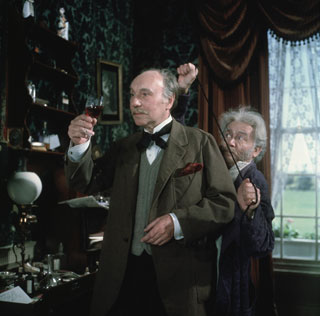


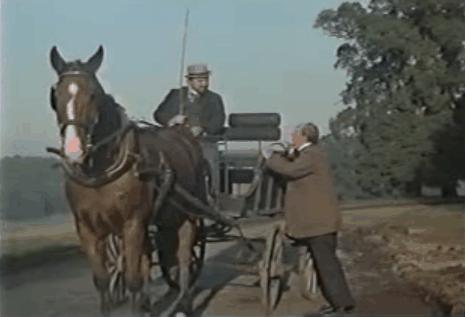
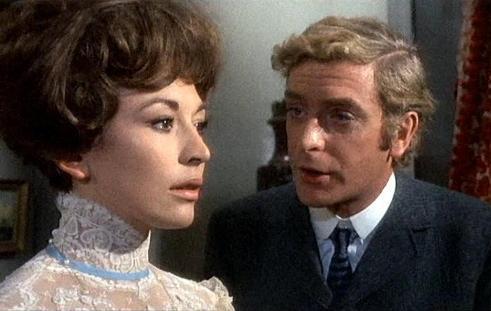
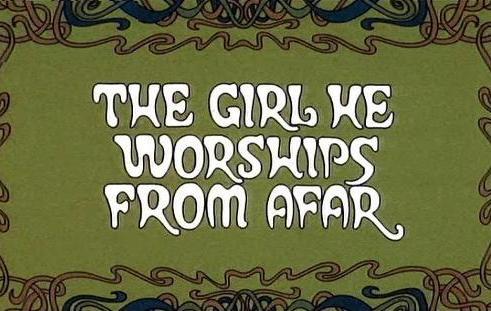 student Michael’s concern about inbreeding. Both, it turns out, are orphans who were adopted by the Finsburys. Julia says of her pater, “Oh, I only knew mine vaguely. My father was a missionary. He was eaten by his Bible class.” Forbes emphasizes the comedy of melodrama by inserting stylized title cards, designed by Robert Ellis, that mix Victorian ornamentation with a 60s pop feel.
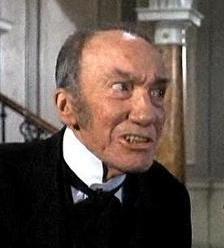





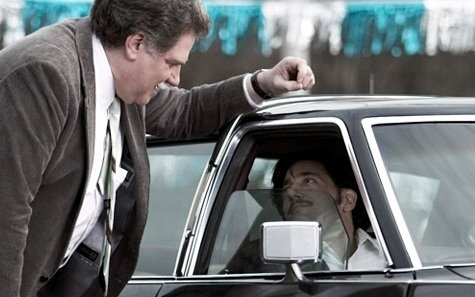





 The most disturbing and meaningful scene of all is the rape of Christ. While Grandier is pleading Loudon’s case with the king, Barre has been whipping the nuns and town into a frenzy. He holds an exorcism in Loudon’s cathedral attended by masked townspeople. The Ursulline nuns strip off their habits and cavort naked and wonton among the horde. One nun is shown licking and rubbing herself against an altar candle. Others allow themselves to be groped, and tear at and rape a priest. The scene climaxes when several nuns lift an enormous crucifix off the church altar and begin licking it; one woman fucks its wooden genitalia. Father Mignon climbs a staircase on the wall, watches the women groping the figure of Christ below, and masturbates desperately. Intercut with this scene of blasphemy is Father Grandier holding a simple mass for himself on a river bank, with a voiceover narration of a letter to Madeleine in which he asks for her prayers that he may fulfill his wish to serve the people of Loudon. Besides being, as Russell calls it, a “mindblowing” scene to watch, it embodies the outrage at the perversion of Christian teachings of forgiveness and love. A cynical government used and abused some already used and abused women to distract and put the town in the mood for a lynching; these “exorcisms” would continue throughout France to allow the Crown to destroy the independent city-states and those who would oppose them.


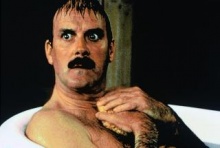 Wag the Dog, 1998), and the result is a near-perfect example of what those comics could do at the height of their gifts. The credits confirm an interesting melding of the two disparate, influential comedy forces to emerge at the time:Private Eye/Beyond the Fringe mastermind Cook, and Monty Python members Cleese and Chapman, with a terrific battery of actors backing them up. Particularly notable is Pinter’s saturnine Hench; if Pinter had ever wanted to be a talk-show host, he’d have done it in style.


 2. There are three major camps in the film-blogging world: the young geeks who tend not to write very well, normally don’t consider any film older than 1990, and usually only read their own kind; the snobs who write pretty well, but impenetrably, and stick with their own kind because to do otherwise would be to lower their status in the film community; the rest of us, a decidedly mixed bag, who aren’t on the make and don’t necessarily give a hoot what people think of what we’re doing.
 3. Cable “news” has had a bigger effect on blogging than anyone would care to admit, as evidenced by a lot of tempests brewed in teapots all over the blogosphere just to drive traffic.
 7. Comment sections are among the best things on a blog. They can be witty and irreverent, more informative than the original post, and include people you never thought would show up. I’ve had the son of the director of One Day in the Life of Ivan Denisovitch, a full-blown family feud in the comments for the Hank Garland biopic Crazy, and a filmmaker or two, in addition to my usual posse.
 12. Macs are hundreds of times better than PCs.
 15. People you don’t know want to control what is said about everything. A blog is one of the best ways to fight back.